



Key findings
- Eighty-two percent of search results appearing in the top position are official, but this drops to 37% by the fourth result.
- Queries for Canada eTA are the riskiest: Only 55% of results are official, while 33% are ads and 12% intermediaries.
- Google shows the most official results overall, but also the highest ad concentration, especially in position one.
- Bing and Yahoo expose users to more intermediaries, especially in the first two positions.
- One in five visa-related results leads to a non-official or misleading page.
- Across all engines, risk rises with each scroll, as official links give way to commercial links further down the page.
Users searching for a visa application online likely assume they’ll land on a government website. But what if the top results aren’t as trustworthy as they seem?
Search engines often place paid listings and commercial “assistance” sites alongside or even above the official portals. For travelers in a hurry, that can sometimes mean overpaying for visas, sharing sensitive personal information, or completing forms on sites that have no official link to the government.
To uncover how widespread this problem is, our research team at holiday.com analyzed nearly 5,800 visa-related search results across 99 countries and five major search engines. We looked at how often travelers are shown legitimate government portals versus intermediaries, ads, and unrelated results.
Our findings reveal a concerning pattern — even when official sites rank well, they’re surrounded by commercial operators and paid listings that can mislead unwary users.
Methodology
To understand how official government visa portals rank in global search results — and whether they’re overshadowed by private intermediaries and misleading paid listings — we ran controlled location-based searches across 99 countries.
The study focused on visa applications for three major systems: the U.S. ESTA, Canada eTA, and EU ETIAS, tested on Google, Bing, Yahoo, DuckDuckGo, and Qwant.
For each country and search engine, we recorded the top four results for every query and classified them as:
- Official – government domain (e.g., .gov, canada.ca, europa.eu)
- Intermediary – commercial visa service selling application or assistance packages
- Ad – paid placements labeled as advertisements
- Other – unrelated or informational pages that do not sell visa services
Each test was run in a clean browser environment to minimize personalization. We then analyzed how official and third-party results varied by country, engine, and ranking position, offering a real-world snapshot of what travelers actually see when they search for visa applications online.
Limitations:
- Search results and ad rankings can vary by time of day or user profile.
- Location-based testing may not fully replicate a local user’s experiences.
- Some private intermediaries are authorized outsourcing partners but were still classified as “Intermediary,” since our focus was on commercial pages.
- Some paid ads may have been blocked by our use of incognito mode and use of a VPN.
- Our dataset spans 99 countries but represents a single testing period; rankings may change over time.
What we found overall: Official vs. ad vs. intermediary
In theory, travelers expect to land on an official government site first when searching for a visa application, and our data suggests that in most cases, they do. But that expectation sometimes fails.
Across 5,752 classified search results from 99 countries, just 52.5% of all listings in the top four results led to legitimate government portals. Private intermediaries — sites that charge users to “assist” with visa forms or mimic official pages — made up 21.6% of all results, while 20.7% were unrelated or informational pages and 5.2% were paid ads.
As seen in the preceding graph, official visa portals dominated our top result (82.5%), but the share of official pages dropped sharply from the second search result onward. Private intermediaries and ads rise sharply as users scroll down. As we will later show, results also depend on the search platform, as well as the government portal. While no user is free from risk, certain users are more exposed to fee-based or even deceptive pages.
More than half of all links in our top four results were official, but the rest can look just as professional. Even a small share (intermediaries ~4.3%) of deceptive results in the top position can mislead millions of travelers worldwide into paying unnecessary fees or sharing personal information with unofficial sites.
Which visa searches are the riskiest
Our results vary sharply by visa type. Some search queries — notably Canada’s eTA and the EU’s ETIAS — expose users to many more commercial or misleading pages than others, while U.S. ESTA searches are dominated by the official government sites.
As the chart shows:
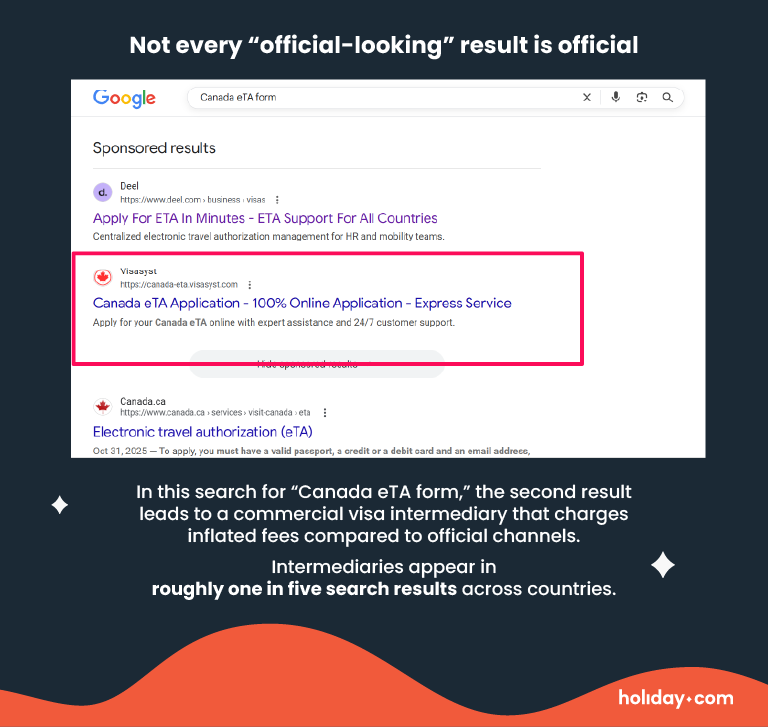
- Searches for Canada’s eTA stand out as exposing users to more risk. Almost one in three top results in our data set are ads, and many of the subsequent links are commercial intermediaries that charge extra fees. This means travelers in a hurry are more likely to click a paid or fee-charging intermediary before reaching the official site.
- ETIAS results also expose users to risk, possibly because the system is new. European authorities have already warned about hundreds of unofficial or fake ETIAS sites that enable phishing sites to attract clicks or collect personal data.
- Searches for ESTA remain comparatively safe. The U.S. official site usually ranks at the top across engines and countries, helped by long-standing government warnings to avoid third-party ESTA sites.
If you search for Canada eTA, you are more likely to see an ad or intermediary near the top than if you searched for ESTA, and those results often look official. That increases the odds of travelers encountering fee-based intermediaries or unknowingly disclosing sensitive personal details to private or fraudulent operators.
Similarly, ETIAS-related searches are especially susceptible to copycats and confusion as the system is new. Until the rollout stabilizes, travelers should be careful to use only the official EU portals.
Why some visa searches attract more commercial sites:
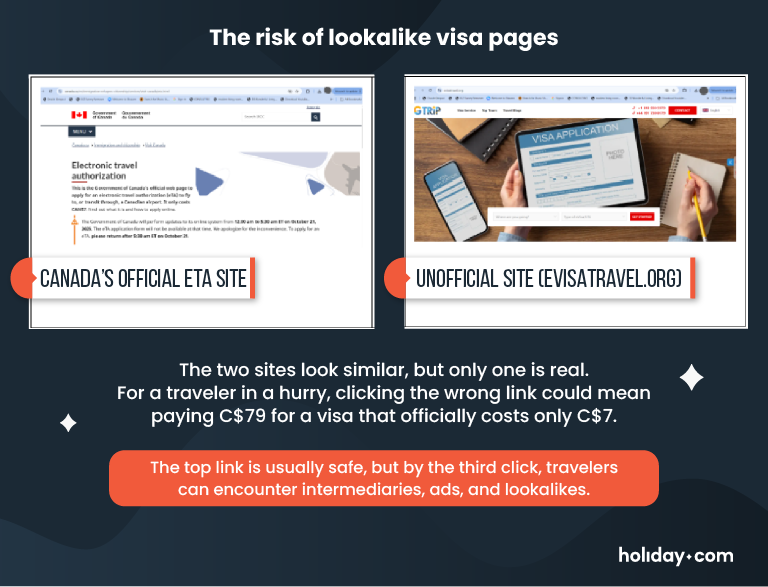
- High demand and low official fees (like Canada’s C$7 eTA) make it easy for intermediaries to inflate fees for “help” while still appearing inexpensive.
- When visa systems are new (e.g., EU ETIAS), confusion creates opportunities for copycat sites to appear, before users know which sites are genuine.
- Commercial operators also buy ads and use search engine optimization to appear above or beside the real government page.
Together, these factors help explain why commercial visa pages continue to dominate certain searches, even when official sites rank high. For travelers, the safest move is to double-check web addresses carefully and avoid any site charging more than the government’s listed fee.
Which search engines help or hurt
Our research shows that search engines rank the same queries differently. Some engines prioritize official government pages, while others display commercial or less authoritative sites more prominently.
Across our dataset of 99 countries, Google was the most reliable at showing official visa application pages within the top four results, but also displayed the highest number of ads.
Yahoo, Bing, and DuckDuckGo consistently placed official pages first, yet each surfaced intermediaries in roughly one out of every four results.
Except for Google, the other four search engines showed a notably higher share of paid placements, especially for queries like “Canada eTA form.” Bing stood out for featuring intermediaries more often in the very first position.
Overall, while most engines return some official government links at the top, intermediaries and ads remain present across all platforms, creating real risk for travelers who click without checking domain names.
How the risk rises as you scroll
While the first search result is generally the official portal, risk grows with every subsequent result.
Travelers who — perhaps accustomed to the top position being a paid ad for other, more casual search queries — quickly move to the second result onwards are more likely to encounter intermediaries or ads that can charge extra fees or mimic official pages.
As the chart shows, the further you scroll from the top result, the less likely you are to find an official government page, and the more likely you are to stumble onto intermediaries or ads.
Official visa portals dominate the first position (82.1%) in our data, but their visibility drops sharply (to 45.4%) by the second result and continues to decline (to 37.4%) by the fourth. Lower rankings are increasingly filled by commercial intermediaries and general or unrelated information sites, which appear in the middle and bottom results.
Paid ads cluster mainly at the top, with 12% of all first results being sponsored links. But below that, intermediaries become more common, especially in the second and fourth spots — positions where travelers are more likely to click and mistake them for official pages.
In conclusion, every scroll downward increases the odds of landing on a less trustworthy page.
Discussion
Overall, our findings reveal a clear pattern of risk — travelers searching for Canada eTA and EU ETIAS are frequently directed toward commercial intermediaries or paid listings rather than official government portals.
Search engines, especially Google, often place these links prominently, creating a global network of repeat intermediary sites that profit from user confusion and limited awareness.
Clear labeling of official portals and stricter regulation of visa-related advertising are needed to prevent users from overpaying or submitting personal data to unverified operators.
Explore the full dataset
Use the following table to see how each visa query ranked across 99 countries — and which results (official, intermediary, ad, or other) appeared in the top four positions.
| Sharing our content: holiday.com is the sole owner of all assets on this site. If you would like to share our content, we ask that you cite holiday.com and provide a link to the page you are citing. This will enable us to maintain the integrity of our intellectual property and continue providing the quality guides and informational content that our readers trust us for. |
About our author

You might also be interested in...
-
 Safety
SIM swapping fraud: How to protect your digital identity
When you’re in a foreign country, a sudden loss of mobile signal might seem like an international roaming glitch or a network issue. But it could be one of the red flags that someone has just hijack...
 Aishah Mustapha
 07.03.2026
 -
 Safety
How to stay safe while traveling: A practical guide for 2026
Traveling puts you in unfamiliar environments where many things can go wrong. A stolen bag or a compromised digital account can quickly derail your trip. Many travelers assume safety means avoiding ri...
Sarah Kirton
05.26.2026 -
 Safety
Is hotel Wi-Fi safe? What you should know and real-world risks
Travelers commonly log into hotel Wi-Fi without giving a second thought to the potential security risks. Public sources of Wi-Fi, including at hotels, can be vulnerable to cyberattacks. This could exp...
Chené Murphy
05.26.2026 -
 Safety
Is airport Wi-Fi safe? Avoid common scams in 2026
When you’re stuck in an unexpected layover or need to book a ride to the hotel, connecting to the free airport Wi-Fi seems like the fastest solution. The truth is that public networks can put your d...
Ivana Shteriova
05.21.2026 -
 Safety
30+ common travel scams to watch out for abroad
Travel scams can be hard to spot. Scammers often operate out of sight, or greet you with a warm smile as they present an offer that sounds too good to miss. They take advantage of the fact that you’...
Aishah Mustapha
05.15.2026 -
 Safety
Hotel safety tips: The ultimate guide in 2026
Staying in a hotel should feel relaxing and serve as a main highlight of your trip. But even the best properties can pose safety risks. It’s not just theft that can turn the perfect getaway into a s...
Sarah Kirton
05.12.2026