



Most people ask if eSIMs are safe because they feel risky. They’re digital, they’re newer technology, and they’re often used while traveling. That combination makes people assume they’re easier to compromise, but that just isn’t the case.
eSIMs connect to the same mobile networks as physical SIM cards and remove some of their most common security problems. The real risks don’t come from the eSIM itself. They come from accounts and devices management.
We’ll help you separate fact from fiction and explain what matters when it comes to eSIM safety and what common misconceptions you can ignore.
How eSIM security actually works
To mitigate these risks, eSIM technology includes built-in protection systems. In general, eSIMs are a safer option compared to physical SIM cards in these ways:
- Physical security. Unlike a physical SIM card that you can remove from a phone, an eSIM is embedded directly into your device’s hardware. You’d have to dismantle the phone to extract it, which eliminates physical theft and SIM cloning risks.
- Remote provisioning. The eSIM activation process goes through encrypted channels between the carrier and device. This includes authentication checks to verify the installation is legitimate.
- OTA updates. eSIMs support over-the-air (OTA) updates. This means developers can fix any issues without replacing the hardware, improving long-term security.
eSIM vs. physical SIM: Security comparison
For most, eSIMs are safer than SIM cards because they negate most risks caused by physical cards. Consider the most common security concerns below:
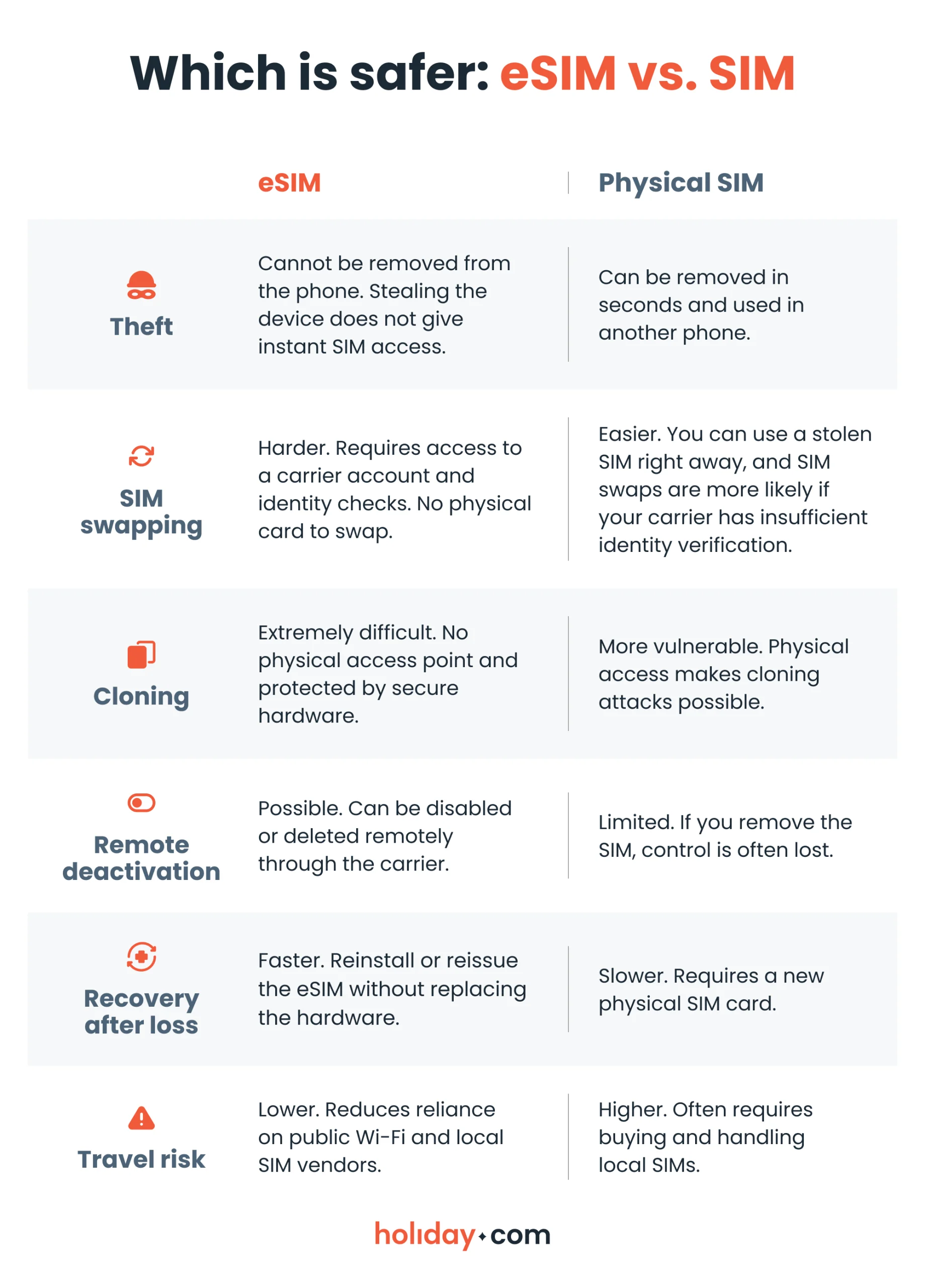
What are some common eSIM safety concerns?
Most eSIM security concerns arise from practical, high-stakes use cases where people are more alert to security, such as travel, roaming, and online banking. But here’s what you should actually focus on to protect your data.
eSIMs are safe for travel and roaming
An eSIM uses mobile data from a carrier, not public Wi-Fi. Public Wi-Fi in airports, hotels, and cafés is one of the most common ways people get their data exposed. Mobile networks are safer than open Wi-Fi.
A foreign network is not automatically risky and using an eSIM abroad does not reduce security. The same protections apply at home and abroad.
eSIMs are safe for banking and 2FA
An eSIM is as safe for these activities as a physical SIM card. Banking security depends on how well you and your bank protect your accounts. The main risk comes from weak account security, not from eSIMs.
The safest banking setup is:
- A locked phone
- Banking apps
- App-based two-factor authentication instead of SMS codes
If your phone and accounts are adequately secured, using an eSIM does not increase the risk of bank fraud.
What are the real eSIM security risks?
If something goes wrong with an eSIM, it’s rarely because someone hacked your eSIM. Real damage comes from a small number of common issues. Here are some often-used methods:
- Phishing and social engineering. This is the most common problem. Cybercriminals use deceptive tactics to trick people into giving away login codes, passwords, or account access through fake emails, messages, or support calls. Once someone has access to your account, they do not need to hack an eSIM. They already have the keys.
- Weak carrier account security. Another potential risk occurs when a cybercriminal contacts your carrier's customer support. An attacker pretends to be you and convinces a carrier to move your number to a new SIM or eSIM. This is an identity and verification failure, not a technical failure of eSIM technology.
- Malware and unsafe apps. Malicious apps or files can compromise the phone itself. When malware infects a device, everything on it is at risk, including apps, messages, and SIM access. This is not specific to eSIMs. The same risk exists with physical SIM cards.
These are the security issues you're most likely to encounter when using an eSIM. Notice how they don’t involve a direct attack on your eSIM. You can mitigate the risk of compromised accounts by implementing basic security practices.
eSIM safety: Myths debunked
An eSIM itself is not an easy or realistic hacking target. When problems occur, they are usually the result of human error, not from breaking into the eSIM technology.
Below is a quick breakdown of what actually happens for these real-life scenarios:
| Scenario | Realistic risk | What actually happens |
| Phishing emails to gain access to your accounts | ✔ | An attacker tricks you into giving access, then uses your account to take control |
| SIM swapping through customer support | ✔ | The attacker fools the carrier into moving your number to another SIM or eSIM |
| Malware on your phone | ✔ | A bad app compromises the device, affecting everything on it |
| Remote eSIM cloning | ✗ | Physical access is the only easy way to clone a SIM |
| Random eSIM hijacking | ✗ | Attackers cannot target eSIMs at random |
| Hacking an eSIM by knowing your number | ✗ | A phone number alone is not enough to access any sensitive SIM info |
| Intercepting eSIM data during activation or network use | ✗ | eSIM activation uses strong encryption and authentication methods during transmission |
The verdict: eSIMs are safe
If your phone and accounts are secure, the eSIM is not at risk.
eSIMs don’t fail on their own. Problems happen when you grant access through phishing, weak passwords, or poor account protection. The technology itself removes common risks like SIM theft and swapping.
What attackers can’t readily do is copy, hijack, or break into an eSIM. There is no button, tool, or trick that lets someone steal an eSIM from afar.
Protect your device and your accounts, and the eSIM takes care of itself.
FAQ
-
Are eSIMs safe to use compared to physical SIM cards?

Yes. eSIMs are generally safer than physical SIMs because you can’t easily remove, steal, or swap an eSIM.
-
Can you hack an eSIM remotely?
No. Remote eSIM hacking is not a real-world risk. Security problems usually come from account access, not the eSIM itself.
-
Can someone steal my phone number through an eSIM?
Someone can steal your number only if they gain access to your mobile account. The eSIM itself does not make number theft easier.
-
Are eSIMs safer than using public Wi-Fi while traveling?
Yes. Mobile data from an eSIM is safer than public Wi-Fi. Public Wi-Fi networks are often unsecured and easy to intercept, while mobile networks use carrier-level encryption by default. eSIMs are a safe option for travel and more secure than Wi-Fi.
-
Does switching carriers with eSIM increase security risk?
No. Switching carriers with an eSIM does not add risk. You’re changing the mobile network provider, which doesn’t lower device or account security. The same built-in phone protections apply during and after the switch.
About our author

You might also be interested in...
-
 eSIM
eSIMHow to turn off an eSIM: Quick guide and tips in 2026
Turning off your eSIM can be helpful in many situations. You may want to disable a travel data plan, switch to another SIM, or avoid roaming charges. The process is quick and you can do it from your p...
 Ana Marković
 06.16.2026
 -
 eSIM
eSIMWhat is an ICCID number and why does it matter?
Knowing how to find your integrated circuit card identifier (ICCID) number makes it easier to manage devices that use SIM cards and eSIMs. When things are going smoothly, you hardly have to think abou...
Sarah Kirton
06.16.2026 -
 eSIM
eSIMeSIM vs. data roaming: Which is better for international travel?
Staying connected while traveling is easier than ever, but the way you access mobile data can make a big difference in your experience and costs. Two popular options are purchasing a travel eSIM or re...
Dawn Prevete
06.09.2026 -
 eSIM
eSIMeSIM vs physical SIM: Pros, cons, and which one is right for you?
An eSIM (embedded SIM) is the digital equivalent of a physical SIM card built into your device. It allows you to activate and manage cellular plans entirely through software, meaning there’s nothing...
Ivana Shteriova
06.08.2026 -
 eSIM
eSIMHow to delete data usage history in 2026: A step-by-step guide
You can erase the data usage counters on your phone, but you can’t permanently erase your carrier’s system-level logs. Deleting your local statistics so the counter returns to zero takes only a fe...
Ana Marković
06.08.2026 -
 eSIM
eSIMDoes an eSIM drain your battery? Fact versus fiction
While eSIMs use the same hardware as physical SIM cards and consume virtually the same power, there are times when you might notice your device’s battery draining faster than usual. Most often, itâ€...
Sarah Kirton
06.08.2026