



Long-haul travel can leave you wide awake at midnight or too exhausted to enjoy the start of your trip. Instead of diving into your itinerary, you end up losing precious vacation time struggling with broken sleep and relentless fatigue.
While this biological mismatch is common, you don't have to accept feeling miserable for the first half of your holiday. Understanding how your internal body clock works makes it easier to prepare before departure and reset once you land.
See what causes jet lag and learn practical, proven strategies to speed up your recovery so you can make the most of your travels.
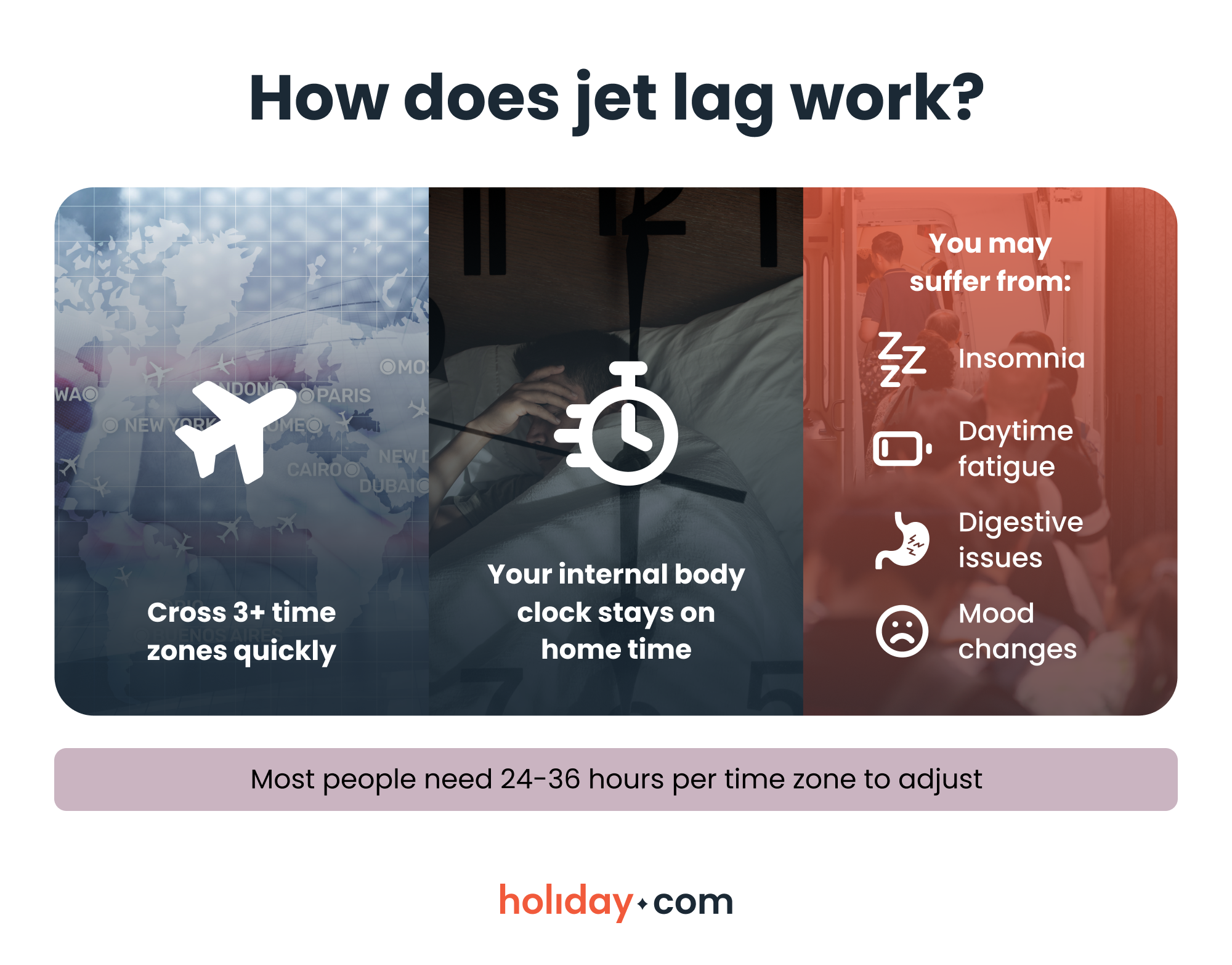
What are the symptoms of jet lag?
While everyone experiences travel fatigue differently, you’ll likely notice physical and mental shifts as your body adjusts.
- Sleeping problems. You may struggle to fall asleep at local bedtime or wake up hours before sunrise.
- Daytime fatigue. Even after spending enough hours in bed, you might feel unusually tired during the day because your sleep cycle is off.
- Brain fog and reduced focus. Slowed thinking and difficulty concentrating can make navigating a new destination frustrating.
- Digestive changes. Eating at times that conflict with your internal clock can lead to changes in appetite or mild stomach discomfort.
- Mood changes. Irritability or feeling emotionally flat can occur when your sleep is disrupted and hormones are temporarily out of sync.
Why does jet lag happen?
Jet lag happens because your circadian rhythm (i.e., your body’s internal clock) can’t instantly adjust to a new time zone. This clock regulates your sleep and wake cycles, alertness, hormone release, digestion, and body temperature based on a consistent light and dark pattern.
Because light exposure plays a central role in resetting this rhythm, rapidly crossing time zones creates a biological mismatch. The local sunlight schedule changes abruptly, but your brain still responds to your home time.
This means melatonin (a hormone that promotes sleepiness) releases according to your previous time zone, making you drowsy during the day. Similarly, your body temperature cycle may peak or dip at inappropriate local times, contributing to daytime fatigue and insomnia.
How long does jet lag last?
Jet lag typically lasts about 24-36 hours for each time zone crossed. For example, crossing six time zones may take your body a week to really adjust.
Traveling east often takes longer to recover from because it shortens your day. Age can also influence recovery time. Older adults may need more time to adjust, while children sometimes adapt at a different pace depending on their sleep habits. Starting a trip already sleep-deprived can make symptoms feel worse and prolong the adjustment period.
Estimated recovery time
After crossing several time zones, recovery often follows these general patterns:
| Time zones crossed | Estimated recovery time |
| 1-2 | Minimal disruption or 1-2 days |
| 3-5 | About 3-7 days |
| 6-8 | About 6-12 days |
| 9 or more | Up to 2 weeks in some cases |
These estimates reflect averages. Individual response varies based on travel conditions and personal sleep patterns.
How can you avoid jet lag when traveling?

While you may not be able to completely prevent jet lag, you can reduce its intensity with thoughtful preparation.
Before departure
- Gradually shift your bedtime closer to your destination schedule in the days leading up to your trip.
- Prioritize quality sleep so you’re not already sleep-deprived before flying.
- If possible, choose a flight that arrives in the afternoon rather than early morning.
During the flight
- Stay hydrated by drinking water regularly.
- Limit alcohol and caffeine, which can disrupt sleep.
- Try to sleep if it aligns with nighttime at your destination.
After arrival
- Spend time in natural daylight at appropriate local hours.
- Avoid long daytime naps, especially close to bedtime.
- Eat your meals according to the local time.
While adjusting to a new schedule, having reliable connectivity makes a difference. Access to light-exposure apps, sleep-tracking tools, and up-to-date local information helps you stay on track. With unlimited data on your holiday.com eSIM, you can stay connected abroad and manage your sleep schedule the moment you land.
HOT TIP
Try to stay awake until local bedtime on your first day, even if you feel exhausted. Sleeping too early can delay your adjustment and extend jet lag symptoms.
Don’t let jet lag steal your vacation days
Jet lag is a temporary but disruptive side effect of crossing multiple time zones. By understanding what causes it and taking proactive steps before, during, and after your flight, you can minimize its impact and recover faster.
FAQ
-
How many time zones cause jet lag?

Most people notice jet lag after crossing three or more time zones. Shorter trips may cause mild fatigue, but significant symptoms often appear when you’re forced to push your internal clock several hours out of sync.
-
Is jet lag worse when flying east?
Yes. Flying east tends to feel worse because it shortens your day and requires you to fall asleep earlier than your body expects. Travelers generally adjust more simply when flying west.
-
Are some people more sensitive to jet lag than others?
Yes. Age, sleep quality before departure, stress levels, and travel direction can all influence how severe your jet lag is. Some travelers adjust within a few days, while others need more time.
-
Can you fully avoid jet lag?
No. You can’t eliminate jet lag completely when crossing several time zones, but you can minimize its intensity. Preparing your schedule before departure and managing light exposure can alleviate symptoms.
-
How do I reset my body clock after a flight?
The most effective way to reset your body clock is through timed exposure to light. Spend time outdoors during daylight at your destination and stay awake until local bedtime, even if you feel tired.
About our author

You might also be interested in...
-
 Travel
8 best all-inclusive destinations for 2026: From budget to luxury
Planning an all-inclusive trip sounds simple until every destination starts to blur together. While one place might promise pristine beaches, another might highlight budget-friendly rates or family pe...
 Chené Murphy
 07.09.2026
 -
 Travel
23 best bachelorette party destinations for every vibe
Planning a bachelorette party sounds fun until the reality of clashing budgets and conflicting schedules sets in. What starts as excitement can quickly turn into stress. The stakes rise when you reali...
Ivana Shteriova
07.08.2026 -
 Travel
Best solo travel destinations for every travel style
Traveling alone is an exciting prospect that becomes daunting when you weigh important factors like affordability, safety, convenience, and your level of social comfort. If you’re planning a solo ex...
Chené Murphy
06.30.2026 -
 Travel
The best food destinations worldwide: 10+ countries for food lovers
With so many “must-visit” food destinations online, it’s harder than ever to tell which places truly deliver and which ones are overhyped. There’s also the uncertainty that the craze around In...
Ivana Shteriova
06.26.2026 -
 Travel
15+ best vacation spots for couples (romantic & unique getaways)
Planning a romantic getaway should be fun, but comparing endless lists to find the perfect trip can make it a chore. What starts as an exciting idea becomes bogged down with too many choices and not e...
Sarah Kirton
06.25.2026 -
 Travel
International travel packing list: Never forget a thing
There are always two types of people: some love packing for an international trip and have a whole system worked out. Others might feel anxious about the packing process and dread pulling out their su...
Ivana Shteriova
06.24.2026