



Waiting in long security lines and dealing with delayed flights can turn even a routine trip into an irritating experience. Without a structured system, these recurring issues waste time and increase stress.
To add to this, flights booked at the wrong time or without a clear rewards strategy can drain hundreds of dollars over the course of a year. Many travelers sign up for loyalty programs but never fully benefit from them, missing out on upgrades and priority perks.
Between airline alliances, credit card points, baggage strategies, and ever-changing airport procedures, flying can feel like a guessing game.
We’re here to help you make frequent flying more time-efficient and cost-effective. From booking your flight to exiting the airport, you’ll learn how to maximize rewards and stay comfortable throughout your journey.
What to consider before booking
The decisions you make during the booking phase dictate how smooth and affordable your trip will be.
Join an airline alliance
Instead of committing to a single airline, alliances allow you to earn and redeem miles across multiple partner airlines. This means you can keep the loyalty benefits while maintaining route and schedule flexibility.
When you fly regularly, loyalty begins to matter more than the price. A cheaper ticket might seem appealing at first, but sticking within an alliance can unlock upgrades, priority boarding, lounge access, and faster check-in lines. Over time, these benefits outweigh small price differences and drastically improve your travel experience.
HOT TIP
While airline alliances work best for general frequent flyers who want to stay flexible, business travelers focused on efficiency should stick to one airline to achieve elite status faster. You’ll climb the ranks quicker for perks like premium lounges and priority rebooking. Choosing one airline is also the best option if your home airport is a hub for a specific carrier.
Maximize frequent flyer miles
Rather than focusing only on flying to earn miles, stack multiple earning sources together. For instance, staying at partner hotels and eating at partner restaurants can contribute to your rewards balance. Also, most airlines have online shopping portals with participating stores. When you buy through them using co-branded credit cards, you earn miles and loyalty points that bring you closer to upgrading your flyer status.
The key is to stay consistent and use the same ecosystem across your travel (and spending) habits.
Book directly and at the right time
Booking through an airline is often the safest and most convenient option, especially when it comes to flight cancellations and customer support.
Timing also plays a crucial role. Early morning flights tend to have fewer delays because aircrafts are already in position. Due to peak travel times, avoid Friday evenings and Sunday returns, as your flight will have a higher chance of being delayed. Midweek and off-season bookings can help you cut down on costs.
Here’s an overview of the best times of day for airplane travel:
| Time of day | Conditions |
| Early morning (5-8 a.m.) | Highest chances of an on-time departure |
| Midday (9 a.m. to 2 p.m.) | Balanced option, moderate delays |
| Afternoon peak (3-7 p.m.) | Air traffic congestion likely, most delays |
| Late night (8 p.m. to midnight) | Lower prices but risk of cumulative delays |
Pre-flight preparation
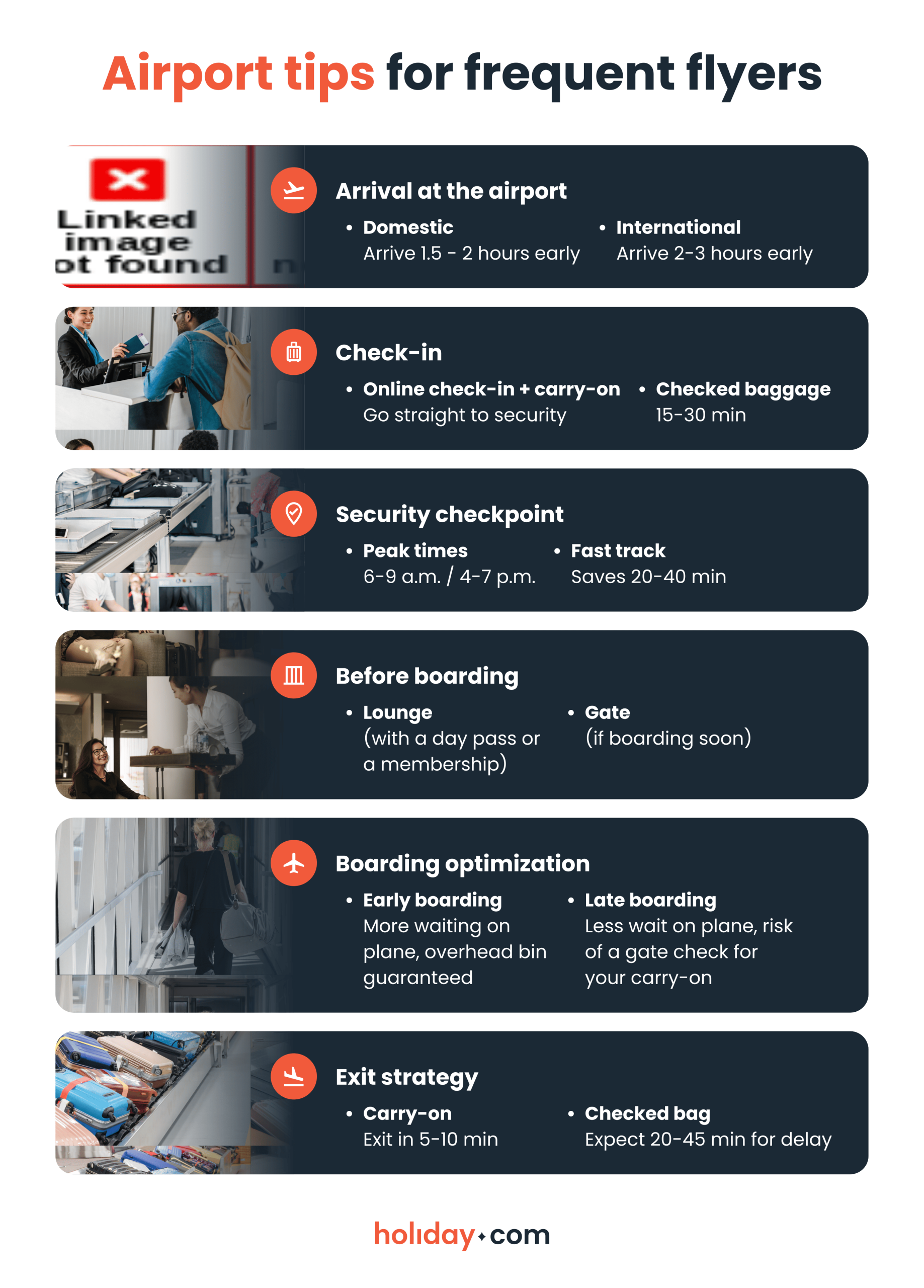
Having a clear game plan for navigating the airport can shave hours off your total transit time. Here’s a breakdown of the typical flying process and tips on how to save time. Creating a system before each trip helps eliminate last-minute airport stress.
Use packing cubes and a “day” bag
Packing cubes help you organize your clothes into categories for easy access without unpacking your entire suitcase. They’re especially useful for short trips or multi-destination itineraries.
Packing a separate “day bag” in your carry-on is equally important. This smaller bag should contain all flight essentials, such as chargers, documents, and snacks. Keeping these items accessible lets you move quickly through security and settle into your seat without digging through your luggage.
Join the TSA PreCheck/Global Entry programs
Trusted traveler programs reduce wait times in security lines. For U.S. citizens, the TSA PreCheck program (about $85 for a five-year membership) lets you move through checkpoints without removing your shoes, jacket, laptops, or liquids. Over multiple trips, this saves hours.
If you often travel to the U.S., the Global Entry program (around $120 for a five-year membership) speeds up customs processing and includes TSA PreCheck access.
Create a digital travel hub
Create a folder for all your documents, including boarding passes, hotel confirmations, identification backups, and travel insurance details. Store everything on your phone and back it up in the cloud to avoid scrambling for important information. If there’s a delay or detour for your flight, having instant access to your details helps you make fast decisions and avoid long customer service lines.
Rely on airline apps for real-time updates
Airline apps provide real-time notifications for gate changes, delays, and boarding times to your phone. These apps also streamline check-in and often let you rebook flights if issues arise. For more granular data, third-party flight tracking tools like Flightradar24 and FlightAware offer delay alerts and weather overlays on real-time maps.
In-flight optimization tips
Once you’re on the plane, a few small adjustments can make you feel more comfortable.
Use the three-seat selection trick
If you’re traveling with another person, book window and aisle seats together so there’s a higher chance of the middle seat staying empty. It’s not a guaranteed success, but it’s worth a try, especially on longer flights.
Sit over the wings for less turbulence
Over-the-wing seats generally experience less movement compared to those at the front or back of the airplane because the wings provide a more stable center of gravity.
Booking over-the-wing seats is a particularly good option if you’re flying on a smaller aircraft or if the route involves crossing over mountain ranges or through tropical areas. All these factors increase the chances of turbulence.
Store bags in the opposite bin
Newbie travelers and frequent flyers alike tend to put their bags directly above their seats. Instead, using the bin across the aisle makes it easier to get your luggage without disrupting other passengers. It also lets you exit the plane faster.
Use airplane pockets
While the standard seat-back pockets in a plane can be convenient for storing things, seasoned travelers warn that these are rarely deep-cleaned. Also, it’s incredibly easy to leave your passport or other belongings in there while you’re rushing to exit the plane.
The solution is an airplane pocket, a washable fabric sleeve that slides over your tray table. It creates a clean zone with slots for your water bottle, phone, laptop, and snacks, so you can keep an eye on your essentials before you leave the plane.
Stay hydrated
Cabin air is extremely dry, so drinking enough water is essential. Add electrolyte tablets to help your body retain moisture and consider using a saline nasal spray to keep recycled-air germs at bay.
Download everything before you go
In-flight Wi-Fi can be unreliable. Download content in advance to ensure uninterrupted access to entertainment and work materials throughout the flight.
Safety tips for frequent flyers
Don’t overlook safety for convenience. These precautions will help keep your belongings and data secure.
Use a USB data blocker
Never plug your phone into a public USB port, as cybercriminals can use these to install malware or steal your data. A USB data blocker prevents data transfer while still allowing your device to charge. Alternatively, you can bring your own wall plug and a portable power bank.
Ensure a safe internet connection when you land
Airport or hotel Wi-Fi can be unsecure, so install a VPN before your trip if you plan to use shared networks. Public Wi-Fi can also be patchy, so consider getting a local SIM for a more reliable internet connection.
HOT TIP
If you don’t want to deal with physical SIM swapping, using a travel eSIM like holiday.com is the easiest way to stay connected abroad. You can install it and purchase a data plan before your trip. Once you land, you can activate it right away.
Use trackers for luggage
Put tracking devices (like AirTag for iPhone or Moto Tag for Android) inside your checked luggage and your carry-on. If your bag starts moving without you, you’ll know exactly where it is before the airline does. This is especially useful during layovers.
Make a habit of optimizing your trips
Frequent flying is easier when you trade guesswork for a solid routine. Every decision you make before and during your flight plays a role in creating a better travel experience.
But the real secret to seeing results is consistency. Apply these strategies regularly to eliminate airport friction and cut down on your costs. The less energy you spend managing travel logistics, the more you’ll have left for your actual destination.
FAQ
-
What are the best travel tips for frequent flyers?

Join an airline alliance and stack rewards to earn more miles. Book flights directly through the airline for better customer service, and remember to keep all your important documents easily accessible on your phone.
-
How can I save time at the airport?
Check in online, travel with just a carry-on, and enroll in fast-track security programs. Depending on your ticket and flyer status, you may also gain access to priority boarding.
-
How can I find cheaper flights?
Compare prices across flexible dates and prioritize Tuesday or Wednesday departures when possible. Use airline rewards programs and credit card points to reduce costs. Remember to take advantage of early-morning or late-night flights, as they’re often cheaper and less crowded.
-
What are some packing travel hacks?
Stick to a carry-on to save time. Also, it’s a good idea to use packing cubes to stay organized and pack a separate “day” bag for essentials.
-
Which travel apps should I use?
Download your specific airline’s app for boarding passes and real-time gate updates. Supplement it with third-party flight tracking tools for interactive maps and weather alerts.
-
How can I stay comfortable on long-haul flights?
Choose seats over the wings for less turbulence and stay hydrated. Bring essentials like a neck pillow and headphones and download entertainment or work materials beforehand. Also, remember to move periodically to reduce stiffness.
-
What are the top safety tips for frequent flyers?
Use a USB data blocker when charging in public and use a travel eSIM for a more secure internet connection. Track your luggage with smart tags and keep digital backups of your important documents.
About our author

You might also be interested in...
-
 Travel
8 best all-inclusive destinations for 2026: From budget to luxury
Planning an all-inclusive trip sounds simple until every destination starts to blur together. While one place might promise pristine beaches, another might highlight budget-friendly rates or family pe...
 Chené Murphy
 07.09.2026
 -
 Travel
23 best bachelorette party destinations for every vibe
Planning a bachelorette party sounds fun until the reality of clashing budgets and conflicting schedules sets in. What starts as excitement can quickly turn into stress. The stakes rise when you reali...
Ivana Shteriova
07.08.2026 -
 Travel
Best solo travel destinations for every travel style
Traveling alone is an exciting prospect that becomes daunting when you weigh important factors like affordability, safety, convenience, and your level of social comfort. If you’re planning a solo ex...
Chené Murphy
06.30.2026 -
 Travel
The best food destinations worldwide: 10+ countries for food lovers
With so many “must-visit” food destinations online, it’s harder than ever to tell which places truly deliver and which ones are overhyped. There’s also the uncertainty that the craze around In...
Ivana Shteriova
06.26.2026 -
 Travel
15+ best vacation spots for couples (romantic & unique getaways)
Planning a romantic getaway should be fun, but comparing endless lists to find the perfect trip can make it a chore. What starts as an exciting idea becomes bogged down with too many choices and not e...
Sarah Kirton
06.25.2026 -
 Travel
International travel packing list: Never forget a thing
There are always two types of people: some love packing for an international trip and have a whole system worked out. Others might feel anxious about the packing process and dread pulling out their su...
Ivana Shteriova
06.24.2026