

For many, tipping can be an anxiety-inducing aspect of international travel. Almost half (46%) of U.K. travelers say they're not confident about tipping overseas, with confusion particularly high for destinations like the UAE (64% uncertain) and Japan (57%). At the same time, 26% of American tourists admit they're often unsure what constitutes appropriate gratuities in foreign countries, despite 60% of them always attempting to tip abroad.
Getting it wrong can be more than personally embarrassing. In some countries, attempting to leave a tip can be perceived as insulting, suggesting the service worker needs charity or pity. In others, failing to tip can create hardship for workers who depend on tips to survive on minimal base wages.
This guide cuts through the confusion with clear, region-by-region breakdowns of tipping customs across 20+ countries, helping you navigate tip-free as well as tip-dependent cultures. You'll learn how much to tip, why customs differ, and how to show appreciation appropriately wherever your travels take you.
The basics of tipping etiquette
At its core, a tip is money given to a service worker in addition to the basic price of the service. While historically it was intended to reward exceptional effort, traditions surrounding tipping have evolved differently around the world, and can vary wildly depending on where you are. In some economies, it’s the primary source of income for the staff, in others it’s a nice bonus — and in some it can be perceived as an insult.
Cultural variations in tipping
Before you open your wallet, you’ll want to understand how the local culture interprets that extra cash.
- Tipping as a wage supplement: In some destinations, tipping, while still optional, is somewhat required by certain employees. Labor laws may allow employers to pay staff well below the typical minimum wage, meaning your tip essentially subsidizes their salary.
- Tipping as appreciation: In other places, service staff earn a living wage as part of their base pay. A tip here is a legitimate "thank you" for exceptional service rather than a necessary part of their income.
- Tipping that offends: In some countries, good service is considered standard and expected. Here, tipping can be seen as offensive — it could imply that you think the employer doesn’t pay the worker enough, or that the worker needs your charity to survive.
- The "no-tipping" policy: Even in cultures where tipping is common in some industries (like food service), specific companies or sectors may strictly ban employees from accepting tips. Government workers are also normally excluded from accepting tips since it can be interpreted as a bribe. You can check for "No Tipping" signs to avoid putting a worker in an awkward position.
Dos and don'ts of tipping
You’ll want to keep a few general rules in mind for a smooth tipping experience:
- DO carry small bills. Whether it’s dollars, euros, or yen, having small denominations allows you to tip without demanding change from a large note (or without having to wait around for change at all).
- DO hand cash directly to the recipient when possible. Leaving it on a messy table increases the risk of it being stolen or swept into the trash.
- DON’T assume you can tip everywhere with a credit card. Many establishments around the globe still can’t process a tip on a card terminal.
- DON’T leave a $0 tip for workers who rely on them, such as restaurant staff in the U.S. In these places, reduce the tip (typically to 10%) and consider discussing service issues with management.
- DON’T feel obligated to leave a tip for a one-to-one service, such as a haircut, if the result is truly unacceptable. This is true even in the U.S., where service workers often expect tips.
Universal considerations
Regardless of the country, check these three variables before settling the bill.
1. Service charges. A “tip” and a "service charge/gratuity” are different. A service charge is a surcharge or fee set by the business that may be divided among staff, but may also not be, depending on local laws. A tip is a voluntary amount that belongs to the employee.
The Rule: If you see a "Service Charge" on the bill, you generally do not need to tip the full 20%. However, adding a small extra amount (5%-10%) directly to your server is often appreciated.
2. Cash is king. Even with widespread card payment, cash remains the preferred method for tipping worldwide. It ensures the worker receives the money immediately and without administrative deductions. If you tip on a card, the worker may wait weeks to see that money, or management may skim a percentage for "processing fees."
3. The mindset: Appreciation vs. obligation. In the U.S., you should view the tip as part of the cost of the meal. Mentally add 20% to every menu price you see. Almost everywhere else, the tip is viewed as a tool for expressing gratitude for great service.
Common pitfalls to avoid
Over-tipping in non-tipping cultures: You might think you’re being generous, but you may add to an expectation that hurts local industries that can’t afford to match tourist dollars. In effect, a two-tier economy can be created that prioritizes industries that serve foreigners.
Under-tipping in the U.S. or other tipping-heavy countries: Don’t bring your home country's tipping habits with you. Leaving 5% in a New York restaurant because that’s normal back home may leave your server underpaid.
Getting rid of foreign currency: Don’t leave a pile of mixed coins from other foreign nations as a tip, because it’s not. It’s an annoyance the worker now has to sort and exchange, taking time and possibly paying a fee to do so.
North America
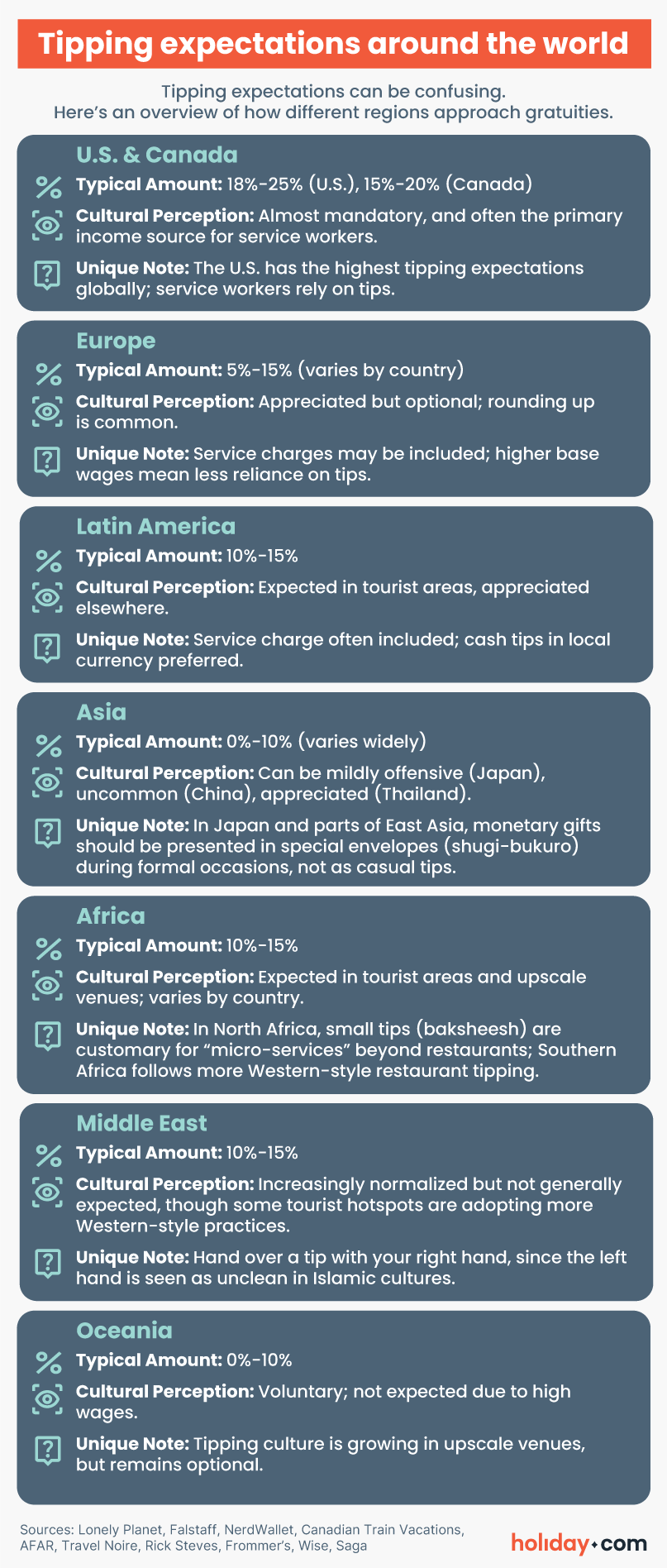
Tipping is an expectation for many industries in the U.S., Canada, and Mexico, but the reasons why, and the customs and percentages involved, can differ dramatically.
United States
The U.S. has the world's most demanding tipping culture because federal law allows employers to pay service workers just $2.13/hour. Tips are expected to cover the rest (although if they don’t, employers still need to make up the difference). For travelers, this means tipping isn't optional. Budget an extra 20% on all restaurant bills and carry small bills for hotel staff.
Where to tip:
- Restaurants: 15%-20% (25% fine dining)
- Taxis/rideshares: 10%-20%
- Hotels: $2-$5/bag (porters), $5-$10/night (housekeeping), $3-$7 (valet)
- Tour guides: $10-$20/person for full-day tours
- Fast-casual cafés: Though still controversial, digital screens now prompt 10%-15%
Tip not expected: Takeout, retail stores
Canada
Canada's tipping culture closely mirrors the U.S., though with slightly lower expectations and less pressure. Unlike American servers, Canadian service staff earn at least the provincial minimum wage (currently $16.60-$17.60/hour in Ontario), making tips supplemental rather than essential. However, digital payment prompts have expanded to new spots like takeout counters and coffee shops, causing some "tip fatigue" among locals.
Where to tip:
- Restaurants: 15%-20% pre-tax (18%-20% in upscale urban establishments)
- Bars: $1-$2/drink or 15%-20% of tab
- Taxis/rideshares: 10%-15%
- Hotels: $1-$2/bag (porters), $2-$5/night (housekeeping)
- Tour guides: $5-$10/person per day
Tip not expected: Takeout, retail stores, liquor stores
Latin America
Latin America combines local tradition with tourist expectations — sometimes a small tip is perfect, elsewhere only round-up change is needed.
Mexico
Tipping in Mexico was initially imported from Europe, being given as thanks for great service. However, over time, and with the help of many U.S. tourists, this has shifted to tips being essential to prop up poor wages. They’re now deeply embedded in Mexico’s service economy.
While tips are essential for workers, be cautious about excessive generosity, since over-tipping can shift dynamics and lead staff to prioritize high-tipping foreigners over locals. Always tip in pesos rather than U.S. dollars, so workers don’t have to spend time and money going to the bank, which often charge fees to exchange currency. Verify your check before adding tips, especially if a service charge is already included.
Where to tip:
- Restaurants: 10%-15% for locals, 15%-20% in tourist areas
- Bars: 20 pesos per drink or 10%-15% of tab
- Taxis: Generally not expected, but if they help with luggage, 10-20 pesos is reasonable
- Hotels: 25-50 pesos/night (housekeeping), 40-50 pesos (porters), 100-150 pesos (concierge)
- Tour guides: 100 pesos for group tours; 200-400 pesos for half-day private tours, 300-600 for full-day
- All-inclusive resorts: 20-40 pesos per drink, 50-200 pesos per meal
- Spas: 15%-20%, often left in an envelope at the front desk with the attendant’s name on
- Grocery baggers: 10-20 pesos (they work for tips only)
Tip not expected: Takeout, self-service buffets
Argentina
Tipping is customary but unofficial in Argentina — 10% is the norm in restaurants, always given in cash since card slips never include a tip line. Most locals and visitors use pesos, and going significantly above 10% is rare except for outstanding service.
Because outdoor seating is common, you’ll not want to leave cash tips unattended on tables, especially in busy areas — give it directly to your server to avoid theft. Always carry small bills, as restaurants rarely have change and prefer tips in pesos.
Where to tip:
- Restaurants: 10% cash
- Bars/cafés: Round up or small change (not obligatory)
- Taxis: Round up, or 5%-10% for luggage help
- Hotels: 5,000-10,000 ARS per bag (porters); 10,000 ARS/night (housekeeping)
- Tour guides: 10%-20% for exceptional service
Tip not expected: Takeout, street vendors, informal markets
Brazil
Tipping in Brazil is simplified due to the mandatory 10% service charge (taxa de serviço) on most restaurant bills. This charge is legal and standard practice, so always check your receipt before adding more. At the same time, this charge is technically optional. If you feel service was poor or were informed that the fee doesn’t go to staff, you can have it removed (and then tip your server directly if you prefer).
Overall, Brazil doesn’t have a prominent tipping culture, but contributions made for great service are nonetheless appreciated.
Where to tip:
- Restaurants: 10% automatically included; add 5%-10% for exceptional service
- Bars/cafés: 10% usually included; round up or add 1-2 reais per drink
- Taxis: Round up for short rides; 10% for longer journeys with luggage
- Tour guides: 10% for private tours, at your discretion, depending on your enjoyment
Tip not expected: Takeout, self-service buffets
Chile
Tipping culture in Chile was essentially nonexistent until the 1990s, when increased tourism from countries that traditionally practice tipping introduced the custom. Since then, tipping has found a middle ground between neighboring countries and places like the U.S. It’s not expected, but is appreciated, and lower compared to rates that are normal in the U.S.
Similar to Brazil, Chile legally mandates that restaurants include a suggested 10% tip (propina) on the bill. Technically it remains voluntary and you can request removal, but this is considered rude unless the service was genuinely poor.
Where to tip:
- Restaurants: 10%-15% (usually suggested on the bill; can be declined, but that’s culturally awkward)
- Cafés: Round up the bill
- Bars: 10% suggested tip added to bill
- Taxis: Round up or 5%-10% for longer journeys with luggage
- Hotels: 500-1,000 CLP/bag (porters); 1,000-2,000 CLP/night (housekeeping)
- Tour guides: 2,500-15,000 CLP depending on tour length
Tip not expected: Self-service cafeterias, takeout
Western Europe
For the most part, tipping in Europe is not expected, but rather a bonus for service that was above expectations. Servers in Europe don’t rely on tips in the same way that U.S. servers do, and tend to receive a higher hourly wage. Nonetheless, in most countries in Europe, a tip is still appreciated and will practically never be seen as rude.
United Kingdom
Tipping started in the U.K. (specifically in England) in medieval times when masters rewarded their servants for exceptional performance. These days, tipping isn’t mandatory, but is nonetheless often done and appreciated by staff. 10% is standard, going up to 15% in case of exceptional service, although mandatory service charges of 10%-12% are becoming increasingly common. Check your bill for these before adding an extra tip.
Where to tip:
- Restaurants: 10%-15% if no service charge; check bill first
- Pubs: No tip expected at bars, but appreciated nonetheless
- Taxis: Uncommon, but you can round up the fare or add 10%
- Hotels: £1-£2 per bag (porters), £2-£3 per night (housekeeping)
- Hairdressers: 10% is common but not expected
- Tour guides: Optional, but £5-£10 per day, or 10% for shorter tours
Tip not expected: Takeaway, retail shops
France
France outlawed tip-dependent wages in 1985, requiring that all servers earn at least minimum wage. Today, a 15% service charge (service compris) is automatically included in every restaurant bill by law, and French service workers are paid normal wages and participate fully in France’s labor and social-security systems.
While additional tipping isn't expected, locals often round up to the nearest euro or leave €2-€5 for genuinely excellent service — but never the amounts Americans might be accustomed to.
Where to tip:
- Restaurants: €2-€5 for good service; 5%-10% at high-end establishments (service charge already included)
- Cafés/bars: Round up or leave small coins; nothing required
- Taxis: Round up to the nearest euro or 5% if they help with luggage
- Hotels: €1-€2 per bag (porters), €2-€5 per day (housekeeping)
- Spas/salons: 5%-10%
- Theater ushers: €1-€2 at private venues
Tip not expected: Takeout, coat checks marked pourboire interdit (tipping prohibited)
Italy
Italy has a unique system called coperto (cover charge). This is a €1-€3 per-person fee added to most restaurant bills that covers bread, cutlery, and table linens. This dates back to workers bringing packed lunches and paying just to use the space — and importantly, it isn't a tip and doesn’t go to your server.
Tipping on top of the coperto is rare among Italians. However, tourists in major cities increasingly leave small amounts. If you receive truly exceptional attention, rounding up a few euros or leaving 5%-10% is generous.
Where to tip:
- Restaurants: €2-€5 or 5%-10% for exceptional service (in addition to coperto)
- Hotels: €1-€2 per bag (porters), €2-€5 per day (housekeeping) in upscale hotels
- Tour guides: €5-€10 for full-day tours
- Spas: 5%-10% for high-quality treatments
Tip not expected: Bars, cafés, taxis, takeout, casual trattorias
Central & Eastern Europe
Further East in Europe doesn’t differ from Western Europe much when it comes to tipping expectations. Mandatory service charges are becoming more common, but vary between countries. Tourist cities are the main spots where people may expect more, but even here you shouldn’t feel obliged to tip.
Poland
Like much of Europe, tipping in Poland reflects a philosophy of rewarding great service rather than fulfilling social obligation. The practice has become increasingly normalized over the past two decades, especially in tourist-heavy cities, but remains genuinely optional.
Establishments in larger cities now increasingly add automatic service charges for groups — a practice some Poles see as an unwelcome Western import that removes personal choice.
Where to tip:
- Restaurants: 10%-15% for good service
- Taxis: Round up or 10% for longer journeys and luggage help
- Hotels: Small amount for housekeeping if satisfied
- Tour guides: 10% if happy with their work
Tip not expected: Spas (unless exceptional), takeout, coffee shops
Czech Republic
While 10%-15% tips are appreciated in Czech restaurants, there’s no strict rule, and many Czechs simply round up the bill. Especially in larger tourist cities like Prague, some locals have become annoyed at the excessive mandatory service charges and prompts for tips on card readers that have spread in recent years.
A sharp divide also exists between tourist areas and local neighborhoods. In Old Town Prague, there are tourist reports of waiters complaining when tips fall below 10%, but this is considered rude and generally limited to tourist traps.
Where to tip:
- Restaurants: 10%-15% or round up
- Bars/cafés: Round up or add 20-50 CZK depending on bill size
- Taxis: 10% for longer journeys or luggage help; round up for short rides
- Hotels: 5-10 CZK per bag (porters), 10-15 CZK (concierge for exceptional help)
- Tour guides: 300+ CZK for free walking tours; 200-500 CZK for private guides
Tip not expected: Self-service establishments, stores, takeout, coffee shops
Croatia
Since Croatia adopted the euro in 2023, tipping has become slightly more common as digital payment terminals now offer tip prompts. However, Croatian culture still doesn't expect tips — staff earn regular wages, so tips remain a way of saying thanks rather than an obligation. Most locals round up bills or leave 5%-10% only when truly satisfied.
Touristic coastal cities have seen a particular increase in tipping behavior, but it’s still at your discretion.
Where to tip:
- Restaurants: 5%-10% at mid-range; 10%-15% at high-end establishments
- Cafés/bars: Round up or 5%
- Taxis/rideshares: Round up or €1-€2 for luggage help
- Hotels: €1-€2 per bag (porters); €2-€5 per day (housekeeping) optional
- Tour guides: €5-€10 per person for group tours; 5%-10% for private tours
Tip not expected: Ferry crews, bus drivers
East Asia
East Asian nations are perhaps the most philosophically opposed to Western nations when it comes to tipping (or rather, not).
Japan
Tipping isn’t customary in Japan and is often considered rude or embarrassing. The cultural philosophy is that providing excellent service is a matter of professional pride, not something that requires extra payment.
Tour guides represent the main exception where tips may be appropriate, especially those targeting Western tourists. Place cash in a decorative envelope (available at convenience stores) and present it discreetly with a bow at the tour's end. Modesty and discretion are important here.
Where to tip:
- Tour guides: Modest tip in envelope or thoughtful gift (optional)
Tip not expected: Restaurants, cafés, bars, taxis, hotels, convenience stores, retail shops
China
China operates on a no-tipping model across most service industries. Unlike Western countries, restaurant servers, taxi drivers, and hotel staff don’t expect (and may even refuse) tips. Many businesses even have official no-tipping policies. Some tour groups appear to give tipping expectations for their tour guides and drivers before tours take place, but even this is a contested practice.
Due to the colonial past of Hong Kong and Macau (so-called “Special administrative regions” within China), tipping here is slightly more common. However, most tipping is still confined to the realm of higher-end tourist pursuits like luxury hotels or spas, though you may find that 10% is sometimes added to your restaurant bill.
Where to tip:
- Tour guides: ¥10-¥20/day for group tours; ¥50-¥100 for private guides
Tip not expected: Taxis, casual restaurants, bars, cafés, hotels, street vendors
Southeast Asia
In southeast Asia, tipping has completely transformed as tourism has exploded over the past twenty years. Countries that were once no-tipping cultures now have multiple tourist zones where tipping is expected and even encouraged.
Thailand
Thai locals rarely tip each other except at high-end establishments, but they appreciate small tips from foreign visitors as gestures of respect. Rounding up is a common way to tip, although be sure to check your bill first, since many restaurants already include a service charge.
Some savvy business owners in tourist areas may capitalize on confused visitors who don't understand the currency or local norms. If your bill already includes a service charge and staff still request additional gratuities, this may be a sign they are trying to take advantage of tourists.
Where to tip:
- Restaurants: 5%-10% if no service charge; 10%-15% at upscale venues
- Street food/casual cafés: Round up or 10-20 baht
- Taxis: Round up fare
- Hotels: 20-50 baht (porters/housekeeping); 50-100 baht at luxury properties
- Tour guides: 300-550 baht/day; drivers 100-300 baht/day
- Spas: Flat fee of 50-100 baht is common
Tip not expected: Street vendors, markets, public transportation
Indonesia
People in most of Indonesia have no expectation of tipping, with tips generally being reserved for superb service. Regardless, most people will appreciate tips, and it won’t be seen as rude. Many restaurants already include a 10% service charge. If this isn’t already included and you feel like tipping, 10% is common.
Bali has different tipping norms than the rest of Indonesia due to the overwhelming tourist influence. Service workers here have grown accustomed to foreign gratuities, creating higher expectations than much of the rest of the country.
Where to tip:
- Restaurants: 10%-15% if no service charge; 5%-10% extra if service charge included
- Cafés/bars: Round up or 5,000-10,000 IDR per drink
- Taxis: Round up to nearest 5,000-10,000 IDR
- Hotels: 20,000 IDR (porters); 20,000-50,000 IDR/night (housekeeping)
- Spas/salons: 20,000-50,000 IDR depending on service
- Tour guides: 50,000-100,000 IDR/day
- Drivers: 50,000-100,000 IDR/day for private drivers
Tip not expected: Small shops, laundry services
Middle East
Islamic traditions of generosity have blended with modern service economics and a dose of Western influence to create a unique tipping environment.
Qatar
Traditionally, tipping isn't part of Qatari culture, but the country's large expat population has increasingly normalized it, particularly in tourist hotspots. While not mandatory, 10%-15% tips are now expected at mid-range and upscale establishments, though many locals still don't tip regularly.
It’s worth tipping discreetly rather than making a show of your generosity, since Qatari culture values modesty. You should also use your right hand to hand over a tip, since the left hand is seen as unclean in Islamic cultures.
Where to tip:
- Restaurants: 10%-15% (check for service charge first)
- Taxis: Round up or 5-10 QAR for longer journeys
- Hotels: 10-20 QAR (porters); 10-20 QAR/night (housekeeping)
- Valet: 5-10 QAR when car returned
- Tour guides: 50-100 QAR for full-day tours
- Spas/salons: 10-20 QAR or 10%-15% if no service charge
Tip not expected: Retail shops
UAE
Tipping in the UAE is common but optional. Most restaurants and hotels include a 10% service charge on bills. However, whether this goes to the venue or the staff isn’t always clear, so cash tips direct to your server are always preferred.
Where to tip:
- Restaurants and cafés: 10%-15% (check for service charge first)
- Taxis: Round up to nearest 5-10 AED
- Hotels: 5-10 AED/bag (porters); 10-20 AED/night (housekeeping), 100+ AED (organizational requests from the concierge such as securing popular tickets)
- Valet: 10-20 AED when car returned
- Salons/spas: 10%-15% to technician directly
- Tour guides: 20-100 AED or 10%-20% for private tours
- Food delivery: 5-10 AED
Tip not expected: Retail shops (unless exceptional service)
Africa
Being a large and varied continent, Africa has a wide variety of tipping norms and expectations. We discuss some of the most heavily touristed nations to narrow things down.
South Africa
South Africa has a well-established tipping culture closer to Western norms than other African countries. For satisfactory service, 10% is enough, and if it was excellent, consider 15%-20%.
Major cities like Cape Town and Johannesburg have higher tipping expectations than rural areas, especially in tourist-focused establishments. And safaris are a different beast entirely — expect to budget 150-250 rand daily per person for guides. Lodge staff will often have an anonymous tip box that you can contribute to at the end of your stay, which is shared between all staff.
Where to tip:
- Restaurants: 10%-15% (20% for exceptional service)
- Cafés/bars: Round up or R5-R10 per drink
- Petrol attendants: R10-R20 depending on services
- Car guards: R5-R10
- Hotels: R10-R20 (porters per bag); R20-R50 (housekeeping per day)
- Safari rangers: R50-R100 per person per day
- Taxis: 10%-15% of fare
Tip not expected: Takeout
Egypt
Egypt is perhaps the only country on this list where tipping culture matches (or sometimes exceeds) the U.S. Expect to tip for virtually every service, from restaurant meals to public restroom use. Workers depend on tips to survive since base wages are extremely low, with employers viewing tips as wage supplements rather than bonuses for great work.
As a result, consider carrying small Egyptian pound notes with you wherever you go — you'll need them for bathroom attendants, mosque attendants, parking helpers, and countless other micro-services. This “baksheesh” system operates on frequent small tips, so budget this into daily expenses.
Where to tip:
- Restaurants: 10%-15% (even if service charge included)
- Hotels: 20-30 EGP per service (porters, housekeeping, doormen)
- Drivers: 50-100 EGP (taxis), 250-500 EGP per day (private driver)
- Daily tour guides: 100-500 EGP (group tour per person), 250-1000 EGP (private tour)
- Bathroom attendants: 1-2 EGP
- Mosque attendants: 1-2 EGP
- Street food: Round up or leave 1 EGP if you have small change
Tip not expected: Public transportation, taxis (just round up), street vendors unless offering change
Morocco
Morocco uses a similar baksheesh system to Egypt. Although tourism has normalized tipping expectations, it's viewed as a sign of respect and gratitude rather than obligation. Amounts range from rounding up bills by a few dirhams at cafés to 10%-15% at mid-range restaurants.
Consider carrying small dirham notes with you, since 2-10 DH tips are normal in various daily situations. Some riads and hotels will also have communal tip boxes, ensuring that all staff, including those behind the scenes, can benefit.
Where to tip:
- Restaurants: 10% (check for service charge first)
- Cafés/street vendors: Round up or 1-5 DH
- Tour guides: 50-100 DH/day
- Drivers: 20-50 DH/day; 100 DH/day for private drivers
- Hotels: 50 DH/day per room in communal tip box
- Taxis: Round up to nearest 5-10 DH
- Photo permissions: 5-10 DH to vendors/artisans
Tip not expected: Public transportation, shops
Using technology to navigate tipping norms
Technology offers practical tools to help travelers calculate appropriate tips and understand local customs.
Apps for tipping and currency conversions
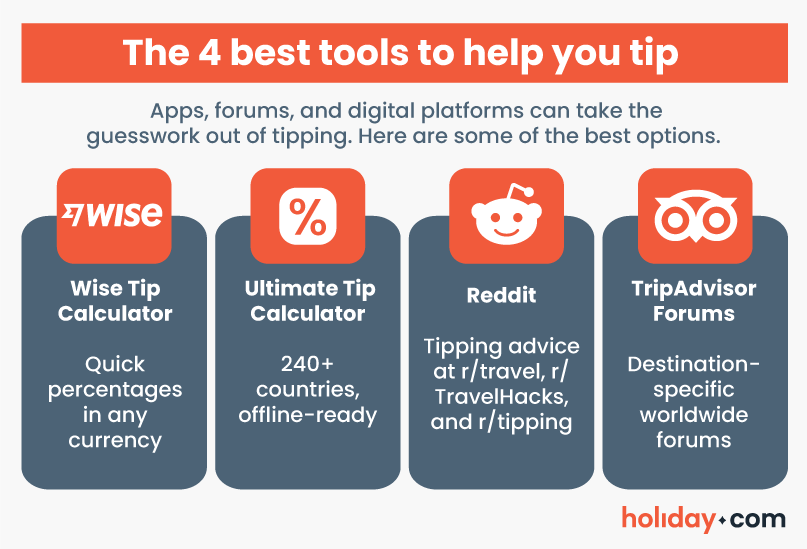
- Ultimate Tip Calculator (Android and iOS): Offers real-time calculations, worldwide tipping guides for 240+ countries, and built-in currency converters
- Wise tip calculator: Quick tip percentage calculator to help you work things out in a pinch
- Smartphone calculators: Your phone’s built-in calculator is often enough. For example, simply multiply your bill by 0.1 to get 10%, 0.2 for 20%, etc.
Checking local etiquette via travel forums
- Reddit communities: r/travel, r/TravelHacks, and r/tipping provide crowdsourced advice about destination-specific tipping practices
- Rick Steves Travel Forum: Offers discussions on tipping for European tours and travel
- TripAdvisor Forum: Massive knowledge base with active forums covering destinations worldwide
- Local Facebook groups: Groups dedicated to specific cities or countries are often made up of a mix of locals and expats, many of whom will have insight into local tipping dos and don’ts
Hotel and tour company guidance
- Hotel concierge services: Many hotel chains offer tipping guidelines in their mobile apps or on their websites.
- Tour company policies: Many specify whether gratuities are included or left to the traveler's discretion upfront; check pre-trip emails or itineraries for more information.
- Digital tipping platforms: Some services enable cashless tips via mobile devices for tour guides and hotel staff. Ask service providers if there’s an app they prefer.
Tipping scams to be aware of
In some areas, restaurants and service establishments are known to use deceptive practices to extract higher gratuities from unsuspecting customers. Here are common tipping scams to watch for:
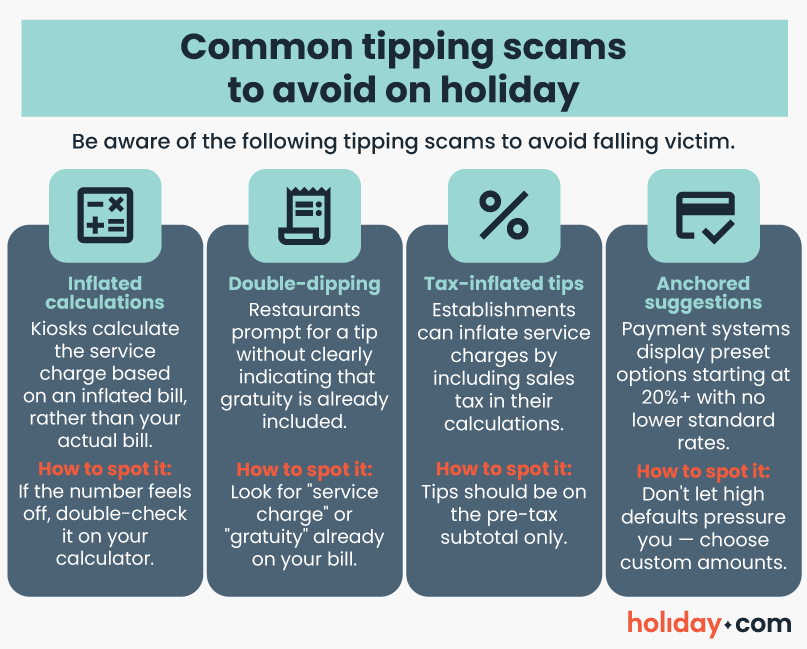
- Inflated percentage calculations. Pay-at-table kiosks display tip percentage options (15%, 18%, 20%, 25%) but calculate them based on an inflated amount rather than your actual bill. For instance, a 20% tip on a $27 bill should be $5.40, but the kiosk might suggest $8.30 instead.
- Double-dipping with service charges. Restaurants automatically add an 18%-20% service charge to your bill, then present a payment screen or receipt line suggesting an additional gratuity without clearly indicating the charge is already included.
- Pre-tax vs. post-tax tipping. Some establishments calculate suggested tip percentages on the total, including sales tax instead of just the food and service cost, inflating the tip amount.
- Manipulated tip suggestions. Digital payment systems display preset tip options starting at 20% or higher, with the lowest option above standard rates to steer customers toward higher amounts. Customers must actively select Custom or No Tip to pay less, creating social pressure while being observed by a server.
When in doubt, watch the locals
Tipping customs reveal how differently cultures can value service, community, and fairness. Whether you're in a country where tipping is mandatory, optional, or discouraged, knowing the expectations helps you express gratitude appropriately and avoid misunderstandings. When in doubt, pay attention to what the locals are doing, or simply ask!
| Sharing our content: holiday.com is the sole owner of all assets on this site. If you would like to share our content, we ask that you cite holiday.com and provide a link to the page you are citing. This will enable us to maintain the integrity of our intellectual property and continue providing the quality guides and informational content that our readers trust us for. |
About our author

You might also be interested in...
-
 Travel
International travel packing list: Never forget a thing
There are always two types of people: some love packing for an international trip and have a whole system worked out. Others might feel anxious about the packing process and dread pulling out their su...
 Ivana Shteriova
 06.24.2026
 -
 Travel
The essential international travel checklist for 2026
Juggling pre-trip logistics like travel documents, banking, and security can make planning a trip feel like a full-time job. Even the most exciting journey can turn stressful when important details sl...
Sarah Kirton
06.03.2026 -
 Travel
19 best girls trip destinations for all travel styles
Somewhere between starting the group chat and comparing different budgets, planning a girls trip can turn from excitement to frustration. One friend wants beaches, another wants culture, someone insis...
Ana Marković
06.03.2026 -
 Travel
21 best honeymoon destinations for every travel style and budget
Planning a honeymoon should be a joyful coda to your wedding, but with a world of possibilities, narrowing it down can feel like another logistical challenge. There’s no one best honeymoon destinati...
Dawn Prevete
05.28.2026 -
 Travel
Family travel tips for stress-free vacations with kids
You can color-code your schedule all you want, but a good family vacation hinges on how well you handle the inevitable curveballs. Anticipating and preparing for any potential disruption is impossible...
Dawn Prevete
05.21.2026 -
 Travel
16 travel tips for frequent flyers: Save time and money in 2026
Waiting in long security lines and dealing with delayed flights can turn even a routine trip into an irritating experience. Without a structured system, these recurring issues waste time and increase ...
Ana Marković
05.21.2026