


Choosing how to stay connected abroad isn’t as simple as it used to be. Should you rent a pocket Wi‑Fi router at the airport or download a digital eSIM before boarding your flight? The wrong choice can lead to headaches on a trip if you overpay or end up with insufficient data for your needs.
For most solo travelers, an eSIM is the simpler and more cost‑effective option. Pocket Wi‑Fi can make sense for families or groups who need to share one connection across a number of devices. Either choice may be the right fit on your next international trip, but it depends on who you’re traveling with and what your plans are.
Learn which option best suits your travel style. We’ll break down the important differences like pricing and logistics to help you decide between using a travel eSIM or a pocket Wi-Fi device.
What are the real differences between eSIM and pocket Wi-Fi?
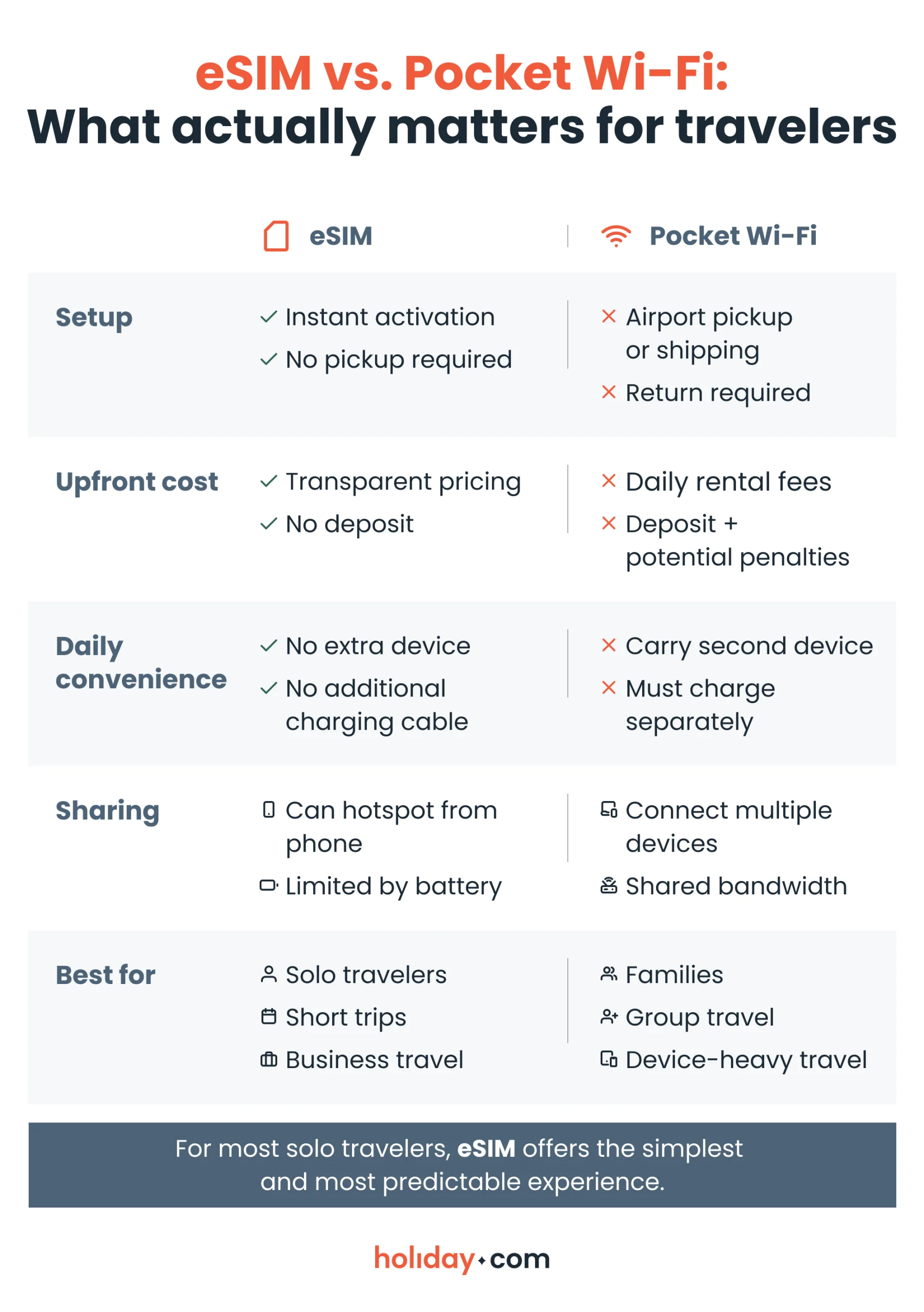
The biggest differences come down to cost transparency, setup logistics, sharing capability and daily convenience.
Costs and hidden fees
An eSIM typically comes with a single upfront price. Simply select your destination and number of days, then download the plan to get set up.
Pocket Wi‑Fi rentals, on the other hand, often include:
- Daily rental fees
- Refundable deposits
- Late return penalties
- Loss or damage charges
- Shipping or airport pickup fees
Those costs aren’t always obvious at first glance. If there’s a delay for your return flight or you forget to drop off the device, there’s a good chance you’ll deal with penalty fees.
HOT TIP
Check airport pickup hours before booking a pocket Wi‑Fi rental. Some kiosks close early, which can delay your connectivity to the next day.
Setup and logistics
With an eSIM, setup takes just a few minutes. You scan a QR code, install it through an app, or manually set it up. There’s no hardware to collect or return.
Pocket Wi‑Fi requires coordination. You’ll either pick it up at the airport or ship it to your accommodation. At the end of your trip, you’ll have to return the device as well. That means an additional step at both the start and finish of your journey.
Daily convenience and charging
An eSIM chip is built into your phone. There’s nothing extra to carry and nothing additional to charge.
A pocket Wi‑Fi router is a second device. That means:
- Another charger
- Another cable
- Another battery to manage
If the router runs out of battery midday, everyone connected to it loses internet access. If you need the extra power of pocket Wi-Fi, you’ll have to make sure and keep it charged.
HOT TIP
Pocket Wi‑Fi devices often need charging by late afternoon, especially when several people connect to it. A power bank becomes essential for full-day use.
Which option fits your travel style?
While eSIMs tend to be cheaper and more accessible, the best choice ultimately depends on how you travel.
Solo Travelers
An eSIM is the most practical option for solo travelers who don’t need large amounts of data. You can travel lighter without the extra devices and hardware. You’ll also save money by avoiding deposits and other fees. Setting up an eSIM is quick, and you can activate your plan in moments when you land in a new country.
Families or small groups
Pocket Wi‑Fi can make sense if multiple people need internet access throughout the day. One router can connect several devices at once with enough data for everyone in your party. Some eSIMs support creating a personal hotspot to share your connection, but it’s not as efficient for long-term use.
Business travelers
Security and reliability often matter more than shared access. Pocket Wi-Fi is generally safe, but the inclusion of an extra step between your device and the network makes it less secure than a direct eSIM connection. The difference may not be significant, but privacy becomes a much bigger concern if you’re accessing financial apps or sensitive work information.
Is an eSIM or a pocket Wi-Fi device more secure?
Small details can make all the difference when it comes to cybersecurity. While neither option is particularly high-risk, an eSIM is often the safer choice. If you frequently access sensitive information while traveling, minimizing extra hardware can reduce the likelihood of cyberattacks.
An eSIM connects to a local mobile network without relying on a shared device. There’s no intermediary hardware to share among several users. On the other hand, a pocket Wi‑Fi router creates a hotspot that connects several devices. It’s generally secure if password‑protected. But like any device, a weak password or outdated software is a potential weak spot for a cybercriminal to exploit.
HOT TIP
For remote work or banking abroad, using an eSIM reduces the vulnerabilities that come with shared devices like pocket Wi-Fi.
The bottom line for travelers
For most solo travelers, an eSIM is the simplest and most cost-effective choice. There’s no hardware to carry, which means no deposit to worry about and no return logistics at the end of your trip. Everything is built into your phone for a seamless experience.
Pocket Wi‑Fi still has its place, however. Families or groups who want a single shared connection may find it convenient, especially if everyone stays together. With the exception of these and similar special circumstances, an individual plan like holiday.com’s unlimited data eSIM is one of the most convenient ways to have connectivity abroad.
FAQ
-
Is an eSIM cheaper than pocket Wi‑Fi for travel?

In most cases yes, especially for solo travelers. eSIM plans usually have transparent upfront pricing, while pocket Wi‑Fi rentals may include additional charges depending on return timing or device condition.
-
Can I share an eSIM connection like pocket Wi‑Fi?
Yes. Some eSIMs allow hotspot sharing, but this draws from your phone’s battery rather than a separate router.
-
Do I need an unlocked phone to use an eSIM?
Yes. Your device must be carrier‑unlocked and compatible with eSIM technology. Most modern smartphones support eSIM technology. If you’re unsure, check your phone settings or contact your network provider for unlocking instructions.
-
What happens if I lose a pocket Wi‑Fi device?
Rental providers usually charge a replacement or loss fee, which can be significant. This is one reason many travelers prefer solutions that don’t require extra hardware.
-
Is eSIM more secure than pocket Wi‑Fi?
Yes, in general. An eSIM connects to a mobile network on your device. A pocket Wi‑Fi router creates a shared hotspot. Travelers handling sensitive data often prefer minimizing extra hardware.
-
Is pocket Wi‑Fi better for families?
It can be. A portable router makes sense when multiple people need constant access on separate devices. For solo travelers or short trips, though, an eSIM is often the simpler overall setup.
About our author

You might also be interested in...
-
 eSIM
eSIMHow to turn off an eSIM: Quick guide and tips in 2026
Turning off your eSIM can be helpful in many situations. You may want to disable a travel data plan, switch to another SIM, or avoid roaming charges. The process is quick and you can do it from your p...
 Ana Marković
 06.16.2026
 -
 eSIM
eSIMWhat is an ICCID number and why does it matter?
Knowing how to find your integrated circuit card identifier (ICCID) number makes it easier to manage devices that use SIM cards and eSIMs. When things are going smoothly, you hardly have to think abou...
Sarah Kirton
06.16.2026 -
 eSIM
eSIMeSIM vs. data roaming: Which is better for international travel?
Staying connected while traveling is easier than ever, but the way you access mobile data can make a big difference in your experience and costs. Two popular options are purchasing a travel eSIM or re...
Dawn Prevete
06.09.2026 -
 eSIM
eSIMeSIM vs physical SIM: Pros, cons, and which one is right for you?
An eSIM (embedded SIM) is the digital equivalent of a physical SIM card built into your device. It allows you to activate and manage cellular plans entirely through software, meaning there’s nothing...
Ivana Shteriova
06.08.2026 -
 eSIM
eSIMHow to delete data usage history in 2026: A step-by-step guide
You can erase the data usage counters on your phone, but you can’t permanently erase your carrier’s system-level logs. Deleting your local statistics so the counter returns to zero takes only a fe...
Ana Marković
06.08.2026 -
 eSIM
eSIMDoes an eSIM drain your battery? Fact versus fiction
While eSIMs use the same hardware as physical SIM cards and consume virtually the same power, there are times when you might notice your device’s battery draining faster than usual. Most often, itâ€...
Sarah Kirton
06.08.2026