


An eSIM (embedded SIM) is the digital equivalent of a physical SIM card built into your device. It allows you to activate and manage cellular plans entirely through software, meaning there’s nothing to insert, remove, or misplace. It effectively removes the friction of physical SIM cards.
When it comes down to it, eSIMs offer greater flexibility and convenience for modern cell phone users over physical SIMs, which remain necessary for older devices. If you travel many times throughout the year or need a second line for work, an eSIM is the superior choice.
Still, there are nuances. We’ll explain the key differences between eSIMs and physical SIMs and show you how to choose the right option for your lifestyle.
While some major carriers offer travel add-on plans, dedicated travel data providers like holiday.com often provide greater flexibility (such as custom plan lengths and multi-network coverage) at a more affordable rate.
eSIMs perks at a glance
Once you download a carrier profile, your phone’s built-in eSIM chip connects to a mobile network via software. This allows you to switch carriers or add additional plans without visiting a SIM store and having to turn a paper clip into a makeshift SIM ejector tool.
You can activate your eSIM via your phone’s settings. Depending on the provider, you can set up a plan through an app, by scanning a QR code, or via your phone’s settings. Once configured, the eSIM provides full network connectivity like a physical SIM card.
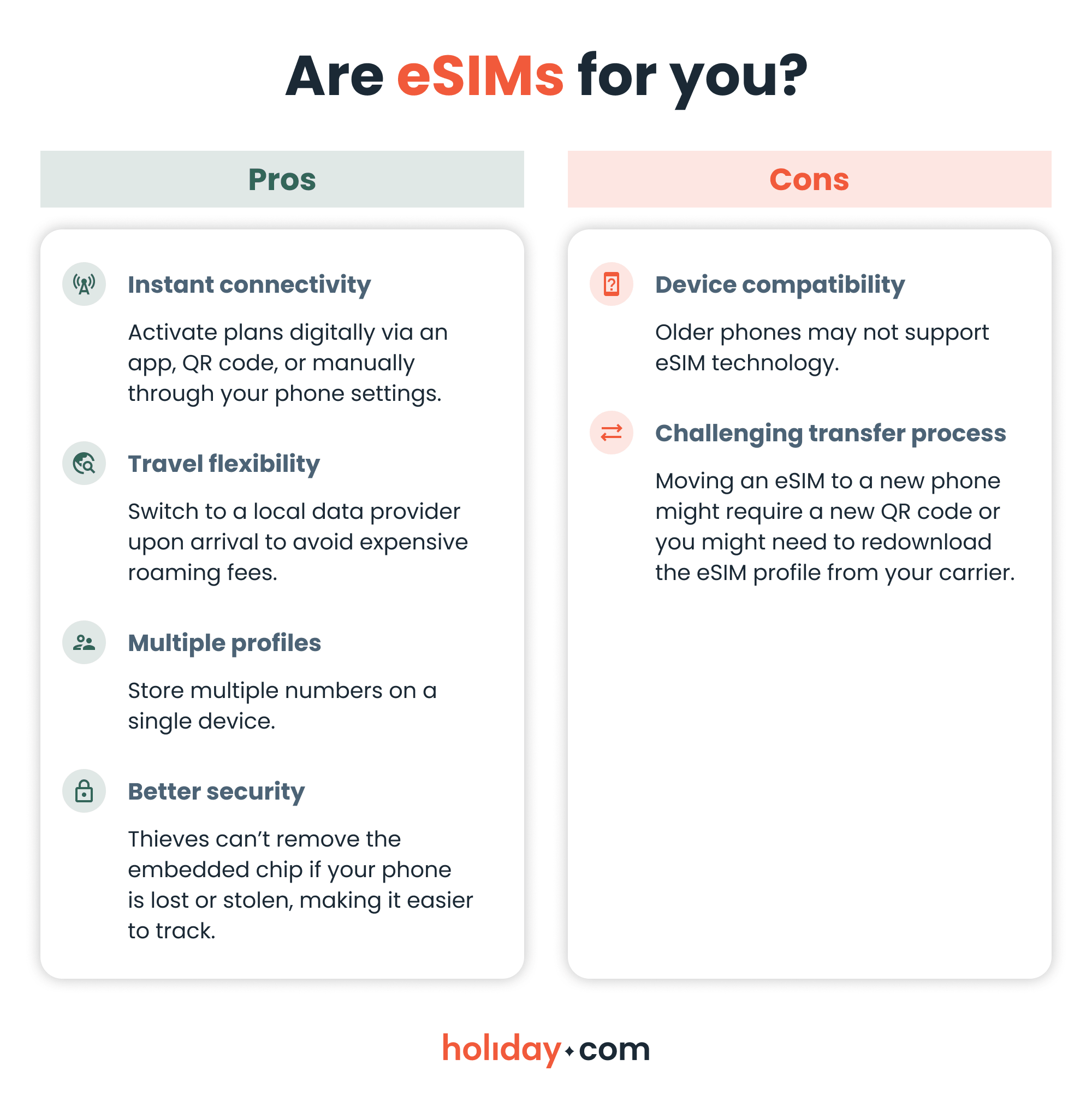
What are the pros and cons of eSIMs?
While eSIMs are the future of connectivity, like any technology, they have their own advantages and limitations.
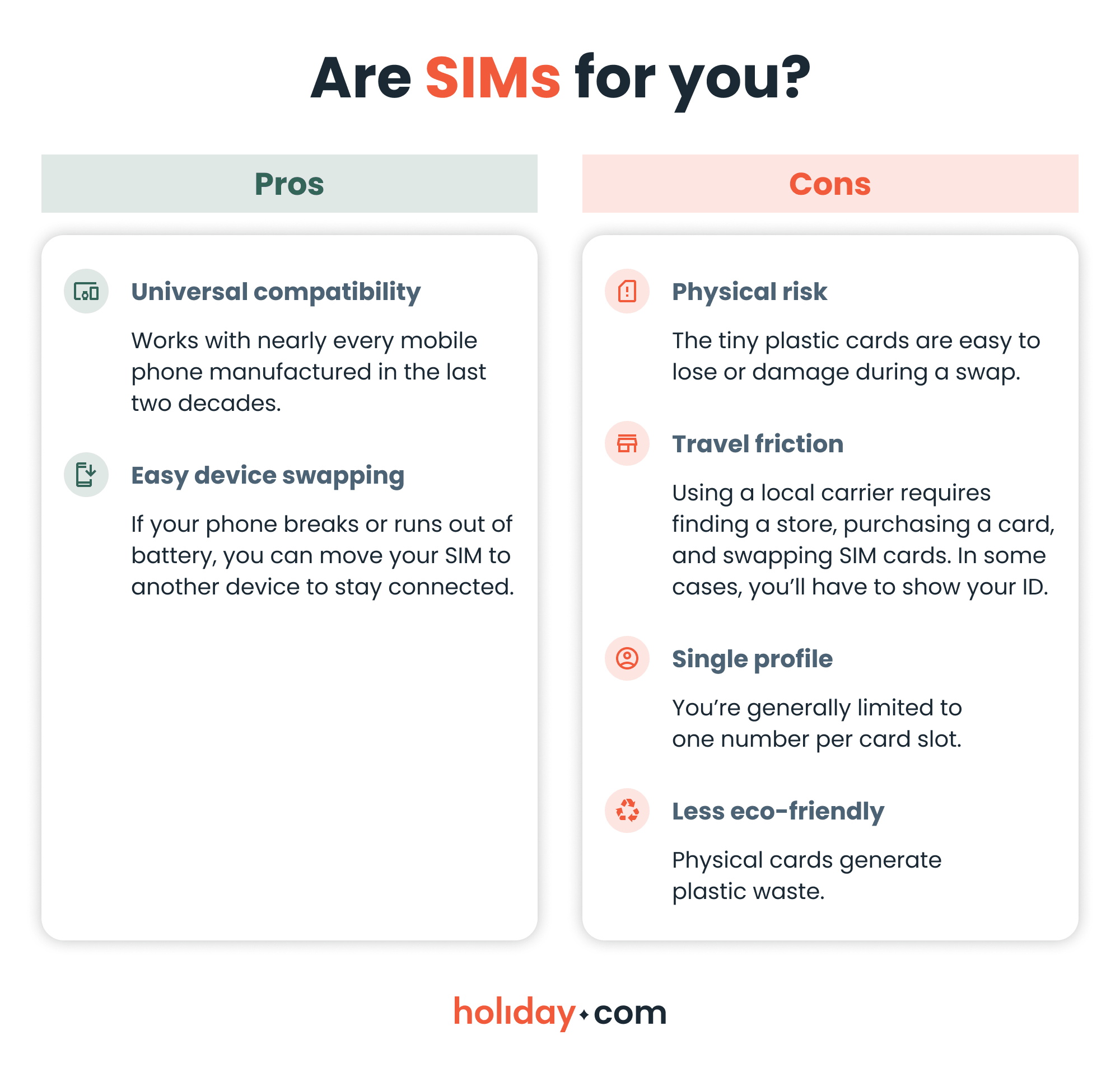
What are the pros and cons of physical SIMs?
Physical SIMs remain the standard for a reason: they’re simple, familiar, and are compatible for almost every device.
Head-to-head SIM comparison
The following table outlines the key practical differences to help you decide which format fits your needs.
| eSIM | Physical SIM | |
| Activation | Install via app or QR code in minutes. | Requires inserting a plastic card. |
| Compatibility | Newer smartphones (iPhone XS and newer) | Universal (almost all phones) |
| Calls & texts | Supported (though travel plans are often data-only). | Supported by default (usually includes a local number) |
| Switching plans | Switch profiles via your phone settings menu | Swap cards to switch plans |
| Travel | Download local plans on demand | Buy local cards in-store or pay for roaming |
| Security | Embedded (can’t be removed) | Removable (can be lost or stolen) |
Use cases: eSIM vs. SIM card
The right choice between using an eSIM and a SIM chip card depends on your lifestyle. While both formats connect you to the network, they excel in different scenarios.
International travelers
This is where eSIMs shine. Instead of hunting for SIM kiosks at the airport or paying daily roaming fees, you can install an eSIM like holiday.com before you leave for your trip. You get access to local networks the moment you land.
Digital nomads
If you often move between countries, an eSIM lets you switch data plans without carrying a collection of plastic cards. You can keep your home number active for two-factor authentication codes (2FA) while using a travel eSIM to connect to a local network for internet access.
Business users
Professionals can use a dual SIM setup to keep a dedicated work line and a personal line on the same device, eliminating the need to carry two phones.
Domestic users
For standard daily use, physical SIMs work fine, especially if you rarely switch carriers or use an older device that lacks eSIM support.
The best option comes down to how much flexibility you need. By understanding these specific use cases, you can better determine which SIM format aligns with your daily routine and travel plans.
eSIM or physical SIM: Pick what’s best for you
There is no one-size-fits-all answer. Choose an eSIM if you prioritize convenience, are a frequent flyer between countries, or want the flexibility of dual lines. Stick with a physical SIM if you have an older device, don’t need multiple lines, or prefer a familiar, manual setup.
Modern connectivity is about flexibility. If your phone supports it, using a physical SIM for your main line and an eSIM for travel data gives you the best of both worlds.
FAQ
-
Does an eSIM affect signal strength?

No. eSIMs and physical SIMs can connect to the same mobile networks. If you experience poor signal, it’s due to network coverage in your area, not the type of SIM you’re using.
-
Can I use WhatsApp with a travel eSIM?
Yes. You can continue using your primary number for WhatsApp, iMessage, and FaceTime while using your travel eSIM for data.
-
Is an eSIM harder to transfer to a new phone?
It can be. While you just need to swap or move physical SIM cards to the new slot, transferring an eSIM often requires generating a new QR code or using a “quick transfer” feature during device setup.
-
Is an eSIM safe to use?
Yes, eSIMs are generally more secure than physical SIMs. Because the chip is soldered inside the phone, thieves can’t steal it and use it in another device if you lose your phone.
-
Which devices support eSIM?
Most flagship phones from Apple (iPhone XS and later), Samsung, and Google released in the last few years support eSIM.
About our author

You might also be interested in...
-
 eSIM
eSIMHow to turn off an eSIM: Quick guide and tips in 2026
Turning off your eSIM can be helpful in many situations. You may want to disable a travel data plan, switch to another SIM, or avoid roaming charges. The process is quick and you can do it from your p...
 Ana Marković
 06.16.2026
 -
 eSIM
eSIMWhat is an ICCID number and why does it matter?
Knowing how to find your integrated circuit card identifier (ICCID) number makes it easier to manage devices that use SIM cards and eSIMs. When things are going smoothly, you hardly have to think abou...
Sarah Kirton
06.16.2026 -
 eSIM
eSIMeSIM vs. data roaming: Which is better for international travel?
Staying connected while traveling is easier than ever, but the way you access mobile data can make a big difference in your experience and costs. Two popular options are purchasing a travel eSIM or re...
Dawn Prevete
06.09.2026 -
 eSIM
eSIMHow to delete data usage history in 2026: A step-by-step guide
You can erase the data usage counters on your phone, but you can’t permanently erase your carrier’s system-level logs. Deleting your local statistics so the counter returns to zero takes only a fe...
Ana Marković
06.08.2026 -
 eSIM
eSIMDoes an eSIM drain your battery? Fact versus fiction
While eSIMs use the same hardware as physical SIM cards and consume virtually the same power, there are times when you might notice your device’s battery draining faster than usual. Most often, itâ€...
Sarah Kirton
06.08.2026 -
 eSIM
eSIM11 benefits of eSIMs every traveler should know
You shouldn’t have to put up with inconveniences or pay a small fortune to stay connected while traveling. Yet for years, travelers have had to deal with roaming charges, unreliable Wi-Fi, and the h...
Ana Marković
06.01.2026