



Staying connected while traveling is easier than ever, but the way you access mobile data can make a big difference in your experience and costs. Two popular options are purchasing a travel eSIM or relying on data roaming via your home carrier.
In the past, data roaming plans through your mobile carrier meant paying a fee every time you accessed data. Many carriers now offer daily or monthly travel passes. While using roaming options may seem simpler than setting up an eSIM, you’ll need to read the fine print if you want to avoid hidden messaging and calling fees and surprise overage charges.
On the other hand, travel eSIMs give you flexibility, predictable pricing, and more control over your data plan. The best ones give you access to the most popular local networks available, ensuring reliable coverage from the moment you land.
Here’s what you need to know before you travel. We’ll break down how eSIMs and data roaming compare across the factors that matter most, including data costs, network speeds, coverage, and ease of activation. Understanding these differences can help you choose the most reliable and cost-effective way to stay online when you travel.
Advantages to using an eSIM
Choosing an eSIM over your home carrier’s roaming plan comes with significant benefits, especially when it comes to the three “C”s: cost, convenience, and control over your data. This makes eSIMs a more traveler-friendly choice in most situations.
Cost
- Often cheaper than roaming. You benefit from region-based pricing when you use a travel eSIM, which is usually less expensive than per-use roaming fees or travel passes from your carrier.
- Upfront, transparent costs. With a prepaid eSIM, you know your total cost upfront. You won’t have to deal with traditional roaming overage charges if you exceed your data limits.
Convenience
- Access to your home SIM. As long as your device supports dual SIM technology, you can keep your regular number active for calls and verification texts while using the eSIM for data.
- Flexibility and choice. Instead of relying on your home carrier’s rates, you can compare eSIM providers to find the best rates and coverage for your trip.
More control over data
- Transparent data limits. eSIM plans offer transparent data allowances, so you can choose the right plan for your trip. With pay-as-you-go roaming, you’re charged a fee per megabyte of data and there’s no set data allowance. You can easily rack up expensive roaming fees this way.
- Unlimited data options. Some eSIMs (like holiday.com) offer no-limits data plans, which let you stream and make video calls without stressing about how many megabytes you’re using. Unlimited plans are the best way to ensure you’re never cut off from data.
eSIM vs. data roaming: Side-by-side comparison
The chart below highlights how certain features differ between eSIMs and data roaming. Roaming plans vary by carrier, so be sure to contact your mobile provider to confirm full details.
| Travel eSIM | Data roaming | |
| Payment structure | Prepaid. Pricing based on a set amount of data and number of days. | Prepaid or post-paid. Based on pay-as-you-go for data, messaging, and calls or daily/monthly passes. |
| Cost predictability | High. No additional fees with unlimited data plans and set fees for preset data plans. | Medium. Risk of unexpected overage fees depending on plan. |
| Flexibility | High. A wide variety of providers means you have many plans to choose from. | Low. You’re tied to your home carrier options. |
| Speeds | High. For unlimited plans, speeds may slow temporarily once you exceed a preset allowance per day. | High. For unlimited plans, speeds may slow temporarily once you exceed a preset allowance per day. |
| Installation | One-time eSIM setup through QR code, carrier app, or manual installation. | No third-party software required. |
| Activation | Requires a manual update in your settings | Automatic |
| Best for | Short or long trips to one or more destination(s) for business or leisure travel, digital nomads. | Short trips, travelers with employer-paid roaming, or emergency cases. |
Data usage for typical travel activities
Typical travel activities consume varying amounts of data, from minimal usage for basic messaging and browsing to a few gigabytes per hour for high-definition video streaming.
Here are some examples of how much data you’ll use:
| Activity | Estimated data consumed |
| Streaming TV show or movie | 0.7-1 GB (SD) to 2-3 GB (HD) per hour |
| YouTube video streaming | 500 MB (SD) to 1.25 GB (HD) per hour |
| Livestreaming | 0.5-1.5 GB (SD) to 3-4+ GB (HD) per hour |
| Uploading HD reels to social media* | 50-100 MB per minute of video |
| Video calls (WhatsApp, Zoom, FaceTime) | 300-600 MB (SD), 1-2 GB (HD) per hour |
*Varies based on length, resolution, and platform. Longer videos use more data per minute.
Using your mobile phone as a hotspot to share data with family or connect a tablet or laptop will also increase your data use, sometimes as much as 10 GB per week. If you’re working remotely, you may use 7-28 GB per week.
When to use data roaming
There are a few situations where sticking with data roaming may make sense. If you’re taking a very short trip, such as a two-night stay for a business meeting, many carriers offer international travel passes packaged as daily add-ons to your current plan. You’ll pay a flat daily fee for access to the same perks you get on your home carrier plan.
Roaming may also be convenient if you need full access to your home number, particularly for business contacts who rely on your primary number for incoming calls. But even in these cases, it’s important to check the total cost and any data caps to avoid unexpected charges.
What to look for in a data roaming plan
Your available options for a roaming plan depend on your mobile provider, so make sure you understand the details of your carrier’s offerings. Throttling speeds, data limits, and international coverage are all important considerations, especially if you’re visiting a few countries. The most important factor for most people, however, is affordability.
Most carriers have two different pricing models for roaming. You can either pay per megabyte and for each call, or you can pay a daily or monthly fee for a roaming plan with a preset allowance.
Pay-as-you-go roaming is the costlier option, with some carriers charging as much as $2-$4 per minute for a phone call and around $2 per megabyte of data. Paying ahead of time for a data roaming plan is almost always more cost-effective. Prices can range from $5 per day for limited data to $100+ per month for unlimited plans.
Relying on your home SIM runs the risk of incurring surprise fees if your phone connects to a foreign network. If you decide to avoid these risks, using an eSIM can negate some of these issues.
How to pick the right eSIM for hassle-free travel
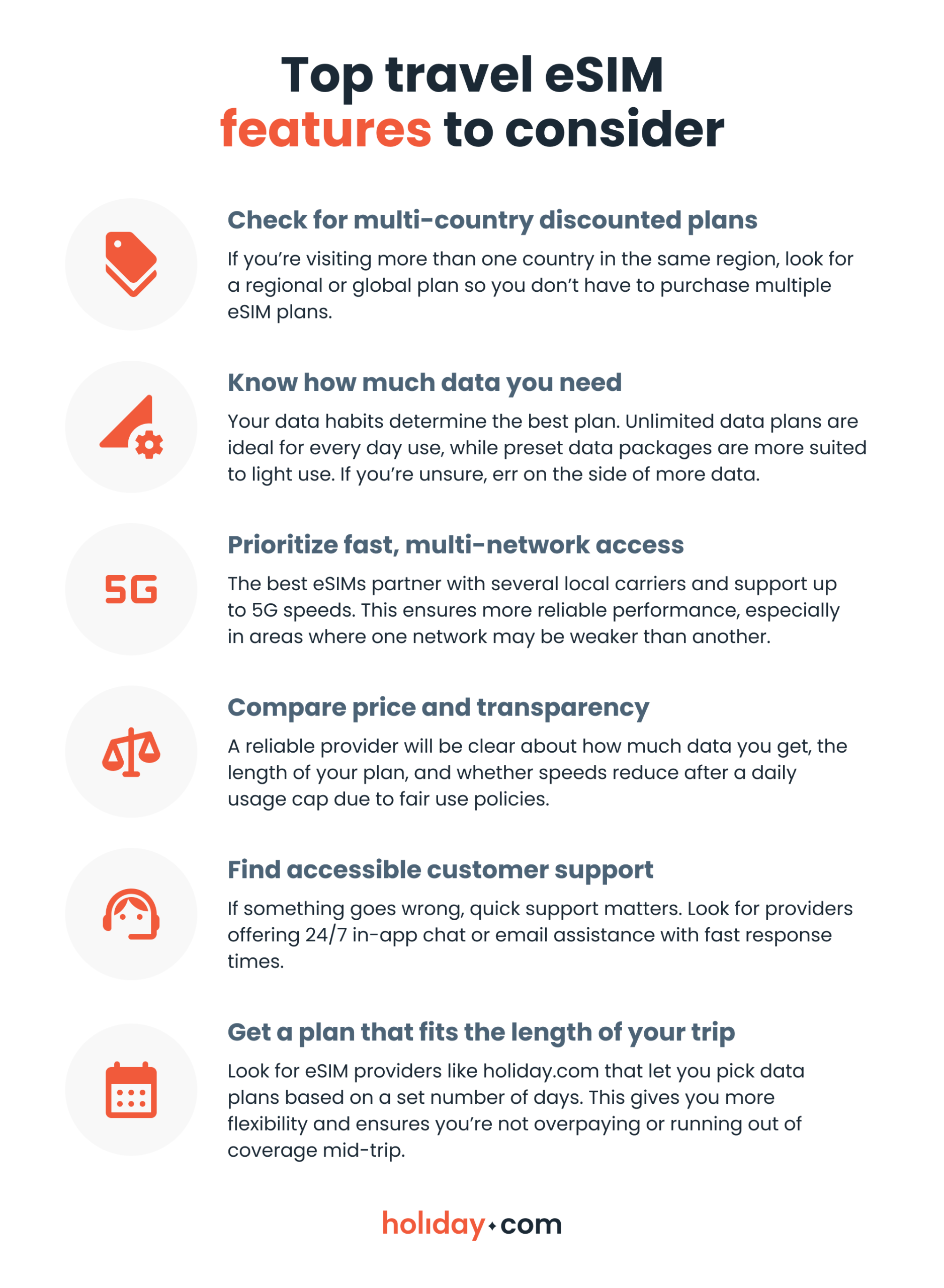
To choose the best travel eSIM plan, you’ll want to consider your destination, trip length, budget, and how you plan to use your phone. These key factors will help you compare providers and choose a plan that suits your travel style.
Why an eSIM beats data roaming for travel
While roaming plans and day passes can work in a pinch, eSIMs give travelers more flexibility and clearer pricing without the risk of surprise charges. Options for unlimited data and tailored data plans give travelers even more control over flexibility and costs. For most travelers, an eSIM is the smarter, easier, and more reliable way to stay connected abroad.
FAQ
-
Will my phone work with an eSIM?

If you have a recent phone model, it likely supports eSIM technology. To confirm, check your device settings. On iPhone, go to Settings > Cellular (or Mobile Data). If you have an Android device, look under Network & Internet > SIMs. Your device is compatible if you see an option to add an eSIM.
-
What are the best eSIM plans?
The best eSIM plans offer fast local network speeds, transparent pricing, and easy activation. holiday.com ranks as a top eSIM choice thanks to its reliable connectivity, unlimited data packages, and flexible data packages you can top up in the app.
-
Are there disadvantages to using an eSIM while traveling?
There are a few disadvantages. Not all older phones support eSIM and you need reliable Wi-Fi to install it. But for most travelers, the advantages of eSIMs compared to traditional data roaming plans and mobile carrier “day passes” far outweigh these drawbacks.
-
What can trigger unexpected charges with a data roaming plan?
Unexpected charges happen when your phone connects to a local network by default, uses data in the background, or you exceed your plan limits. Common triggers include app updates, photo/video backups, navigation apps refreshing routes, and iOS Wi-Fi assist switching you to mobile data when a signal is weak. Even small background tasks can add up on roaming plans.
-
Should I turn off data roaming when using a travel eSIM?
Turn data roaming on when you arrive at your destination so your travel eSIM can access the local partner network. If you have a dual-SIM phone, make sure to keep data roaming turned off for your home SIM to avoid unexpected charges. This setup ensures only the travel eSIM uses data.
About our author

You might also be interested in...
-
 eSIM
eSIMHow to turn off an eSIM: Quick guide and tips in 2026
Turning off your eSIM can be helpful in many situations. You may want to disable a travel data plan, switch to another SIM, or avoid roaming charges. The process is quick and you can do it from your p...
 Ana Marković
 06.16.2026
 -
 eSIM
eSIMWhat is an ICCID number and why does it matter?
Knowing how to find your integrated circuit card identifier (ICCID) number makes it easier to manage devices that use SIM cards and eSIMs. When things are going smoothly, you hardly have to think abou...
Sarah Kirton
06.16.2026 -
 eSIM
eSIMeSIM vs physical SIM: Pros, cons, and which one is right for you?
An eSIM (embedded SIM) is the digital equivalent of a physical SIM card built into your device. It allows you to activate and manage cellular plans entirely through software, meaning there’s nothing...
Ivana Shteriova
06.08.2026 -
 eSIM
eSIMHow to delete data usage history in 2026: A step-by-step guide
You can erase the data usage counters on your phone, but you can’t permanently erase your carrier’s system-level logs. Deleting your local statistics so the counter returns to zero takes only a fe...
Ana Marković
06.08.2026 -
 eSIM
eSIMDoes an eSIM drain your battery? Fact versus fiction
While eSIMs use the same hardware as physical SIM cards and consume virtually the same power, there are times when you might notice your device’s battery draining faster than usual. Most often, itâ€...
Sarah Kirton
06.08.2026 -
 eSIM
eSIM11 benefits of eSIMs every traveler should know
You shouldn’t have to put up with inconveniences or pay a small fortune to stay connected while traveling. Yet for years, travelers have had to deal with roaming charges, unreliable Wi-Fi, and the h...
Ana Marković
06.01.2026