


Renting a car while abroad comes with some unique challenges, like booking an appropriate car, driving in foreign countries, and even getting the right driver’s license. At the same time, rental agencies are notorious for having surprise fees and confusing insurance options, and sometimes use pressure tactics to cajole people into making hasty decisions. And you don’t want to be in an argument about a scratch you didn't cause while trying to catch a flight home.
Renting a car while traveling internationally offers more freedom than other options, like taking the metro or a bus. You don’t have to wait for trains or figure out foreign-language bus schedules — you simply get in and go. It's why 64% of respondents to a nationwide survey by Zubie stated convenience as their primary reason for renting a car, with most prioritizing flexibility over cost.
But that freedom comes with some fine print. Drivers under 25 face surcharges in most of Europe. Many countries, including Japan, Italy, and Spain, require an International Driving Permit. And credit card insurance, often assumed to be enough for most travelers, frequently falls short of the demands of many rental agencies.
This guide walks you through the entire car rental process, from booking to drop-off, so you can enjoy the open road with less stress.
Before your trip: Planning ahead
A little preparation before you pick your car up can save you time and money, and help you avoid some common frustrations.
Verify your license requirements
You'll need your valid driver's license, passport, or photo ID (if you have an older paper license), a recent utility bill or bank statement showing the same address as your license, and a credit card that doesn't expire before your rental period ends.
Many countries require Americans to carry an International Driving Permit (IDP), including most EU nations (Germany, Italy, Spain, Poland, and others), as well as Australia, Japan, and Thailand. Also, if your license uses non-Latin characters, like Arabic or Cyrillic, you'll likely need an IDP.
According to a survey by BCD Travel Research & Intelligence, only 61% of travelers check whether an IDP is required before their trip. The rest risk being turned away at the counter (or worse, driving illegally).
In the U.S., you can obtain an IDP through AAA or AATA. Fill out an application, provide two passport photos, show your valid U.S. driver's license, and pay a $20 fee. You can apply in person at any AAA office or order by mail and the permit is valid for one year. Keep in mind that IDPs issued after you’re already overseas can take five days or longer to reach you.
Some countries (including the majority of EU countries, South Africa, Vietnam, and many more) only accept an IDP that complies specifically with the 1968 Vienna Convention on Road Traffic. Others, including the U.S., Canada, and the U.K., issue IDPs under the 1949 Convention. China doesn’t recognize IDPs at all. Check your destination country’s requirements well before leaving to make sure you have the right IDP.
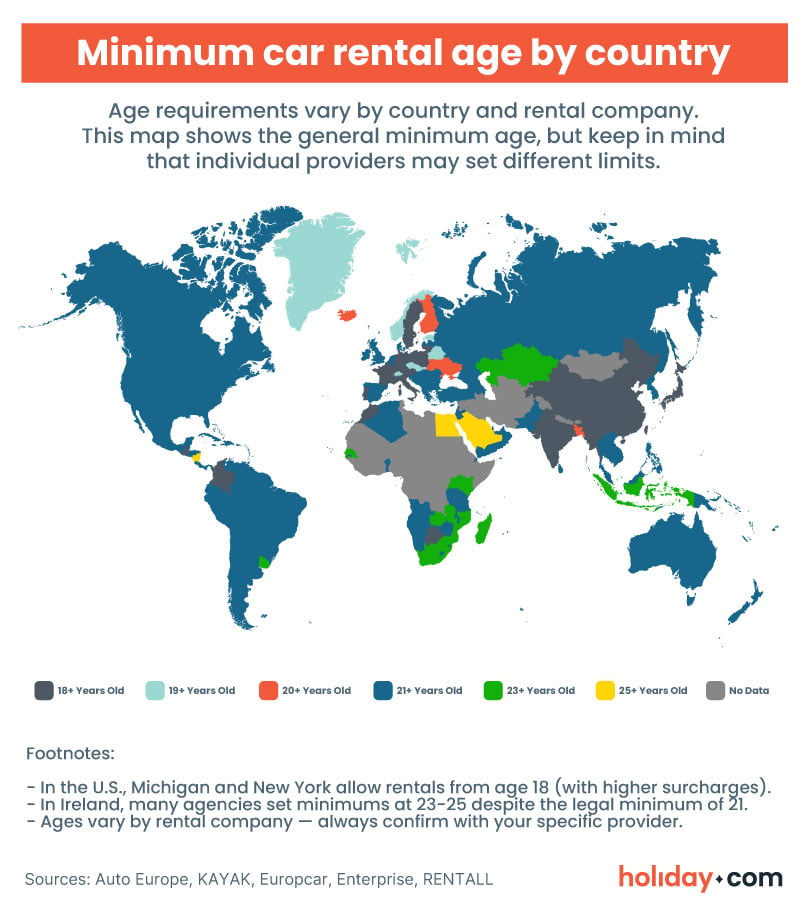
Research shows that insurance premiums for younger renters in the U.S. are between 30%-50% more expensive than for older drivers. If you're under 25 and in the States, you can expect to pay around $25 extra per day. Senior drivers may also face restrictions around age 75, with some companies requiring a doctor's certificate or proof of recent accident history.
Choose reputable rental agencies over comparison sites
Sites that compare multiple car rental agencies can be useful to get a quick overview of your options, but they’re better avoided when it comes to actually choosing a deal. Comparison sites often display artificially low rates that increase once you add extras like fuel and insurance.
To find a reputable rental agency, check recent customer reviews on Google Reviews and Trustpilot and look for companies with actual offices, addresses, and professional websites. A company requesting payment via gift cards, demanding full payment upfront, or refusing credit cards is a red flag.
Enterprise ranks highest among car rental agencies in the J.D. Power 2025 satisfaction study (U.S.) with a score of 734, followed by National at 721. However, while using a major North American agency that operates internationally can make planning easier, local agencies often offer better rates.
Book early and pay upfront when possible
Reserve a rental car three to six months ahead for popular destinations or holiday periods. This way, if your itinerary is set, you can also pay upfront to lock in discounts and avoid international transaction fees. Collision damage waivers purchased upfront are also cheaper. If your plans change, you may be able to cancel without penalty depending on the rental type; be sure to ask before you sign or pay if you’re unsure of your trip’s details.
Select strategic pick-up and drop-off locations
According to a NerdWallet analysis, in the U.S., airport rentals cost about 18.4% more than rentals from downtown locations. If you don't need a car immediately, consider picking up your vehicle in town. Just keep in mind that these agencies may have shorter hours or be harder to find; avoid small-town pickups on weekends or holidays when offices are often closed.
Cars are generally rented in 24-hour periods. If you pick up at 10 in the morning and return at noon the next day, you'll pay for two full days. Try to schedule your pickup around when you’ll actually need the car.
Watch for hidden costs in rental agreements
Read your car’s reservation voucher thoroughly and double-check charges at pickup. Key costs to watch for include:
- Fuel policy: Avoid full-empty deals where you pay a premium for fuel used. Always opt for full-to-full and refuel yourself before returning.
- Mileage limits: Some companies charge big fees for exceeding daily mileage caps.
- Additional driver fees: This is generally a daily surcharge, or free with some companies. Without declaring additional drivers, you risk driving without coverage.
- One-way charges: Dropping the vehicle off at a different location can add huge costs.
- Late fees: Returning the vehicle late can result in substantial charges.
- Cleaning fees: Return the car reasonably clean to avoid charges.
Select the right vehicle for your journey
Consider passenger count and luggage. Compact cars work for two people with limited luggage, while larger groups will need SUVs or vans. Think ahead for where you’ll be driving, too. For instance, some cities in Europe with tight, narrow streets will be better suited to small, agile cars, while four-wheel drive may be required for mountain driving or rough, off-road terrain (or bad roads).
European cars typically have manual transmissions — automatics cost more and have limited availability, so book well in advance if needed. If you're driving far, prioritize fuel efficiency. For long drives, ensure the car has comfortable seats, air conditioning, and navigation.
Book ahead: Car insurance
Understanding rental car insurance is one of the most confusing and important aspects of renting abroad. Get it wrong and you could be liable for thousands in repairs, liability claims, or towing fees. Get it right and you'll drive with peace of mind without overpaying.
What's usually included
When looking at insurance coverage for rental vehicles, you’ll need to pay particular attention to a few key terms. Companies may use these terms slightly differently, so you’ll want to read your rental agreement carefully to be sure you’re getting the coverage you expect. Typically, companies offer:
- Collision Damage Waiver (CDW): Covers the value of a vehicle damaged or totaled in a collision, but often excludes the tires, windscreen, undercarriage, and roof. The deductible (or "excess") is typically between $650 and $3,800. And if the damage occurs while you're speeding, illegally parked, or driving drunk, you may be responsible for the entire cost.
- Loss Damage Waiver (LDW): Similar to CDW, but also covers theft of the vehicle. If someone steals the rental car, an LDW caps your liability at your deductible. Just don’t leave the keys in the ignition; coverage may be voided entirely in the event of theft.
- Third-Party Liability Insurance: This protects you if you injure someone or damage their property while driving. It covers medical expenses, property damage, and legal costs if you're found at fault. Rental cars typically include basic liability, but coverage limits vary — check that they meet local legal requirements.
- Theft Protection (TP): Similar to the LDW, theft protection limits your liability should your rental vehicle be stolen. TP may be included as part of, or in addition to, the LDW, but can also be separate coverage. As with the LDW, you can’t leave the vehicle unattended with the keys inside, the vehicle should be locked when unattended, and you must report the theft promptly.
Add-ons worth considering
Beyond standard coverage, rental companies offer additional insurance. Here's what each does and typically costs daily (in the U.S.):
- Super Collision Damage Waiver (SCDW): Often reduces or eliminates your deductible entirely, and usually covers windscreen, tires, and underbody damage that the standard CDW excludes. More expensive but can save you a significant amount if an accident occurs.
- Supplemental Liability Insurance (SLI): Increases the payout limit on third-party liability, which is useful if you cause an accident with high injury or property damage costs. Around $10-$15/day.
- Personal Accident Insurance (PAI): Supplemental coverage for medical expenses for you and your passengers should anyone be injured in an accident. Often includes ambulance transport. Around $5-$10/day.
- Personal Effects Coverage (PEC): Covers loss or damage to personal belongings inside the rental car. Around $2-$5/day.
- Roadside Assistance: Supplemental service for mechanical issues such as breakdowns, flat tires, lockouts, dead batteries, and low fuel. Often included in Europe; may be an add-on elsewhere.
According to research by Radical Storage, a full package of add-ons (insurance, child seat, GPS, additional driver) averages around $49 per day on top of your rental fee. In some destinations like Durban, Paris, or Windhoek, add-ons can nearly triple your base rental rate.
Credit card coverage: Helpful but limited
Many travel credit cards offer Collision Damage Waiver or Loss Damage Waiver as a cardholder benefit. Coverage limits typically range from $50,000 to $75,000, depending on your card and the vehicle value.
While sometimes useful, credit card coverage also has some restrictions and limitations drivers need to be aware of, including:
- Coverage periods: Often limited to 15 consecutive days in the U.S. and 31 days abroad.
- Vehicle exclusions: Trucks, large vans, motorcycles, and luxury or exotic cars are commonly excluded.
- No liability coverage: Credit cards don't cover injuries or property damage you cause to others.
- Exclusions: Personal injuries, property damage, lawsuits, loss, mechanical breakdowns, off-road damage, and personal belongings are typically not covered.
- Primary vs. secondary coverage: This matters. Primary coverage pays first if you have an accident. Secondary coverage only reimburses what your personal auto insurance or travel insurance doesn't cover, which can mean multiple claims and more hassle.
To use credit card coverage, you also need to pay for the rental with that card and decline the rental company's CDW. If you don't own a car or don’t carry personal auto insurance, secondary coverage often becomes primary by default.
Why you should avoid buying insurance at the counter
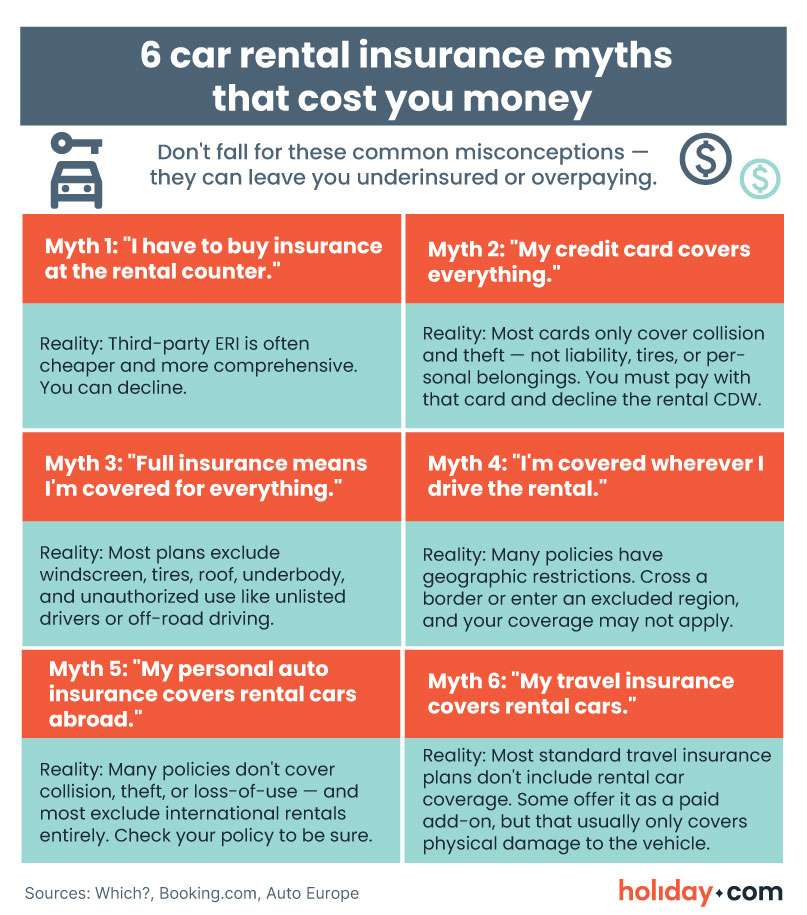
Research by Which? shows that buying insurance from the rental company is more expensive and less comprehensive than third-party policies. Rental-desk coverage often excludes windscreen, tires, underbody damage, wrong-fuel incidents, and lockouts — all of which reputable third-party providers cover.
Rental agents may pressure you into buying "full protection" policies, but you have the right to refuse. A better approach is to purchase Excess Reimbursement Insurance (ERI) from a third-party provider before your trip. You'll know exactly what's covered, avoid surprise upsells, and usually even pay less.
If you decline the rental company's insurance, you'll need to leave a deposit on a credit card — usually around $1,400. The card must be physical (not stored on your phone), in the primary driver's name, and have enough available credit. Most companies place a pre-authorization hold, blocking those funds until about a week after you return the car.
At the rental agency: Inspection, documents, and deposits
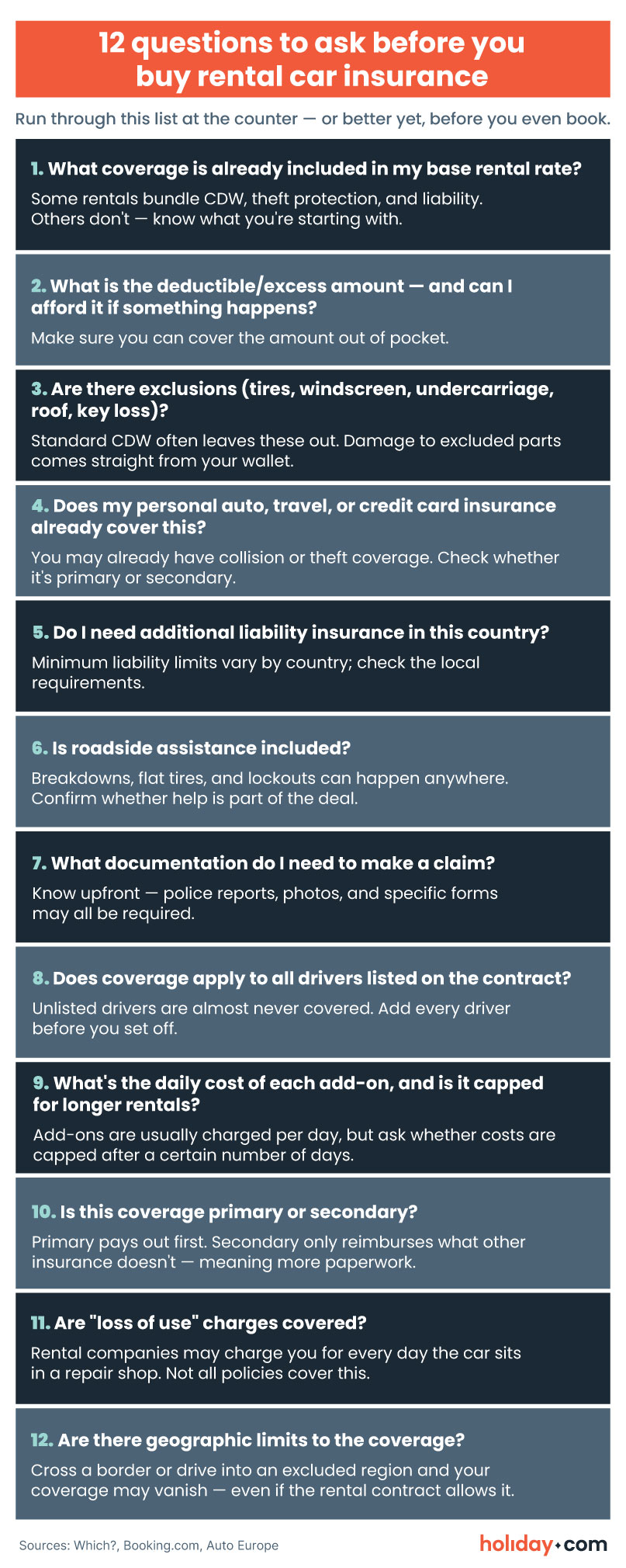
You've done your homework, booked ahead, and sorted your insurance. Now comes what you’ve been waiting for: picking up the car. Unfortunately, this is where travelers can get tripped up by missing documents, unexpected deposits, or damage they didn't cause.
Bring the right documents
Here's what to have ready:
- Driver's license: Needs to be valid and not expiring during your rental period. If your license uses non-Latin characters (such as Arabic, Chinese, or Cyrillic), bring an International Driving Permit or certified translation.
- International driving permit: Required in countries like Italy, Japan, Germany, and Spain. Check which type you need, and bring it alongside your regular license, not instead of it. For instance, to drive in New Zealand you’ll need a 1949 IDP, while Vietnam requires the 1968 version. A 1926 version also exists but is rarely required these days.
- Passport: Required for international rentals. Be aware that your passport may need to be valid for up to six months after your return date. Some rental companies will keep a copy during your rental.
- Credit card: Must be a physical (not digital) card, in your name as the primary driver, and the same card you used for a reservation if you prepaid. Debit cards often get rejected or require extra documentation and higher deposits. If you’re renting abroad, notify your bank of your travel plans in advance to avoid your card being blocked at a bad time.
- Reservation confirmation: A digital copy on your phone usually works, but a printed backup never hurts. If you booked a special rate, make sure it's clearly indicated, and bring proof of any membership or eligibility requirements.
- Proof of insurance: If you're using third-party or credit card coverage, bring documentation showing what's covered.
Understand your deposit
Rental companies require a deposit as a financial guarantee in case of damage, fees, or violations. This amount gets blocked on your credit card until after you return the vehicle. It’s normally released within a week, although some companies actually withdraw the funds and refund them later.
Deposit amounts vary based on:
- Vehicle type: Larger or luxury vehicles require higher deposits.
- Your age: Younger drivers may face higher deposit requirements.
- Location: Deposits differ by country and rental company.
Typical deposits range from $100 to $1,000, though (in some extreme cases) they can equal a vehicle's replacement cost. Make sure you read the fine print to avoid this. Even with Zero Excess coverage, you'll still need to leave a deposit to cover items that aren’t included in the insurance (tires, windscreen, underbody, etc.).
Make sure your credit card has enough available credit to cover a deposit on top of other travel expenses. If a hold maxes out your card, you could run into problems paying for hotels, meals, or emergencies.
Read your rental contract carefully
Even if you pre-booked online, read your contract before signing it at the counter. Some key things to verify include:
- Vehicle details: Make, model, license plate, and starting mileage.
- Rental period: Exact pickup and return dates and times.
- Pricing: Daily rate, taxes, and any additional charges.
- Insurance: What's included, what's excluded, and your deductible amount.
- Fuel policy: What level to return the tank at.
- Mileage limits: Daily or total caps, and fees for exceeding them.
- Geographic restrictions: Some contracts don’t allow cross-border travel or driving into specific regions.
- Return conditions: Location, time, and penalties for late returns.
If anything is unclear, always ask before signing. Don't let pressure from a busy counter rush you into an agreement you don't fully understand.
Red flags to watch for include:
- Pressure to accept upgrades or coverage you didn't request
- Mandatory extras that weren't agreed upon before
- Vague or contradictory wording on fuel or toll policies
- No vehicle inspection form — always insist on documenting your car's condition (and photograph it yourself)
- Reluctance to show an insurance certificate or policy details (or missing insurance details on relevant forms)
- "Too good to be true" deals combined with cash-only payment or skipped paperwork
- Any instructions not to involve police or claims that accidents are handled internally
Inspect the rental car thoroughly
Before driving off, inspect the vehicle inside and out. Any damage you don't document before you drive away might be blamed on you when you return the vehicle.
Exterior:
- Walk around the whole car. Check for scratches, dents, or paint damage on all panels, bumpers, doors, and roof.
- Examine the windscreen for cracks or chips. Get into the driver’s seat to see the view from the inside and whether any damage impacts your visibility.
- Inspect all four tires, checking for adequate tread depth, bulges, cuts, or punctures.
- Test all lights: headlights, taillights, brake lights, turn signals, and hazard lights.
- To be totally sure, you can also check oil and water levels.
- Ensure the doors, trunk, and hood open and close securely.
Interior:
- Check upholstery for rips, tears, or stains.
- Inspect the dashboard and controls for damage.
- Test air conditioning and heating.
- Confirm all seatbelts work properly.
- Check for any warning symbols on the vehicle’s dashboard.
Safety equipment:
- Check that the car includes a first-aid kit, fire extinguisher, and reflective triangle (required in many European countries).
- Ask if there's a spare tire and tools, or what the roadside assistance arrangement is in case of a flat.
- Locate the owner's manual and check for a working phone charger or power source.
Document everything:
- Take photos and video of the entire vehicle, including every panel, wheel, the windscreen, interior, fuel gauge, and odometer. If any existing damage isn't noted on your rental agreement, make sure it’s added before you leave.
Without this documentation, you're relying entirely on the rental company's word when you return the car.
Driving abroad: Local rules and tips
Vehicle accidents are the leading cause of non-natural death for U.S. citizens abroad, accounting for nearly 29% of such deaths between 2002 and 2022. Unfamiliar roads, different traffic laws, and local driving cultures all add risk. A little preparation goes a long way.
Know the local rules before you go
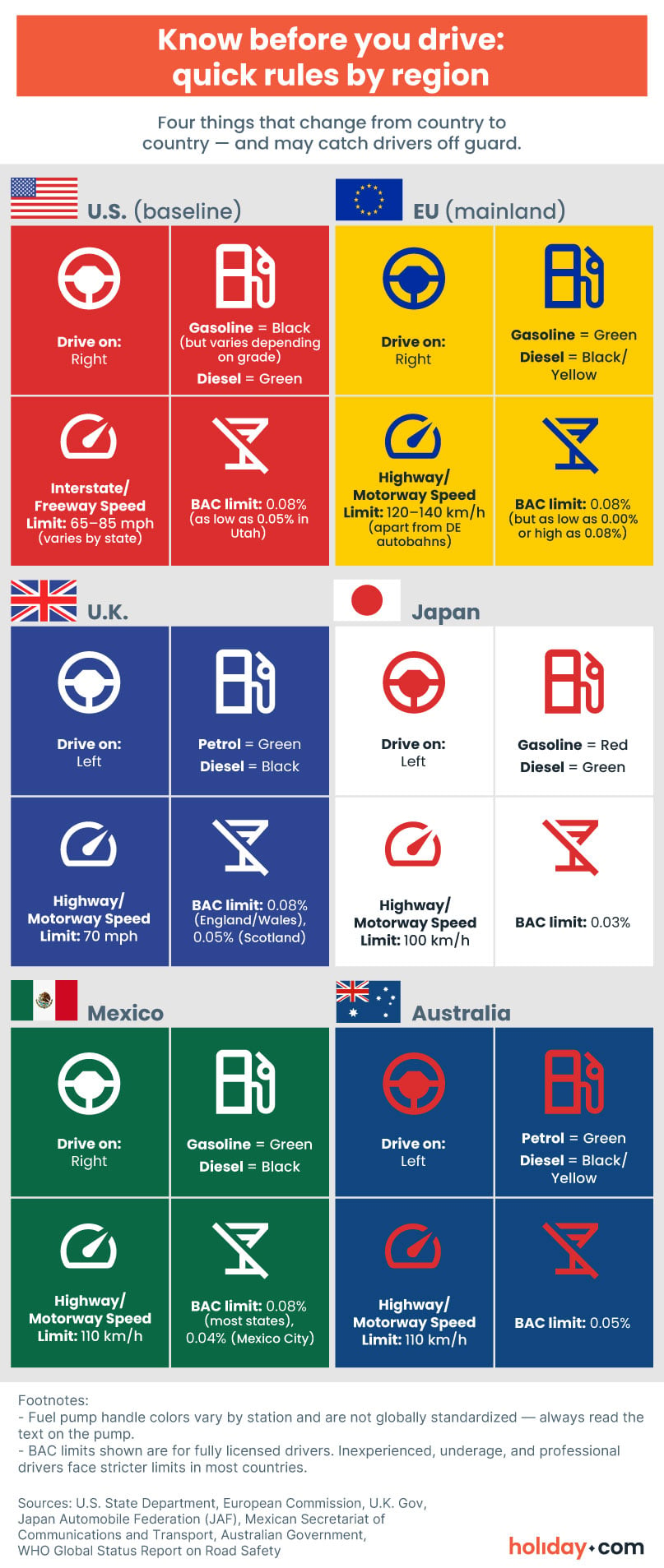
Traffic laws vary significantly between countries. Before your trip, research:
- Which side of the road: Left-side driving applies in the U.K., Ireland, Japan, Australia, and some others. If you're not used to it, an automatic vehicle can help reduce mental load and let you focus purely on the road.
- Speed limits: These vary by road type and country. Navigation apps like Google Maps and Waze can help you track current limits (and your current speed) in real time.
- Road signs: Symbols and shapes differ between countries. In Japan, stop signs are inverted red triangles rather than octagons. European signs often use pictograms instead of text. Familiarize yourself with local signage before driving — a quick image search or your rental agency can help.
- Required equipment: Many European countries require a reflective vest, warning triangle, and first-aid kit in your vehicle. Snow chains may be mandatory in winter, even with winter tires. Some countries require a U.K. sticker if you're driving from Britain.
- Sat-nav restrictions: In France, for example, it's illegal to use GPS equipment that shows speed camera locations.
Understand toll systems
Many countries operate toll roads, and how you pay can vary quite a bit, including:
- Cash tolls: Keep loose change in local currency handy for toll booths.
- Vignettes: In countries like Austria, Switzerland, and the Czech Republic, you need a vignette (a sticker or electronic tag) to use highways. You can buy physical vignettes at border crossings or gas stations, although buying an electronic one online in advance is often easier. Driving without one can result in large fines.
- Environmental zones: Many European cities restrict certain vehicles from entering low-emission zones. Some require an environmental sticker on your windscreen. Check your destination's requirements before driving into city centers.
- Rental toll programs: Many rental companies charge a (usually high) processing fee for each toll if you don't opt into their toll program. But their programs can require payment for your entire rental period, even if you only use toll roads once. Research toll roads on your route and pay them yourself online, in-person, or via a transponder to save some money.
Don't get confused at the pump
Fuel labeling is different around the world, and the wrong fuel can destroy an engine.
In much of the French-speaking world (including Canada, France, and other parts of Europe), gasoline is called essence and diesel is known as gazole or diesel. In Spain, gasoline is known as gasolina and diesel gasolio, but in Spanish-speaking South America, gasoline might also be called nafta or bencina.
Sometimes these are false cognates. You might see a word that looks like “gasoline” at the pump, only to discover that it’s diesel (or vice-versa). When you pick your vehicle up from the rental agency, ask what fuel it takes. And before you fill up, be sure to familiarize yourself with the local terminology.
EU countries use standardized pump labels:
- Unleaded: Green pump, labeled with an "E" in a circle, like E5, E10, E85, where the numbers stand for the ethanol content.
- Diesel: Often black or yellow, labeled with a square containing a "B" such as B7, B10, where the numbers stand for the biodiesel content. "XTL" is synthetic diesel.
Unfortunately, pump handle colors aren't universal. In the U.S., green handles typically mean diesel, while yellow is E85 ethanol. In most of Europe, it's reversed: green means petrol/gasoline, while diesel is black or yellow. In Canada, diesel is yellow. Try to acquaint yourself with the right words, symbols, and colors as soon as you can, and always read the text on the pump — look for "Diesel," "Petrol," "Unleaded," or "Gasoline." Never rely on color alone.
In some countries (and only New Jersey in the U.S.), the expectation is that a pump attendant will fill up for you. For these cases it’s worth learning the correct foreign pronunciation for whichever fuel type your car needs to avoid mistakes.
Parking rules vary widely
Parking regulations differ not only by country but also city. Look for colored lines and signs:
- Blue lines: Usually paid parking with time limits (common across Europe).
- White lines: Often free parking.
- Yellow lines: Typically restricted, with no parking or limited to residents, taxis, or deliveries (“double yellows” in the U.K. mean no parking at any time).
- Pink lines (Italy): Reserved for expectant mothers or parents with young children.
Try to learn about the parking culture of the place you’re visiting. For instance, in high-density Asian cities, parking bumper-to-bumper might be normal due to space constraints, while in the U.K. that might be considered rude at best, and criminal damage at worst.
Common fines and how to avoid them
Two violations catch tourists most often:
- Speeding: Long, straight roads can look like highways but have lower speed limits. Limits can also change frequently along a route. Use GPS to track current limits.
- Restricted traffic zones: Many European cities have zones where only authorized vehicles can enter, such as LEZs and ZEZs, or LTZs. Cameras record every plate, and fines can arrive months later. Ask your rental agency about restricted zones in your area — they can tell you which areas to avoid and how to get a day pass if needed. Your hotel can usually help sort this out for you, too.
If you get a traffic fine in a rental car, the ticket goes to the rental company, who will either pass your details to authorities so you can pay directly, or pay on your behalf and charge your card. Either way, try to pay off fines quickly so they don’t grow out of control.
Tools that help
- Offline maps: Download maps for your region before you go. Google Maps and Here WeGo offer turn-by-turn navigation without a data connection (as long as you’ve pre-downloaded the relevant map data).
- Phone holder: If your rental doesn't have built-in navigation, a mount keeps your phone visible and hands-free.
- Car charger and power bank: Keep your phone charged for navigation and emergencies.
- Physical map: Tech fails sometimes. A paper map can save you in remote areas with no signal.
- Sunglasses: Driving toward the sun without eye protection is uncomfortable and dangerous.
Know your emergency numbers
Save your rental company's emergency line before you leave the lot. Also note local emergency numbers:
- Europe: 112 (universal across the EU)
- U.S., Canada, Mexico, Dominican Republic: 911
- U.K.: 999
- Australia: 000
- Japan: 110 (police), 119 (fire/ambulance)
- India, South Africa: 112
If you're in an accident
If you're in an accident, stay calm and follow these steps:
1. File a police report. Notify local authorities and get documentation. Depending on the country, this can take a while.
2. Contact your rental company immediately. Don't wait until you return the car. They may have a specific location for the vehicle and might provide a replacement.
3. Notify your insurance provider. If you're using personal or travel insurance (not the rental company's coverage), start a claim.
4. Document everything. Photograph damage to all vehicles involved. This protects you against false claims later.
5. Collect contact information. Get names, phone numbers, email addresses, insurance details, and license plate numbers from everyone involved. If there are witnesses, get their information too.
Returning the car: Avoiding extra charges
The drop-off process is where avoidable fees often appear. A few simple steps can save you money and prevent disputes.
Before you arrive
- Refuel: If you agreed to a full-to-full policy, fill up nearby before returning. Keep your receipt as proof.
- Check for belongings: Travelers often leave items behind, especially in seat pockets or the trunk.
- Clean up: You don't need to wash the car (unless it’s truly dirty), but remove trash, avoid obvious stains, and clear out any strong odors (such as from food).
At drop-off
- Arrive on time: Late returns can trigger extra day charges. If you're running behind, call ahead.
- Photograph everything: This includes the fuel gauge, odometer, and all exterior panels. If possible, photograph the car in its return space with a visible timestamp.
- Get a receipt or confirmation: If staff inspect the car, ask for written confirmation that it was returned in good condition. If you're dropping off after hours, document everything thoroughly because you're responsible for any damage until staff inspect it.
Out-of-hours returns
Some locations allow after-hours drop-off via a key drop box. This is convenient but risky: you remain liable for the vehicle's condition until an employee checks it. Take comprehensive photos and video before leaving, and note the exact time and location.
Out-of-hours fees vary. Companies will charge extra for this, with higher fees after midnight. Airport and train station locations often have extended hours, so consider these if timing is tight.
If you're charged for damage later
If a bill arrives for damage you didn't cause:
- Check the dates and vehicle details. Make sure the claim matches your rental.
- Gather your documentation. Get together your photos from pickup and return, your rental agreement, and any inspection forms.
- Request specifics. Ask for a description of the damage, repair costs, and the car's utilization log (showing who rented it after you).
- Dispute in writing. Use the company's online form or send a letter via certified mail. Attach copies of your evidence (but be sure to keep originals).
- Involve your credit card company. If the charge is on your card and you believe it's fraudulent, file a dispute.
- Escalate if needed. Contact the Better Business Bureau (in the U.S. or Canada), your state attorney general (in the U.S.), or the European Consumer Centre (in the EU).
Follow up after 30 days if you haven't heard back. If the claim is dropped, get written confirmation.
Hold onto all rental paperwork, photos, fuel receipts, and return confirmations for at least a month after your rental ends. Most damage claims surface within this window.
| Want to track your progress? Download this printable checklist summarizing the best practices for renting a car abroad. |
Hit the road
Car rental abroad isn't complicated, you just need to watch out for a few moving parts, such as license requirements, insurance options, contract terms, local rules, and return procedures. If you think ahead and don’t fall prey to pressure tactics, renting can be one of the easiest parts of your trip.
From there, everything else is enjoying the ride!
| Sharing our content: holiday.com is the sole owner of all assets on this site. If you would like to share our content, we ask that you cite holiday.com and provide a link to the page you are citing. This will enable us to maintain the integrity of our intellectual property and continue providing the quality guides and informational content that our readers trust us for. |
About our author

You might also be interested in...
-
 Travel
International travel packing list: Never forget a thing
There are always two types of people: some love packing for an international trip and have a whole system worked out. Others might feel anxious about the packing process and dread pulling out their su...
 Ivana Shteriova
 06.24.2026
 -
 Travel
The essential international travel checklist for 2026
Juggling pre-trip logistics like travel documents, banking, and security can make planning a trip feel like a full-time job. Even the most exciting journey can turn stressful when important details sl...
Sarah Kirton
06.03.2026 -
 Travel
19 best girls trip destinations for all travel styles
Somewhere between starting the group chat and comparing different budgets, planning a girls trip can turn from excitement to frustration. One friend wants beaches, another wants culture, someone insis...
Ana Marković
06.03.2026 -
 Travel
21 best honeymoon destinations for every travel style and budget
Planning a honeymoon should be a joyful coda to your wedding, but with a world of possibilities, narrowing it down can feel like another logistical challenge. There’s no one best honeymoon destinati...
Dawn Prevete
05.28.2026 -
 Travel
Family travel tips for stress-free vacations with kids
You can color-code your schedule all you want, but a good family vacation hinges on how well you handle the inevitable curveballs. Anticipating and preparing for any potential disruption is impossible...
Dawn Prevete
05.21.2026 -
 Travel
16 travel tips for frequent flyers: Save time and money in 2026
Waiting in long security lines and dealing with delayed flights can turn even a routine trip into an irritating experience. Without a structured system, these recurring issues waste time and increase ...
Ana Marković
05.21.2026