

If you’re traveling abroad, don’t assume your home country’s emergency number will work at your destination. Emergency systems vary around the world, and the number you rely on at home may not connect you to help in another country.
In a stressful situation like a car accident or medical emergency, not knowing the correct number to call can slow down your ability to get help. Every minute of confusion can delay the arrival of an ambulance or other emergency services when it matters most.
That’s why it’s important to check local emergency numbers before you travel. While 911 works in the United States, Canada, and Mexico, most countries use different numbers. Even in Europe, where 112 works across much of the European Union, it isn’t the only emergency number in use.
In this guide, you’ll find our list of emergency numbers used around the world and learn who to call for police, medical help, or fire services in different countries. We’ll also share practical tips to help you prepare, so you’ll know what to do if something unexpected happens.
The 4 most common emergency numbers worldwide
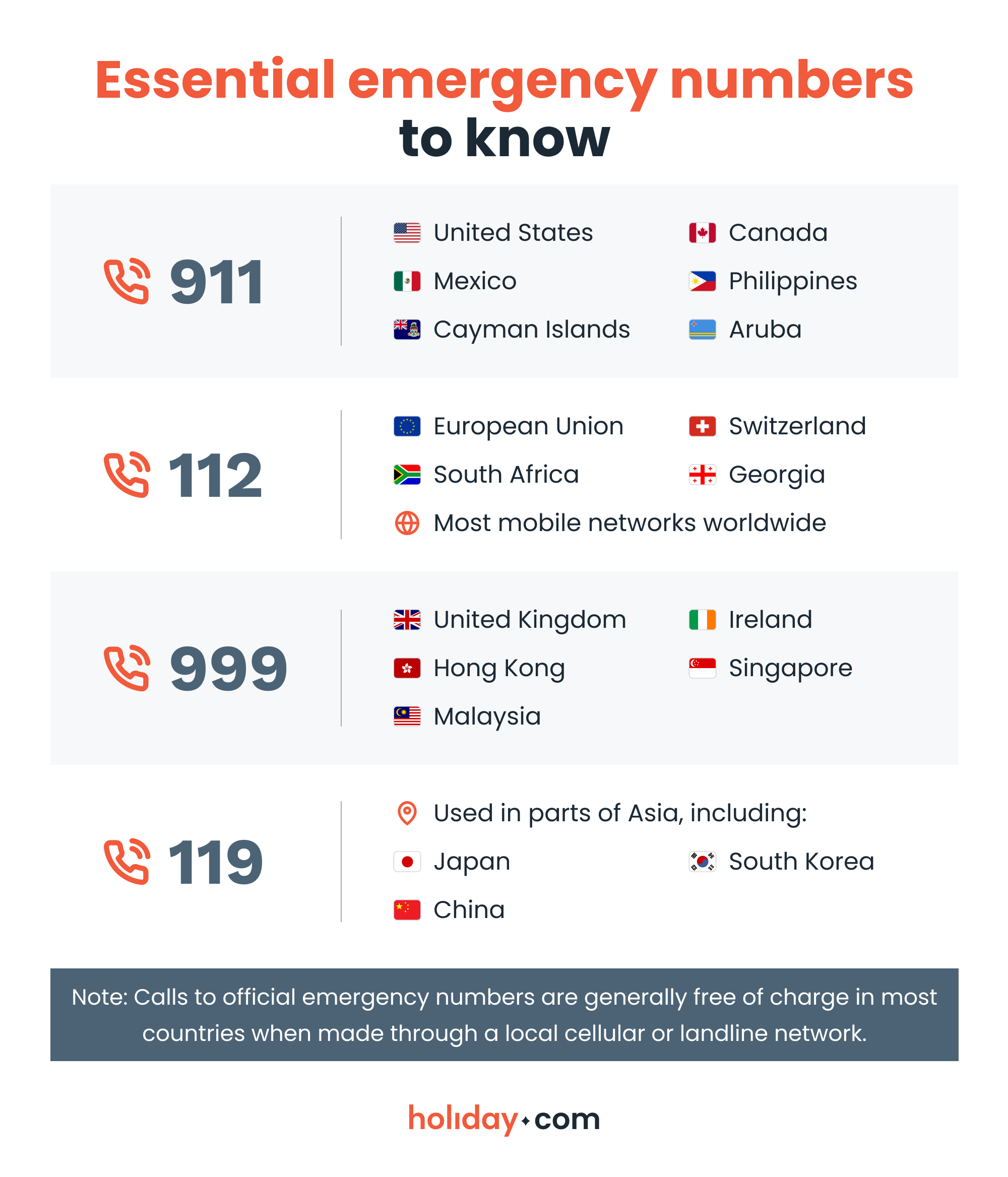
In some countries, dialing 911 or 112 from a mobile phone may automatically redirect your call to the local emergency service, but this doesn’t always work. To avoid delays, don’t rely on forwarding. Instead, check the official numbers for police, fire, and medical services in your destination before you travel.
Every country maintains its own official emergency numbers, but a few are recognized around the world. Knowing them in advance can save precious time if you ever need help.
What number should you call for different emergencies?
If you need help while traveling abroad, the emergency number to call depends on the country you’re in. While many countries use 911, 112, 999, or 119 to connect callers with the police, emergency medical services, or the fire department, not all do. Because emergency systems vary globally, you should always confirm the local emergency numbers for your destination before you leave.
North, Central, and South America
911 is the predominant emergency number in the Americas, but some Central and South American countries have their own numbers that can allow you to reach the proper services more quickly.
North America
| Country | Police | Ambulance | Fire |
| Canada | 911 | 911 | 911 |
| Mexico | 911 | 911 | 911 |
| United States | 911 | 911 | 911 |
Central America
| Country | Police | Ambulance | Fire |
| Belize | 911 | 911 | 911 |
| Costa Rica | 911 | 911 | 911 |
| El Salvador | 911 | 132 | 115 |
| Guatemala | 110 | 122 | 123 |
| Honduras | 911 | 911 | 911 |
| Nicaragua | 118 | 128 | 118 |
| Panama | 104 | 911 | 103 |
South America
| Country | Police | Ambulance | Fire |
| Argentina | 911 | 107 | 100 |
| Bolivia | 110 | 118 | 119 |
| Brazil | 190 | 192 | 193 |
| Chile | 133 | 131 | 132 |
| Colombia | 123 | 123 | 119 |
| Ecuador | 911 | 911 | 911 |
| Guyana | 911 | 911 | 911 |
| Paraguay | 911 | 911 | 911 |
| Peru | 105 | 106 | 116 |
| Suriname | 112 | 112 | 112 |
| Uruguay | 911 | 105 | 104 |
| Venezuela | 911 | 171 | 171 |
Europe
112 works in all EU countries, as well as Albania, Armenia, Georgia, Moldova, Iceland, North Macedonia, Montenegro, Liechtenstein, Norway, Serbia, Switzerland, Turkey, the UK, and Vatican City.
Some EU countries also have additional numbers, but not all. For example, Germany reserves 110 for police, while there are no Netherlands emergency numbers beyond 112.
112 may redirect you to the proper authorities in other countries, but here are some important alternate numbers to remember when traveling in Europe:
| Country | Police | Ambulance | Fire |
| Andorra | 110 | 116 | 118 |
| Armenia | 102 | 103 | 101 |
| Azerbaijan | 102 | 103 | 101 |
| Belarus | 102 | 103 | 101 |
| Bosnia and Herzegovina | 122 | 124 | 123 |
| Kosovo | 192 | 194 | 193 |
| Russia | 102 | 103 | 101 |
| San Marino | 113 | 118 | 115 |
| Ukraine | 102 | 103 | 101 |
Asia
Asian countries use a wide variety of different numbers, so it’s a good idea to look up the info for whatever country you’re visiting. For example, there are several emergency helpline numbers in India, including a specific number for tourists (1363), but 112 is the primary number and the easiest to remember.
Here are the emergency numbers for Asia’s most popular destinations:
| Country | Police | Ambulance | Fire |
| China | 110 | 120 | 119 |
| Thailand | 191 | 1669 | 199 |
| Japan | 110 | 119 | 119 |
| Malaysia | 999 | 999 | 999 |
| Hong Kong | 999 | 999 | 999 |
| Vietnam | 113 | 115 | 114 |
| India | 112 | 112 | 112 |
| South Korea | 112 | 119 | 119 |
| Indonesia | 110 | 118 | 113 |
| Singapore | 999 | 995 | 995 |
Australia and Oceania
In Australia and the surrounding region, 911 is generally an effective way to reach emergency services, but here are the standard numbers in Oceania’s top destinations:
| Country | Police | Ambulance | Fire |
| Australia | 000 | 000 | 000 |
| New Zealand | 111 | 111 | 111 |
| Fiji | 911 | 911 | 911 |
| Papua New Guinea | 112 | 111 | 110 |
Africa and Middle East
Many African and Middle Eastern countries don’t rely on popular global emergency numbers like 911 or 112. For best safety practices, you should know all the various numbers for the country you’re visiting. In these regions, it’s particularly important to have a translation app on hand due to language barriers when speaking to providers.
| Country | Police | Ambulance | Fire |
| Algeria | 1548 | 14 | 14 |
| Egypt | 122 | 123 | 180 |
| Israel | 100 | 101 | 102 |
| Kenya |
112 or 999 or 911 | 112 or 999 or 911 | 112 or 999 or 911 |
| Morocco | 19 | 15 | 15 |
| Saudi Arabia | 999 | 997 | 998 |
| South Africa | 10111 | 10177 | 10177 |
| Tanzania | 112 | 114 | 115 |
| Tunisia | 197 | 190 | 198 |
| United Arab Emirates | 999 | 998 | 997 |
Hot tip
Countries with extensive coastlines and mountainous terrain often have special numbers for mountain and maritime rescue.
- Alpine rescue: Austria (140), Switzerland (1414), Italy (118), France (15), and Canada (5555).
- Maritime rescue: Canada (16), France (196), Greece (108). In the USA, the coast guard monitors radio frequencies and digital distress signals.
Why do emergency numbers change from country to country?
Just as countries adopted different electrical plugs or rail gauges, they also built their public safety systems independently. By the time mobile phones became common and international cellular standards began to align, most nations already had emergency numbers and dispatch systems in place.
Several practical factors explain why the fragmented emergency number systems travelers encounter today are so difficult to update:
- Legacy infrastructure. Emergency calls travel through networks operated by mobile carriers and landline providers. These include cellular technologies such as 3G, 4G, and 5G, along with GSM networks and older landline systems that many countries still rely on to support national emergency services.
- Prohibitive cost. Emergency numbers connect to national dispatch centers that coordinate police, fire services, and ambulances. Updating the call routing software and training procedures across an entire region can be expensive.
- Logistical complexity. Retrofitting a nationwide public safety system requires coordination between governments, telecommunications providers, and emergency teams, meaning it’s not a quick or simple process.
How to get help when you don’t speak the local language
A language barrier can make it much harder to get help in an emergency. If you can’t clearly explain your location or the type of assistance you need, it may take responders longer to reach you.
These simple strategies can help you communicate more effectively when you need help in a foreign country:
- Use a translation app. Install a translation app on your smartphone before your trip. It can help you translate basic phrases if you and the emergency operator don’t share a common language.
- Keep your message simple. Use short, direct phrases when you speak with emergency operators. Start by stating the type of emergency, such as police, ambulance, or fire. Then explain your situation and share your location.
- Share nearby landmarks. If you don’t know the exact address, describe what you see around you. Mention nearby landmarks, such as a train station, hotel, or well-known building.
- Use location tools on your phone. Open a mapping app and check your location. Sharing your coordinates or nearby address can help responders find you faster, especially in unfamiliar or remote areas.
To travel smarter, prepare for emergencies before you go
The best way to handle a crisis abroad is to prepare before your trip begins. A few simple steps can make a big difference if something goes wrong.
- Create an emergency contact file. Save a note on your phone or carry a small card that lists your blood type, allergies, medications, and emergency contacts at home.
- Save embassy information. Keep the address and phone number of your country’s nearest embassy or consulate on your phone and laptop. Embassy staff can help if you lose your passport, face legal trouble, or experience a serious emergency abroad.
- Plan for reliable connectivity. Without mobile data, you can’t use translation or mapping apps. Arrange for reliable mobile service with a travel eSIM like holiday.com before you depart so your phone can connect to the local network as soon as you arrive.
- Download maps for offline access. As an extra precaution, save offline maps before heading out, especially for outdoor activities. You’ll still be able to view your location even if your cellular connection is weak.
Final tips for safe travel abroad
Travel emergencies are rare, but they happen. Being prepared can make a stressful situation much easier to handle.
Before your trip, save the local emergency numbers for your destination in your phone’s contact list, including police, ambulance, and fire services. If you plan outdoor activities like skiing, hiking, or sailing, it’s also worth checking whether there are separate mountain or maritime rescue numbers.
Keep a few other important contacts stored in your phone as well, including your embassy, travel insurance provider, and a trusted contact at home. Knowing who to call and how to reach them can make all the difference if something unexpected happens while you’re abroad.
FAQ
-
Are 911 and 112 universal emergency numbers?

No. Emergency numbers vary by country. While the United States uses 911 and 112 works across the European Union, they’re not universal. Many countries use completely different numbers. That’s why it’s important to check the correct emergency numbers for your destination before you travel.
-
Are emergency calls free worldwide?
In most countries, emergency calls are free when made from a mobile or landline phone. However, coverage and access can vary depending on the country and network. If you’re traveling internationally, you must be able to connect to a local network in order to place the call.
-
What languages do emergency operators typically speak?
Emergency operators usually speak the official language of the country you’re in. In many tourist destinations, operators may also speak English or French or have access to translation services, but this isn’t guaranteed. Using simple phrases or a translation app can help you communicate more clearly.
-
Should you save local emergency numbers before traveling?
Yes. Before you set off, save local emergency numbers to call for help if something goes wrong. Store numbers for police, ambulance, and fire services in your phone so you don’t have to search for them during a stressful situation.
-
When should you contact your embassy in an emergency?
You should contact your embassy if you lose your passport, get arrested, experience a serious accident, or need help during a major crisis such as natural disasters or civil unrest. Embassy staff can help you replace travel documents, contact family members, and guide you through local procedures.
-
Should you enable location services on your phone in an emergency?
Yes. Enabling location services makes it easier for emergency responders or dispatchers to identify your location. It also allows you to access accurate GPS coordinates and directions when using mapping apps that you can share when asking for help.
-
Do USA emergency numbers work internationally?
In most countries, dialing 911 won’t connect you to emergency services. Your call might redirect to a local emergency number, but you shouldn’t rely on this. Instead, confirm local emergency numbers for the country you’re visiting and add them to your phone’s contacts so you can quickly call when you need help.
About our author

You might also be interested in...
-
 Safety
How to stay safe while traveling: A practical guide for 2026
Traveling puts you in unfamiliar environments where many things can go wrong. A stolen bag or a compromised digital account can quickly derail your trip. Many travelers assume safety means avoiding ri...
 Sarah Kirton
 05.26.2026
 -
 Safety
Is hotel Wi-Fi safe? What you should know and real-world risks
Travelers commonly log into hotel Wi-Fi without giving a second thought to the potential security risks. Public sources of Wi-Fi, including at hotels, can be vulnerable to cyberattacks. This could exp...
Chené Murphy
05.26.2026 -
 Safety
Is airport Wi-Fi safe? Avoid common scams in 2026
When you’re stuck in an unexpected layover or need to book a ride to the hotel, connecting to the free airport Wi-Fi seems like the fastest solution. The truth is that public networks can put your d...
Ivana Shteriova
05.21.2026 -
 Safety
30+ common travel scams to watch out for abroad
Travel scams can be hard to spot. Scammers often operate out of sight, or greet you with a warm smile as they present an offer that sounds too good to miss. They take advantage of the fact that you’...
Aishah Mustapha
05.15.2026 -
 Safety
Hotel safety tips: The ultimate guide in 2026
Staying in a hotel should feel relaxing and serve as a main highlight of your trip. But even the best properties can pose safety risks. It’s not just theft that can turn the perfect getaway into a s...
Sarah Kirton
05.12.2026 -
 Safety
Is public Wi-Fi safe? The risks you need to know
Public Wi-Fi feels convenient, but it’s not always safe to use. The biggest problem with most public networks is that they use weak security or no encryption at all. Encryption protects the data tra...
Sarah Kirton
04.27.2026