


If you’re a frequent international traveler, you’ve probably encountered GSM before. Whether you knew it, GSM plays an important role in keeping you connected when you travel abroad. But what exactly are we talking about when we refer to GSM?
Global System for Mobile Communications (GSM) set the stage for second generation cellular networks, known as 2G. It was the first widely adopted digital network that worked across multiple countries, carriers, and device manufacturers. It replaced fragmented national systems with a shared technical framework, making it easier to stay connected between countries.
Some mobile carriers around the world have begun to phase out GSM in favor of the newer, flashier networks like 4G and 5G. However, GSM’s 2G networks are still in use in many regions, and the technology remains relevant for international travel.
We’ll show you why GSM plays a vital role in global connectivity, where in the world GSM networks are most prevalent today, and how it can affect speeds and performance when using an eSIM. We’ll also help you make the most of your eSIM in countries and regions that still rely on GSM for full or fallback coverage.
GSM established 2G cellular networks
While fourth or fifth generation networks (4G and 5G) are well known, GSM was the second generation that laid the groundwork for modern digital networks in the early 1990s. Despite its age, GSM is still in use around the world and comes in handy for global travelers who want to stay connected.
How GSM networks function
When you turn on your phone, a GSM network uses your phone’s SIM card or eSIM to verify your subscriber information and confirm you’re allowed to connect to your carrier network. Once authenticated, your phone connects wirelessly to nearby cell towers, which provide coverage for a specific area.
The GSM network tracks your location across coverage areas and switches your connection between its cell towers, making features like uninterrupted calls, consistent data access, and international roaming possible.
Why GSM became the global standard
The first commercial GSM network launched in Europe in 1991, marking a major turning point in mobile communication. It replaced the various national analog systems across the continent, which were incompatible with each other. Essentially, it established a single, unified mobile network system.
GSM’s digital signals had other practical benefits over the first-generation analog systems as well. Digital cell networks support clearer calls, better security measures, and more efficient use of the radio spectrum. GSM also introduced the SIM card, which allowed users to keep their phone number and service independent of the physical device.
Throughout the 1990s, GSM adoption spread beyond Europe into Asia, Africa, the Middle East, and parts of the Americas. Manufacturers built phones for GSM, carriers invested heavily in GSM infrastructure, and roaming agreements expanded worldwide. As more countries adopted GSM, it became the default global standard for mobile communication, laying the groundwork for later technologies such as 3G, 4G LTE, and today’s 5G networks.
GSM is slower than newer network generations
For many years, GSM formed the backbone of global mobile connectivity and the early stages of mobile data usage. It introduced SIM-based user identification and operated on standardized frequency bands, but its 2G technology only supported voice calls, text messaging, and basic data use.
Other network types emerged as mobile usage evolved and data demands increased. Code-division multiple access, or CDMA, used a different method to authenticate and manage multiple users and delivered faster 3G speeds, though it never expanded beyond North America and parts of Asia. Newer 4G and 5G technologies offer increased speeds, lower latency, and better support for modern mobile usage.
GSM vs. CDMA vs. 4G vs. 5G
The table below highlights how GSM compares with these network types in terms of performance, compatibility, and real-world relevance for travelers.
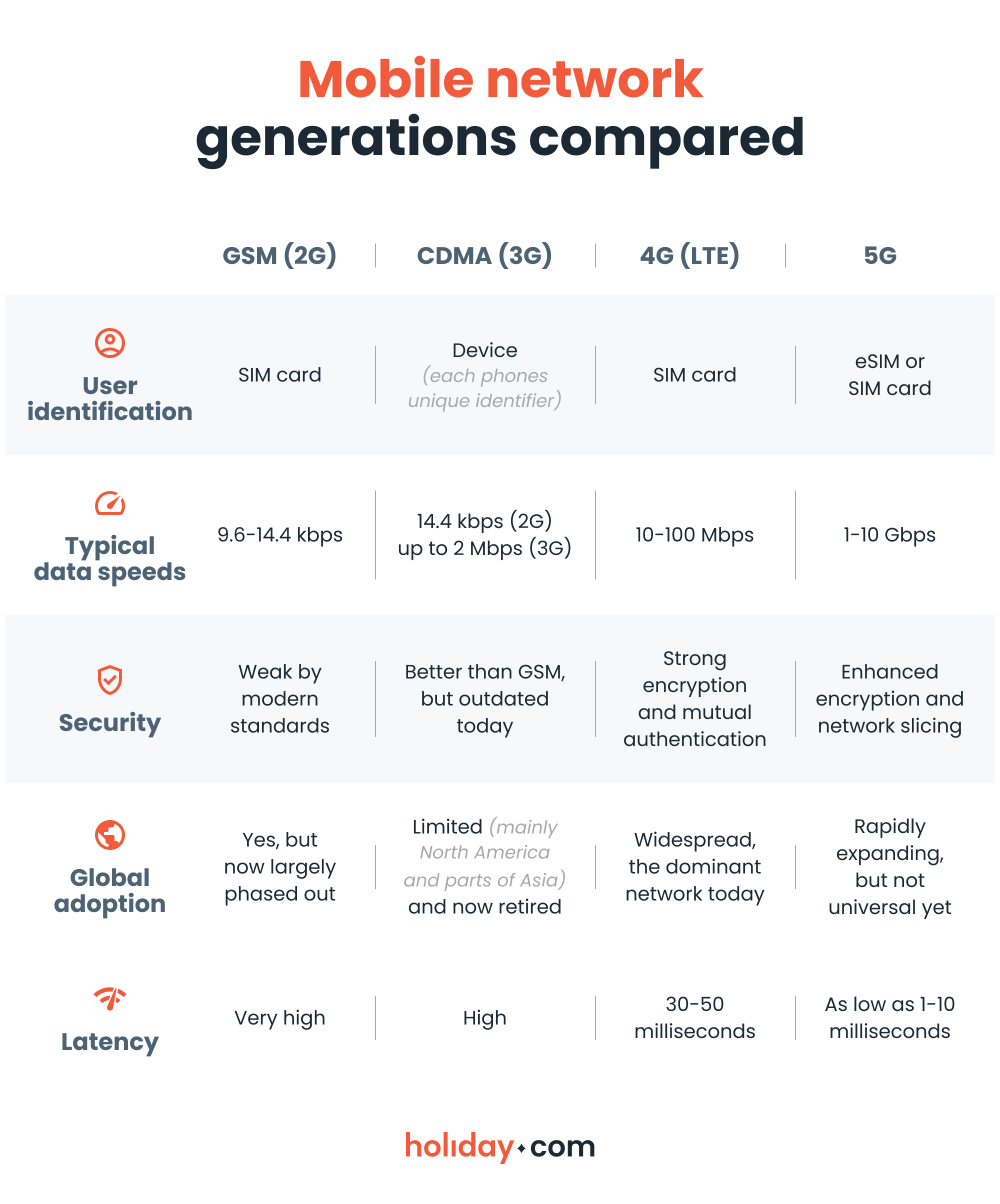
GSM and eSIM: What you need to know when traveling
For modern travelers using eSIM-compatible phones, GSM’s relevance is less about compatibility and more about performance. In regions where GSM is still used, eSIMs provide coverage but will default to the GSM network when faster options are unavailable.
If you’re using an eSIM in a GSM-dependent region, expect slower data speeds, higher latency, and more limited support for data-heavy activities like video streaming or hotspot use.
Travelers shouldn’t assume their eSIM can provide consistent 4G or 5G speeds everywhere and plan for slower connections in rural or less developed areas.
HOT TIP
For the best travel experience, you should preload maps, download tickets or boarding passes in advance, and enable low-data modes on apps. While your eSIM will still connect, its performance will depend on the local network infrastructure rather than the eSIM itself.
GSM is still useful in many regions
Even though much of North America and Europe are phasing out GSM networks, the technology remains relevant in parts of the world where network upgrades are still in progress. GSM continues to support parts of Africa, the Middle East, Asia, and South America. GSM also functions as a fallback network, helping maintain coverage in areas that limit or don’t offer advanced networks.
Tips for using an eSIM in GSM-reliant or fallback regions
- Make sure your phone hardware supports 4G LTE and 5G networks, so your eSIM can connect to these faster bands when available.
- Count on reduced or no performance for streaming, video calls, and large downloads, depending on network availability.
- Use messaging apps optimized for low bandwidth, including WhatsApp, Telegram, and Gmail in plain text mode.
- Download maps, tickets, and other important digital items before arrival.
- Use secure Wi-Fi when available for data-heavy tasks, but not for sensitive tasks or financial transactions.
GSM won’t be around forever
GSM is no longer the primary technology powering modern mobile networks, but it hasn’t disappeared entirely. In many regions, it remains in use as a legacy network for basic voice and text services or as a fallback where newer infrastructure is still expanding. However, as mobile operators continue to reallocate spectrum to faster, more efficient 4G and 5G networks, GSM’s phase-out will accelerate.
For travelers, this means GSM will matter less each year. Modern smartphones using eSIMs will connect to LTE or 5G, even if GSM is still present. Older GSM-only phones may face limited coverage or stop working altogether as legacy networks shut down. GSM is in a transitional phase right now, as it’s still relevant in specific regions while steadily giving way to newer global standards.
Why understanding GSM is important for international travel
Knowing how GSM fits into the global mobile landscape helps travelers set realistic expectations about connectivity. If you’re using a GSM phone, expect limited coverage in countries that are phasing out GSM or no service at all where it’s shut down. Even purchasing a modern SIM card won’t allow you to connect to 4G/5G networks, because GSM phones lack up-to-date technology.
If you have a modern smartphone with eSIM support, GSM will have a different impact. Your phone supports multiple network standards and will automatically use GSM where it’s still the primary network, or switch to 4G LTE and 5G when available. In regions where GSM remains active, your phone’s built-in eSIM or a travel eSIM will still provide reliable connectivity, especially for basic service.
FAQ
-
How do you confirm your phone is GSM-compatible before you travel?

The easiest way to confirm GSM compatibility is to check your phone’s device settings. You can also check your phone manufacturer’s website to confirm support for GSM networks.
-
Will an eSIM work in countries using GSM for mobile connectivity?
Yes, an eSIM will work in countries that still use GSM, such as those in Africa, the Middle East, and Asia. GSM is the type of network your phone connects to, while an eSIM stores your subscriber information digitally. From the network’s perspective, an eSIM works just like a physical SIM, so you can make calls, use data, and stay connected on GSM, 4G, and 5G networks.
-
Can an older phone that uses GSM technology use an eSIM?
No. Your device’s ability to use an eSIM depends on whether your phone’s hardware supports the modern 4G/5G network standards used by eSIMs. Older GSM-only phones will have limited functionality globally and will only support phone calls and text messaging (SMS).
-
Does GSM matter if I’m traveling with an eSIM instead of a physical SIM?
This depends on the country or region. Most modern iOS and Android devices are compatible with GSM technology, so your eSIM can connect to local GSM networks if you’re in an area that doesn’t have newer technologies available.
-
What are the disadvantages of GSM?
GSM has several disadvantages when compared to modern 4G and 5G networks, including slower speeds, increased latency, and security flaws. In part, that’s because GSM is for voice calls and messaging and not equipped to support the modern mobile data user. While GSM laid the foundation for global mobile connectivity, it is no longer the most advanced network technology available today.
About our author

You might also be interested in...
-
 Glossary
What is data roaming and how does it work?
You step off the plane in a new country, open Google Maps or check your messages, and everything works like normal. What you may not see is how quickly those small actions can add up to big expenses w...
 Ana Marković
 06.09.2026
 -
 Glossary
What is a nano SIM card? Features and compatibility
If you’re buying a new phone or getting a new SIM card for any reason, using the correct size is vital for proper functionality. SIM cards come in multiple sizes like standard and micro, but these c...
Ivana Shteriova
06.08.2026 -
 Glossary
eKYC verification: What is it, when you need it, and how to do it
Seeing “Verification Failed” on your phone screen can be a major disruption to your plans. If you have to complete a facial scan to activate an eSIM or access international funds, an unsuccessful ...
Sarah Kirton
06.04.2026 -
 Glossary
What is a SIM card? How SIM technology works
A subscriber identity module (SIM) card is inside almost every mobile phone, yet most people never think about what it does or what it contains. Simply put, it keeps your device connected to a mobile ...
Jelena Relić
06.04.2026 -
 Glossary
What is an APN and how to fix connection errors
There’s nothing more frustrating than seeing full signal bars on your phone while your internet refuses to load. You might be able to make calls or send texts, but your browser, maps, and apps remai...
Jelena Relić
06.01.2026 -
 Glossary
What is mobile internet? A traveler's guide to staying connected
When you check Google Maps in a new city, send WhatsApp messages, or scroll through Instagram Reels on the go, you’re using mobile internet. Mobile internet (also called mobile or cellular data) con...
Sarah Kirton
05.13.2026