

Travel scams can be hard to spot. Scammers often operate out of sight, or greet you with a warm smile as they present an offer that sounds too good to miss. They take advantage of the fact that you’re in an unfamiliar environment, dealing with language barriers, jetlagged, or have your guard down while on holiday.
You can be the target of a travel scam as early as the booking process. According to a 2025 McAfee survey, one in five Americans reported being a victim of booking scams, where nearly a quarter lost money. Whether it’s an online scam, a street con, or an inflated bill, many scams follow similar patterns, so understanding some basic tactics will help you spot them more easily.
From subtle misdirection to bold deception, this guide outlines common travel scams and offers actionable tips for a scam-free trip.
Pre-trip strategies to avoid cons and mitigate losses
A little research can protect you from falling for obvious scams. These tips will help you secure your money and belongings while traveling.
1. Empower yourself through research
Staying informed is your best armor against travel scams. Start by exploring travel forums, blogs, and government advisories, which often highlight country-specific scams. Check out official resources, for example like those for the U.S., Canada, the U.K., and Australia. And talk to friends and families who’ve been to your destination for more insight and tips.
HOT TIP
Build a “scam watchlist” filled with common cons reported at your destination. This is especially useful when visiting multiple countries.
2. Book using reputable websites
Travel scams are becoming more common as scammers use AI to devise increasingly convincing scams, especially phishing attempts designed to steal card details. To stay safe, book your trip through a trusted third-party website or directly with the airline, hotel, or transportation company. Read reviews on social media and search engines to ensure a website or service is legit, and if something feels off, call the establishment to confirm.
3. Safeguard your finances
You may need to inform your banks of the dates you’re traveling to avoid your overseas purchases being detected as fraud. Plan which cards you will be using when abroad, as different card types offer different pros and cons.
| Payment options for overseas travel | |
| Credit card | Widely accepted and typically provides greater fraud protection than debit and travel money cards, but may have higher currency exchange rates and international transaction fees. |
| Debit card | Gives you easy access to your money and is widely accepted if the bank is on Visa or Mastercard networks. A debit card has less protection for fraud charges and transferring money to your card will take time. |
| Travel money card | Lets you load money in multiple currencies and often comes with favorable exchange rates. Fees apply and transferring money into the card takes time. |
| Virtual credit card | Functions like a credit card for secure online payments, and typically comes with a short validity period for single- or multi-use. Its temporary nature, and other protections such as spending limits, make it highly secure. |
| Digital wallet | Stores your cards and money securely, requiring a PIN, password, or biometric data to access the app. It supports multiple currencies (often at lower fees than banks), and some providers offer strong fraud protection. Users typically tap to pay, but payment requires an internet connection. |
| Cash | Accepted everywhere and doesn’t come with extra charges like transaction fees. However, carrying cash can be cumbersome, can make you a prime target for theft, and requires you to find a reputable currency exchange office. |
During your trip, monitor your account by regularly checking your statements online. You may also be able to set up alerts for large transactions or set spending limits.
4. Secure your devices
Scammers can steal your phone, tablet, or laptop and gain access to your personal details and finances, so consider setting up multi-factor authentication before traveling. You can also back up files and remove sensitive data from the devices you’re taking. Taking these preemptive steps makes you far less vulnerable to loss if you’re caught in a scam.
5. Safeguard key documents
Safeguard your passport and ID documents by planning how you will carry and store them, such as in the hotel safe. Place important documents in a waterproof pouch in your handbag or backpack, and never leave them unattended.
HOT TIP
Tips for avoiding common travel scams:
- Trust your instincts
- Be wary of unreal deals
- Guard your belongings in a crowd
- Use established, reputable businesses
- Opt for secure payment methods like credit cards
- Research by looking up the company name + “scam” or “complaints”
Transportation scams
Jetlagged travelers or people in a rush are at an increased risk of transportation scams. We highlight some common cons you might encounter in taxis, ride-hailing services, and train or bus stations.
HOT TIP
Pre-book your transport to and from the airport
Rigged or broken meter scam
Taxi drivers may rig their meters or conveniently forget to reset them to inflate the fare. A rigged meter will run abnormally fast or jump drastically within a short period. Some scammers may claim the meter is broken and quote a higher-than-average fixed price.
Avoiding the rigged or broken meter scam:
- Insist on using the meter before getting in the vehicle
- Ensure the meter is reset to the base fare before starting the journey
- Check the estimated distance to your destination or research the average fare for a ballpark figure
Longer route scam
In this scam, your taxi driver takes a detour, drives around the same area, or pretends to be lost to waste time and push up the fare. They may ignore your suggested route or claim a main road is closed so they can take the longer route.
Avoiding the longer route scam:
- Use a map app to check that the driver is using the quickest route
- Ask locals or hotel staff about the estimated travel time
- Speak up if you think the driver is wasting time
No-change scam
If you pay with a large note, the driver may claim they don’t have change to pressure you into giving them a large tip. This scam isn’t unique to transport services, and you may encounter it at markets, stalls, and tourist attractions.
Avoiding the no-change scam:
- Carry small notes and coins
- Ask them if they have change before the ride
- Push back politely and insist you can wait for them to get change
"Closed" attraction scam
The driver informs you that the destination is closed, under renovation, or not worth a visit. They will then immediately suggest, at times in a pushy manner, an alternative place where they earn a commission from the owners. It’s not just taxi drivers; be wary of tour guides pulling this scam on you, too.
Avoiding the “closed” attraction scam:
- Confirm the opening hours before heading out
- Find another driver if they start to get pushy or refuse to drive to your destination
Fake driver scam
Some scammers may pretend to be a legal taxi or rideshare driver by hanging around pickup zones or touristy areas. Others may be a legitimate driver but not the driver assigned to your booking. You’re less likely to question them when you’re late, tired, stressed, or intoxicated.
Also, be cautious of any driver who asks you to cancel your ride to take your transaction off the official app; they might be trying to scam you.
Avoiding the fake driver scam:
- Don’t get into a taxi with an unregistered driver; the license should be displayed on the dashboard
- Check that the driver and car details match your booking details
- Ask the driver to quote your name and trip details from your booking
- Share your trip details with family or friends to be safe
“Bus is full” or “Ticket is required” scam
Swindlers will approach you at the bus, train, or ferry terminal to claim the ride is sold out and sell you an upgraded ticket or craft an elaborate story to sell you “discounted” tickets. In reality, this ticket is fake or invalid. They often approach you before you reach the ticket counter, sometimes wearing uniforms, and hand out tickets that appear genuine. Another scam variation is selling you tickets to a ride that’s actually free.
Avoiding the “bus is full” scam:
- Only buy from official ticket booths or channels
- Look for a staff member if a stranger approaches you trying to sell tickets
- Watch out for tickets that look fake (e.g. missing logos and typos)
Money and payment scams
Money‑ and payment-related scams are some of the most prevalent tricks travelers face. Before committing to buy or donate, understand the commonly reported scams at your destinations.
Currency exchange scam
Fraudsters set up currency exchange booths with attractive rates and use counterfeit money or misdirection to shortchange you. Some will even approach you at popular attractions and transport hubs. Another payment scam involves legitimate companies charging a high commission fee without informing you beforehand, or giving a terrible exchange rate after assuring you of the “best” rate in the area.
Avoiding the currency exchange scam:
- Research average exchange rates beforehand
- Deal with reputable currency exchanges that don’t charge fees
- Check your cash before leaving the premises
Dynamic currency conversion scam
Some shops or restaurants may offer payment in your home currency instead of the destination’s currency. While this can be a convenience, watch out for exorbitant exchange rates or high, unstated fees.
Avoiding the dynamic currency conversion scam:
- Always pay in the local currency and at your bank’s exchange rate
- Opt for a prepaid travel card with better exchange rates
- Check the receipt to confirm no conversion fee was applied
ATM card-skimming scam
Fraudsters affix card readers or cameras to an ATM to skim your card details and PIN. Alternatively, you may encounter scammers standing close to you in crowded tourist areas to look at your PIN, a method called shoulder surfing.
Avoiding the ATM card skimming scam
- Use ATMs inside banks or financial institutions
- Examine the ATM for signs of tampering
- Cover the keypad when keying in your PIN
- Use an RFID-blocking sleeve or wallet to prevent card-scanning scams
Fake QR code scam
Scammers take advantage of the widespread use of QR codes by placing fake codes in public areas, such as on parking meters, posters, restaurants, and shops. The fake code installs spyware on your phone that steals your personal information or sends you to a phishing site.
Avoiding the fake QR code scam:
- Watch for tampering signs like poor printing, typos, and one sticker placed on top of another
- Confirm with a staff member if unsure or visit the official site
- Preview the code link first before clicking on it
Point-of-sale (POS) overcharging scam
A cashier may inflate your invoice by adding zeros, extra items, or tips without you realizing. Another overcharging tactic is telling you to tap your card again by claiming the transaction failed when it didn’t, effectively charging you twice.
Avoiding the POS overcharging scam:
- Check the final amount before paying
- Ask for a void receipt if the cashier says the payment failed
- Check your transactions online after paying
Dual pricing for tourists and locals
One of the most well-known travel scams involves charging tourists an inflated price compared to locals for the same service or product. This can happen in shops, bars, restaurants, markets, taxis, and at ticket booths. Note that this scam is about vendors overcharging, and not official government tariffs for tourists.
Avoiding the dual pricing scam:
- Observe what the shopkeeper is charging locals
- Ask the price upfront
- Be cautious of places without prices on display
- Save your receipts in case you need to dispute a payment
Money mule and job scams
In a money mule scam, victims are duped into doing admin or finance jobs to transfer money between accounts, including their own accounts, when they’re actually covering for money laundering activities. With job scams, scammers trick victims into traveling with the promise of a good job with benefits. Once there, scammers take away their passports and force them to do illegal work.
Avoiding money mule or fob scams:
- Be cautious of unsolicited offers coming from social media and messaging platforms
- Research the hiring company
- Seek advice from your loved ones
- Never use your account for money transfer activities
Accommodation and travel booking scams
Many travelers hunt for travel deals online and rely on third-party booking sites to find them. While 59% of Americans say they trust these sites, scammers are busy creating fake sites, listings, and deals to trick people keen on grabbing a bargain.
HOT TIP
Use secure, traceable payment methods, such as credit cards with fraud protection, when booking accommodations and tours.
Fake booking sites, accommodation listings, and travel agencies
Fake booking sites and accommodation listings are common scams in which you not only lose money, but also risk exposing your personal data to scammers. Watch for fake travel and tour agencies, too. Hong Kong, Barcelona, and Delhi are all hotspots for this type of travel scam.
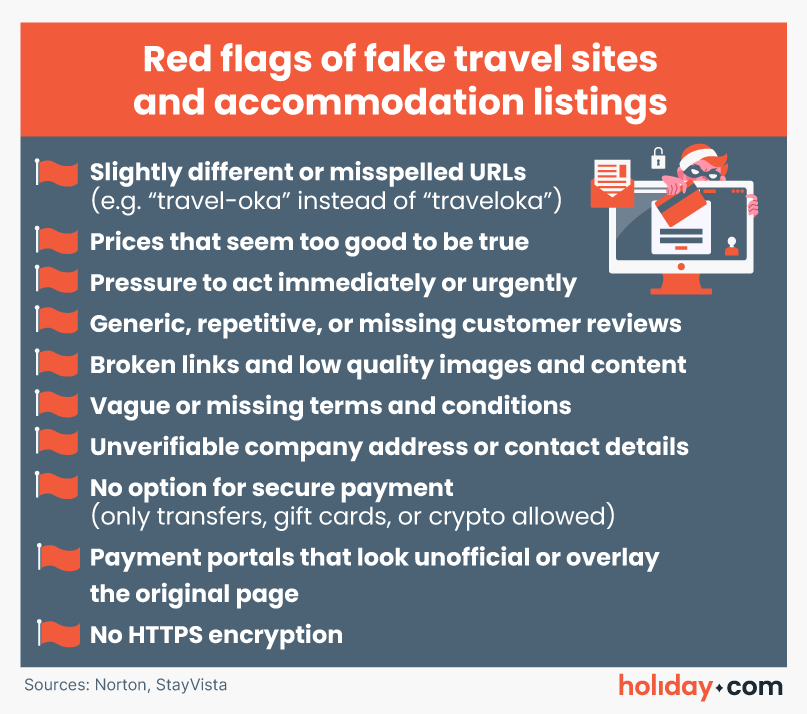
Other variations of this con include listing properties that are either non-existent or unavailable for rent, or double-booking guests into the same location. Scammers may also use photos that look nothing like the property — which is usually in a run-down state — and charge an exorbitant price for it.
Avoiding fake websites and listings:
- Type in the URL yourself or only click on links from official channels
- Use secure digital payment methods instead of bank transfers
- Call the company to check that the link or channel is legitimate
Account takeover scam
The account takeover scam is harder to spot as it involves scammers hacking into the account of a hotel or transport company, sometimes on a legitimate platform, and posing as an employee. They will then message you using legitimate-seeming credentials, claiming there’s a payment issue to get you to reveal your card or bank details.
In other cases, scammers hijack accommodation listings and rent out the property illegally, taking your money but not providing the accommodations.
Avoiding the account takeover scam:
- Watch out for pushy language and poorly written messages
- Don’t click on payment links or share card details through emails or messages
- Use a different, valid form of contact to confirm with the company or host if you suspect something is amiss
- Book accommodations through official sites that take payment upon arrival
Hotel desk scams
Hotel desk scams involve someone pretending to be from the front desk or a staff member calls you. They’ll likely invent a story about a payment problem to get you to pay or disclose your credit card or bank information over the phone. Legitimate hotel employees will almost always ask you to pay at the front desk.
Avoiding the hotel desk scam:
- Hang up and call the front desk if the caller requests payment
- Never divulge your card or bank details over the phone
Fake housekeeping or maintenance staff
Con artists pretending to be from the housekeeping or maintenance team will knock on your door to do light cleaning or inspection. One person will distract you, while the other will snoop around or steal your valuables or passport.
Avoiding fake housekeeping staff:
- If you didn’t ask for cleaning or maintenance, don’t let them in; instead talk to the front desk
- Don’t leave your valuables lying around; use the hotel safe
Street scams
Petty pickpocketing and phone grabbing can be common in crowded areas, but the schemes listed here involve more elaborate ruses.
“Free gift” scam
More common in tourist traps, this scam involves a “friendly” person giving you a “free” gift like a necklace or small trinket, sometimes placing it on you. Once you indicate acceptance, they then demand payment. If you refuse, they’ll either try to gain your sympathy with a made-up story or kick up a fuss to embarrass you into paying.
People running this scam often work in pairs or groups, with more sympathetic members running the con, and more intimidating members pressuring targets into paying. They choose victims who seem to be easy targets to either approach, to increase the pressure to pay.
Avoiding the free gift scam:
- Politely decline any free item and walk away
- If someone places a gift on you or puts it in your hand, give it back to them quickly or place it on the ground
- Don’t engage further with them
Fake charity scam
Swindlers will try to solicit donations from you for their fake charity, often asking for cash or gift cards to avoid a digital trail. Some pose as street collectors, wearing vests or shirts with logos to appear as a genuine representative of a real organization. This scam can sometimes be elaborate with fake professional-looking websites and brochures.
Avoiding the fake charity scam:
- Be wary of pressure tactics
- Research the charity they claim to represent, and don’t rush to donate
- Request their ID to verify their claim as a representative
- Donate directly through official channels instead
Distraction and pickpocketing scams
Pickpockets are everywhere, but scam artists will create a distraction to steal your valuables. Working in teams, they’ll put on a performance, stage a fight, or bump into you to divert your attention. This scam is common in crowded touristy areas — one study ranked Bangkok, Paris, and Prague as the top 3 cities with the highest rate of pickpockets.
Avoiding the distraction and pickpocket scam:
- Use an anti-theft bag with features like slash-resistant fabric and lockable zippers
- Keep your wallet and other valuables in a front pocket (if you lack an anti-theft bag)
- Wear backpacks on your front and position sling bags where you can see them
- Stay alert when walking in crowded places like train stations, markets, and major tourist attractions.
Fake police officer scam
Scam artists pose as police officers patrolling tourist areas and try to rob you through various cons such as issuing a fake fine or asking to see your wallet or phone. They may have an accomplice who helps them appear legitimate by pretending to be questioned.
Avoiding the fake police officer scam:
- Stay calm and ask for their IDs
- Never give them your wallet, phone, passport, or valuables
- Try to move to a well lit and crowded area
- If possible, contact the local law enforcement office to verify their identity
Photo-taking scam
This scam takes different forms but they all involve taking photos and demanding money or stealing from you. One method involves a scammer volunteering to take your photo with your phone and then aggressively asking for money, or simply running off with your device. Another tactic is asking you to take a photo of them with their device and then claiming you damaged it.
Avoiding the photo-taking scam:
- Decline if others want to take a photo of you or vice versa
- Don’t hand your camera or phone to strangers
Rigged street game scam
Believed to date back millennia, the “cup and ball” con is a rigged street game that has the victim bet on which upside-down cup contains a ball. The operator uses sleight-of-hand tricks and misdirection to make sure you always lose your bet.
This racket typically involves an accomplice who encourages you to bet by “gambling” with you or who picks your pockets when you’re distracted. The “cup and ball” is only one variation; you may encounter other games that are essentially the same sham.
Avoiding the rigged street game scam:
- Refrain from participating in or betting on street games
- Only engage in licensed entertainment
- Watch the game from a distance if you’re curious
Attraction, tour, and activity scams
Tourists are often excited to try new activities and explore new places to make the most out of their trip. However, scammers prey on tourists who are unfamiliar with local customs, laws, and pricing.
Fake tour guides
A fake tour guide will typically approach you to offer tours or promise “exclusive” access, but the tour or package doesn’t exist. Alternatively, they may offer to bring you to the “best” restaurants and shops, where they secretly earn a commission.
Avoiding fake tour guides:
- Request to see their ID, company details, and license (if applicable)
- Hire guides from accredited tour companies, hotel desks, or legit websites
- Avoid pressure tactics and tours that are redirected or cash only
Ticket scam
Fraudsters often operate near major attractions and public transport hubs, targeting people looking for a hassle-free, quick way to buy attraction or event tickets. They then sell fake or invalid tickets at a steep discount or at an inflated price with empty promises of exclusive benefits.
Avoiding the ticket scam:
- Only buy tickets at official counters or through official channels
- Research typical prices so you can easily spot a con
Equipment and vehicle rental scams
A rental company may lease you a vehicle or equipment with existing damage in the hope you won’t realize it, and then demand compensation when you return it. Another variation is to demand your passport as collateral when you sign the lease, claiming it’s standard practice. They will then refuse to return your passport after faking damage.
Avoiding equipment and vehicle rental scams:
- Inspect and take pictures or videos of the item before signing the lease and after returning it
- Return the item in person, so the employee can inspect it and provide a receipt to prove you have returned it in good condition
- Never give your passport to rental companies
Restaurant and nightlife scams
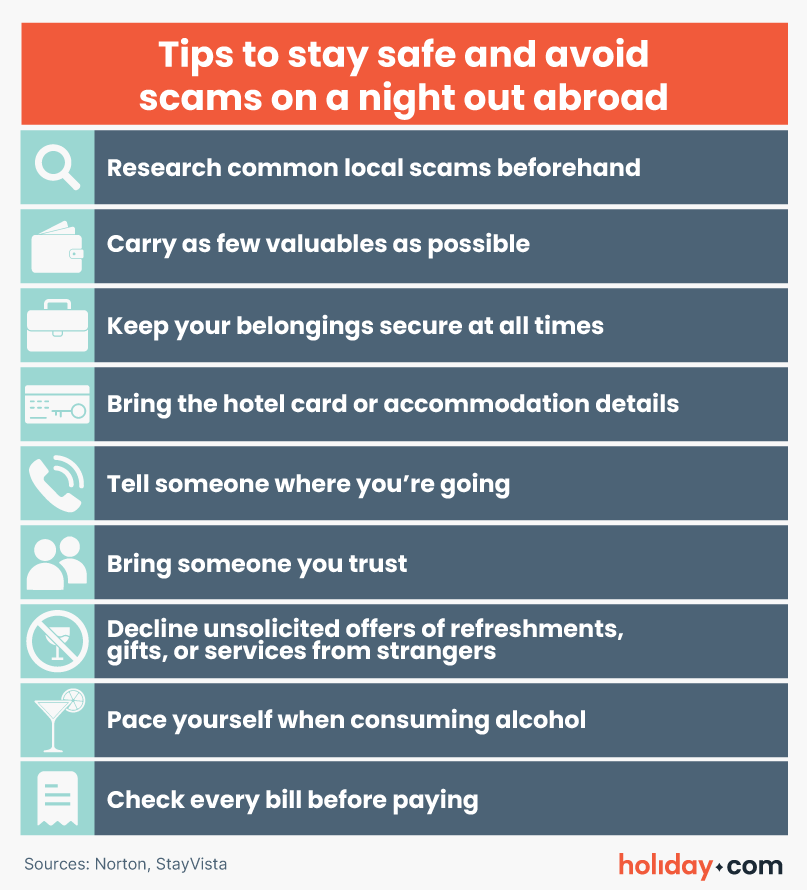
Shady establishments exploit tourists by inflating bills, or worse, by spiking their drinks to take advantage of them. Learn common scams used to lure unsuspecting travelers, and stay safe on a night out.
Inflated bill scam
Some dining venues inflate their rates for tourists. You might see a different menu, vague pricing, or an unexpected surcharge when the bill arrives. Other tactics include pressuring you with a made-up minimum spend rule or placing “complimentary” items that appear as charges later. You might also encounter this scam in shops and markets.
Avoiding the inflated bill scam:
- Always get a menu with prices
- Ask about any tax, surcharge, or other line items before ordering
- Request an itemized bill and review it carefully
- Refuse items you didn’t order, like “free” appetizers
Friendly invitation scam
A “friendly” local will try to befriend you and then invite you to a “great place,” such as a nightclub, bar, or restaurant. Once there, you’re encouraged to order many things — usually overpriced — or the staff will give you items without asking, resulting in an exorbitant bill. If you question it, staff members will intimidate you into paying or threaten to call the police.
Avoiding the friendly invitation scam:
- Familiarize yourself with local pricing
- Decline invitations from strangers who are eager for you to check a place out
- Refuse unsolicited drinks or food
- Ask for a menu with prices and review the bill
Drink spiking and theft scams
This is a dangerous scam that lures tourists into a venue with the promise of “free” drinks or other benefits. The shady operator will then spike your drink and rack up charges on your credit card while you’re intoxicated. Victims have also reported losing cash or money from their bank accounts.
Avoiding the drink spiking scam:
- Never accept a free drink from strangers, including bartenders
- Don’t leave your drink unattended or share drinks
- Avoid bringing multiple cards or your passport
- Bring someone you know on a night out, if possible
Digital and online scams targeting travelers
Before you sign up, log in, or pay online, read these common cons designed to steal your money, data, or identity.
Fake Wi-Fi scam or snooping
Free Wi-Fi is handy, but watch out for fake hotspots. They allow scammers to redirect your connection through their portal or intercept your traffic to obtain personal data such as login credentials, card details, and emails. One red flag is when the network asks for card details or requires you to download an app when connecting. However, note that cybercriminals might still be able to snoop on your activity even on legitimate public Wi-Fi networks.
Avoiding the fake free Wi-Fi scam:
- Don’t connect to a hotspot that requires credit card details
- Never input card details or passwords while using an unsecured network
- Disable automatic connection so your device won’t connect without you realizing
- Use a virtual private network (VPN) that encrypts your data
- Ask trustworthy people, like hotel staff, if there is reliable Wi-Fi
Fake travel apps
Some people rely heavily on travel apps, a fact that scammers exploit by creating fake apps that mimic a real one. Using these fake apps exposes your personal details to scammers or to malware hidden within them.
Avoiding fake travel apps:
- Only download apps through official stores
- Search the company details to see if it matches the app
- Use antivirus software on your device
- Restrict access to the microphone or camera to be safe
Social engineering scam
Con artists will befriend you and use social engineering tactics to extract as much personal information as they can. They have likely done their research on you, such as trawling through your social media. This con doesn’t solely target tourists, but they may be seen as “easier” targets than locals because tourists are in new countries.
Avoiding social engineering tactics:
- Limit sharing travel plans or personal details with strangers
- Only share that you’ve been to a location after leaving
- Only accept friend requests from people you know
Documentation and identity scams
Your passport and ID are among the most important documents you carry when traveling. Before sharing them with or handing them to anyone, recognize the most common tricks that scammers use.
Passport scams
Passport scams can happen online or in person. Online scams involve fake websites that look like legitimate immigration sites, or emails that look real but are fake. In-person scams involve a scammer deceiving you into handing your passport. In both cases, the goal is to steal your passport or capture the details to use for fraud.
Avoiding passport scams:
- Use only official websites when your passport is required
- Don’t give your passport to hotel staff, travel agencies, rental agencies, or strangers
- Keep your passport in the hotel safe when not needed
- Keep a digital copy of your passport in a secure location
Visa/travel authorization scams
You can apply for a visa or travel authorization through official immigration portals or use third-party service providers. However, note that there are scammers who create fake websites or pose as visa agents to steal your data and money.
Avoiding the visa/travel authorization scam:
- Go through official channels to avoid scams (and unnecessary markups)
- Double check the URL to ensure you’re on an official site
- Don’t click on links regarding visas in emails or ads
Scams at home while you’re away
Scammers can also target your home that sits empty while you’re away. Understand common at-home scams to protect your property and pets when you’re traveling.
House or pet sitting scams
The house- or pet-sitter you hire could be unethical, misuse your home, neglect your pets, or steal from you. Some cases can be extreme with pets missing or dead. At least one housesitting case involved the sitter renting out the house they were paid to take care of.
Avoiding the house or pet sitting scam:
- Use reputable platforms and read reviews
- Don’t pay deposits or fees outside the official platform
- Ask for references and call them
- Check in regularly with the sitter while on vacation
Targeted break-ins
Burglars look for signs that a house is — or will be soon — unoccupied. Public social media posts about upcoming trips can reveal when you’ll be traveling. Piled-up parcels and mail, a house with no lights on at night, and an unkempt lawn or unshoveled snow are all clues that no one is home.
Avoiding break-ins during your trip:
- Avoid sharing your upcoming travel plans on social media
- Post travel photos and updates only after you’re back home
- Pause mail deliveries and ask a neighbor to check on your house regularly
- Install security cameras or sensor lights if affordable
What to do if you fall for a scam
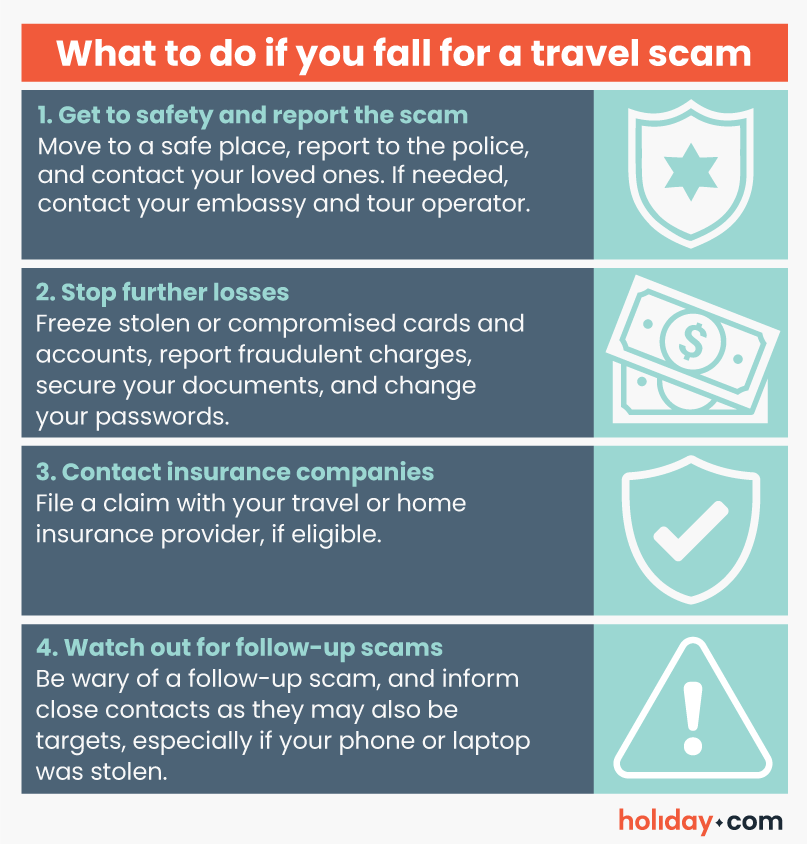
Scammers are tenacious, and even the most careful planning isn’t always enough to keep you safe. Thinking straight and knowing what to do after realizing you’ve been conned can be challenging, especially if you’ve never experienced it. These are practical steps to protect yourself and start recovering what you’ve lost.
Act quickly and report the incident
Some scammers get aggressive, and if you feel threatened, move to a well-lit or more crowded area where you can find help. If that’s not possible, stay calm and assertive, try to de-escalate the situation, and don’t hesitate to shout for help if the situation deteriorates.
Once safe, you should:
- Lodge a police report. You should do this as soon as possible, and no later than 24 hours, especially if you’ve lost your passport and ID documents. Quick reporting may help with insurance claims.
- Speak to the embassy or consulate. They can help you contact your loved ones if you’ve lost your phone, issue a new passport, and refer you to local services. Reporting to the consulate also helps create a record so that agencies can track patterns of fraud and issue travel warnings.
- Inform your loved ones. Let them know what happened to assure them you’re safe and ask for help.
- Consult the tour operator. Speak to your tour guide if you’re part of a tour as they can arrange for assistance.
Stop further financial or personal loss
1. Stem your financial losses
Call your bank or card provider immediately if your card has been stolen or you suspect your card or account has been compromised. If you’ve transferred money to the scammer, it’s less likely the bank can recover the money, but you still need to report it to start the process.
Credit card transactions are much easier to reverse if you can prove fraud. In the U.S., you can dispute charges within 60 days of receiving the bill. And if you’ve been scammed online through a legitimate booking platform, you’ll need to report the scam to the platform to stop the fraudsters and dispute the loss.
2. Secure your digital assets
If any of your online accounts or passwords are compromised, change the password immediately and consider using multi-factor authentication (MFA). If a scammer has accessed your phone or laptop, scan for malware and change the passwords of all accounts saved to your device. If your device is stolen, remove it as a trusted device from every connected account.
3. Secure important documents
Ensure your passport, ID documents, and personal documents are safe and secure. Make digital copies of them if you haven’t already.
4. Record details of the incident
The more details you can remember of the events leading up to the scam and the incident itself, the better your chances of recovery. To help investigations, write everything down and gather relevant documents, such as messages with the scammer and payment records.
Claim eligible insurance and compensation
Most travel insurance policies don't cover travel scams. However, depending on your policy, it may cover:
- Stolen or lost credit or debit card: Covers cases of stolen or lost cards with fraudulent charges. Depending on your policy, you may be able to recover some of your losses.
- Stolen or lost passport: Policies may cover emergency passport replacement costs or additional travel and accommodation costs.
- Stolen baggage and belongings: Some policies require proof that you took all necessary steps to safeguard your belongings. Alternatively, you may be able to file a claim with your home insurance provider.
Make sure you save relevant documents, such as receipts, police reports, and correspondence with the scammer, to support your insurance claim.
Watch out for follow-up scams
You may be targeted in a follow-up scam if the scammer has your personal or financial data. Monitor your accounts, watch for suspicious emails and messages, and stay alert in public.
You should also let your family and friends know. Scammers may target them if your laptop, phone, or passwords — or anything that could allow a scammer to message them in your name — was stolen or hacked.
HELP GUIDE
Preventing travel scams starts long before you board the plane, from researching reputable services to knowing how to best secure your devices while you travel. Avoid travel scams with our printable checklist, which helps keep you organized and outlines the essential steps before, during, and after your trip.
Stay safe during your trip
Travel often brings incredible experiences, but it also comes with the risk of scams, and some cons target you before you even book your trip.
To help protect yourself, read online reviews and stick to reputable transportation, tour agencies, and vendors. And use reputable booking platforms and secure payment methods to avoid online scams. Stay alert and secure your valuables when in public, avoid unsolicited offers, and review prices before agreeing to anything.
Being informed doesn’t mean you have to be paranoid. Enjoy the time off while staying mindful. And if things don’t add up, listen to your instincts and walk away.
| Sharing our content: holiday.com is the sole owner of all assets on this site. If you would like to share our content, we ask that you cite holiday.com and provide a link to the page you are citing. This will enable us to maintain the integrity of our intellectual property and continue providing the quality guides and informational content that our readers trust us for. |
About our author

You might also be interested in...
-
 Safety
How to stay safe while traveling: A practical guide for 2026
Traveling puts you in unfamiliar environments where many things can go wrong. A stolen bag or a compromised digital account can quickly derail your trip. Many travelers assume safety means avoiding ri...
 Sarah Kirton
 05.26.2026
 -
 Safety
Is hotel Wi-Fi safe? What you should know and real-world risks
Travelers commonly log into hotel Wi-Fi without giving a second thought to the potential security risks. Public sources of Wi-Fi, including at hotels, can be vulnerable to cyberattacks. This could exp...
Chené Murphy
05.26.2026 -
 Safety
Is airport Wi-Fi safe? Avoid common scams in 2026
When you’re stuck in an unexpected layover or need to book a ride to the hotel, connecting to the free airport Wi-Fi seems like the fastest solution. The truth is that public networks can put your d...
Ivana Shteriova
05.21.2026 -
 Safety
Hotel safety tips: The ultimate guide in 2026
Staying in a hotel should feel relaxing and serve as a main highlight of your trip. But even the best properties can pose safety risks. It’s not just theft that can turn the perfect getaway into a s...
Sarah Kirton
05.12.2026 -
 Safety
Is public Wi-Fi safe? The risks you need to know
Public Wi-Fi feels convenient, but it’s not always safe to use. The biggest problem with most public networks is that they use weak security or no encryption at all. Encryption protects the data tra...
Sarah Kirton
04.27.2026 -
 Safety
Solo travel safety tips for worry-free adventures
If you’re planning a solo trip to an unfamiliar destination, safety should be at the top of your mind. People traveling alone, especially women, are more likely to be targets for theft or harassment...
Ivana Shteriova
04.27.2026