


You shouldn’t have to put up with inconveniences or pay a small fortune to stay connected while traveling. Yet for years, travelers have had to deal with roaming charges, unreliable Wi-Fi, and the hassle of buying physical SIM cards in every new destination. Travel eSIMs solve that problem by providing a simple, digital way to get online.
With an eSIM, you can install a data plan before your trip and connect to a local network the moment you land. We’ll explore the top benefits of eSIMs and why they’ve become the smarter connectivity choice for modern travelers.
What is eSIM technology?
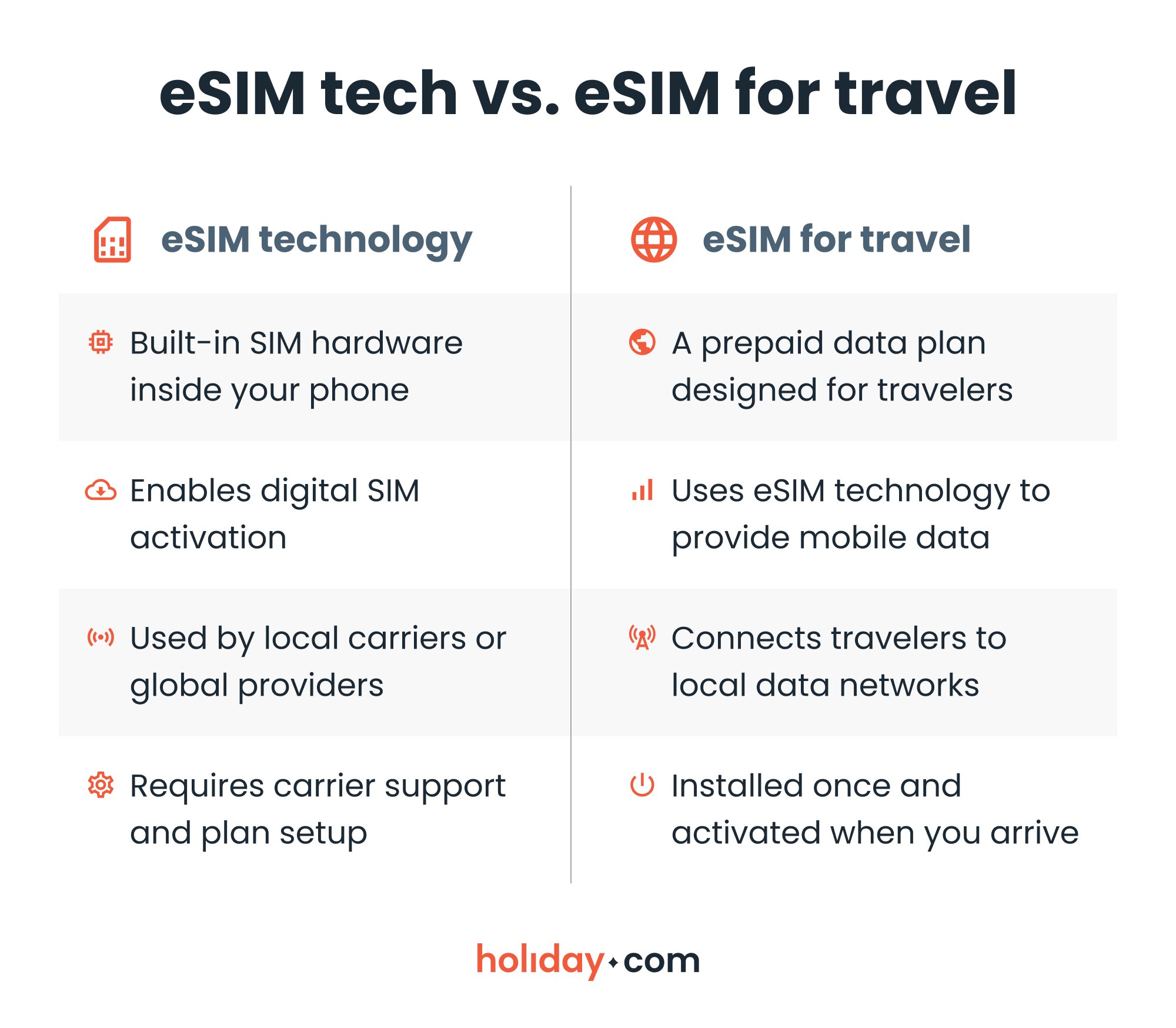
An eSIM, or embedded SIM, is a digital SIM that’s built directly into your smartphone. Instead of inserting a physical SIM card, you download a mobile data profile onto your device and connect to a network digitally.
However, the term eSIM is often used in two different ways, which can be confusing for travelers. One refers to the technology itself, and the other refers to travel eSIM services that use the technology to provide international data to people traveling abroad.
Here’s a simple comparison:
What are the top benefits of travel eSIMs?
Now that you know a little more about eSIM technology, let’s explore the reasons you should choose travel eSIMs to stay connected when traveling.
1. Activate your eSIM as soon as you arrive
Want to get connected the second you land? Install your eSIM before your trip and activate it as soon as you arrive. Once you land, your device connects to a local network automatically. You don’t have to buy a local SIM card or deal with the hassle of swapping those tiny cards.
Using an eSIM streamlines the process of getting online. You’ll be ready to book rideshares, navigate with maps, and use your favorite apps as soon as you arrive at your destination.
2. Avoid expensive roaming fees
Traditional roaming relies on your home carrier’s international agreements. This is a costly way to use data when you travel, as you’ll usually pay daily access fees and inflated per-megabyte rates. There’s also a risk of surprise charges if your phone is unexpectedly using data to run apps in the background.
Travel eSIMs work differently. They offer a prepaid data plan that connects to local networks, so you know your data limits and costs in advance. You get to see the total cost before you travel and avoid bill shock.
3. Store different profiles on one device
Travel eSIMs allow you to store more than one data plan on the same phone. You can keep eSIM profiles for different countries or regions saved on your device and switch between them when you travel.
For example, if you often visit Europe, the U.S., and Asia throughout the year, you don’t need to reinstall a new eSIM every time. Your saved profiles stay on your phone, making it easier and more convenient to stay connected during repeat trips and multi-country travel.
4. Keep your primary number active

An eSIM doesn’t change your phone number, so you’ll still be able to use communication apps like WhatsApp as usual. If you have a dual SIM device, you can keep your main SIM enabled while using the eSIM for mobile data. That means your primary number still works for:
- Traditional phone calls
- SMS messages
- One-time passcodes
- Two-factor authentication
You won’t need to swap SIM cards or set up call forwarding to log into an account. Your phone number stays active while the eSIM handles your data connection. Note that your carrier may charge roaming fees for using your phone number.
5. Protect yourself against SIM-swap fraud
Losing a SIM card while traveling isn’t just inconvenient, it can also put your personal data at risk. But because eSIMs embed in your device, thieves can’t remove or swap them, protecting you from cloning attacks. That means fewer chances for SIM-swap fraud, stolen verification codes, or account lockouts.
6. Choose an eco-friendly alternative to traditional SIMs
Most traditional SIM cards come with disposable plastic packaging and printed instructions. Most of that gets thrown away after a single trip, causing waste and affecting our environment. eSIMs are a superior alternative if you want to be more sustainable.
With an eSIM, everything happens digitally, from purchase to activation. There’s no plastic involved, reducing waste and unnecessary materials. For frequent travelers, this adds up to a cleaner, more eco-friendly way to access data.
7. Enjoy full control over your data costs
Nobody likes hidden charges. That’s why eSIMs give you clear visibility into your data usage and how much data or time you have left on your plan. Because plans are prepaid, there’s no risk of accidentally incurring roaming charges if background apps keep using data.
This is especially useful for longer trips or unpredictable itineraries where your data needs may change. eSIMs let you purchase data as you go, whether it’s a preset number of gigabytes or unlimited data for a set length of time.
8. Stay connected in multiple destinations

Does your trip include more than one country? A travel eSIM can cover the entire route. Many eSIMs offer plans for dozens of countries, so you don’t have to hunt for a new SIM card every time you cross a border.
Regional eSIMs let you save money by bundling nearby countries into one plan. Instead of buying and swapping physical SIMs, use a single eSIM to get online at every stop on your trip.
9. Get reliable data connections for remote work
If you’re a remote worker or digital nomad, reliable data is one of the biggest factors that impacts your work performance. From email chains to freelancing platforms and Google Meet links, you make more money if the connection is strong. But it’s possible that you won’t find a connection everywhere.
With an eSIM, you can connect with the strongest partner networks even if you’re in a remote location. Instead of seeking out public hotspots, use an eSIM for reliable data access to upload client files or log in to a video meeting. Keep up with work as if you never left home, even while moving between cities or countries.
10. Easily switch between carriers
Most eSIMs work with several local carrier partners in each destination. Instead of locking you into a single network, your device can connect to the best available signal supported by your plan.
Data roaming through your carrier usually limits the partner networks you have access to. By using an eSIM instead, you can expect more stable connections as you travel.
11. Make your connection tamper-proof
Public Wi-Fi networks are one of the most common entry points for cyberattacks like phishing and data interception. With an eSIM, your device connects through encrypted cellular networks instead of unsecured public Wi-Fi, lowering the risk of credential theft or malicious access.
An eSIM provides more security by keeping your connection authenticated by a network provider. This helps protect sensitive online activities while you’re on the move.
How to get an eSIM
There are two main ways to purchase an eSIM for your phone. The best option for you depends on how you plan to use your device while traveling.
Get an eSIM from your current mobile carrier
Most major carriers now offer eSIM activation for existing phone plans. This option replaces your physical SIM with a digital one but keeps the same number, plan, and billing structure.
While this works well for domestic use, international travel usually still relies on roaming agreements. That means:
- Daily roaming fees or pay-per-megabyte charges
- Limited control over international data costs
- Billing that appears after the trip rather than upfront
Carrier eSIMs are convenient if you want to digitize your existing SIM, but they don’t change how carriers price international roaming.
Buy a travel eSIM from a global provider
The second option is to purchase a prepaid travel eSIM from a dedicated provider like holiday.com. These eSIMs connect you to local partner networks in your destination.
Travel eSIMs typically offer:
- Fixed, prepaid data plans with transparent pricing
- Local or regional rates instead of roaming charges
- Activation before departure or on arrival
- No long-term contracts or carrier paperwork
If you’re simply switching from a physical SIM to a digital one, your carrier’s eSIM may be enough. But if you’re traveling internationally and want to control your costs and avoid roaming fees, a travel eSIM is often the more practical choice.
Opt for an eSIM when you travel
Travel eSIMs have changed the way people stay connected abroad. Instead of dealing with annoying SIM swaps or unreliable public Wi-Fi, you get a simpler, more predictable way to use data wherever you go.
Now that you know the advantages of using eSIMs, consider one the next time you’re traveling. Whether it’s for a weekend getaway or a long-term working trip, eSIMs offer flexibility and peace of mind for a more enjoyable travel experience.
FAQ
-
Is an eSIM better than a physical SIM?

An eSIM is often more convenient than a physical SIM because it’s built into your device and activated through your settings. You can store several plans without swapping cards, making it especially useful for travel or if you want to have more than one SIM profile on your phone.
-
Does an eSIM drain the battery?
No, an eSIM itself doesn’t drain more battery than a traditional SIM card. Both use the same network radio hardware to connect your device. Battery usage doesn’t depend on the type of SIM. It depends on signal strength, background apps, and having more than one active SIM profile.
-
What happens when an eSIM runs out of data?
When you use up your eSIM data allowance or the plan expires, your mobile internet stops working until you renew or top up the plan. You won’t be able to browse, stream, or use data-dependent services until you add more data or buy a new plan from the provider.
-
Do you turn off your primary SIM when using an eSIM?
You don’t have to turn off your primary SIM when using an eSIM, but you can disable it to avoid roaming charges or duplicate notifications. Most smartphones support dual SIM and let you choose which line is active for calls, texts, and data through your settings without physically removing the original SIM card.
-
Can I use my existing phone number with an eSIM?
Yes, you can transfer your existing phone number to an eSIM by requesting it from your carrier. This moves your number and network plan from a physical SIM to an eSIM. You’ll keep the same number as long as the carrier supports eSIM activation for your line.
About our author

You might also be interested in...
-
 eSIM
eSIMHow to turn off an eSIM: Quick guide and tips in 2026
Turning off your eSIM can be helpful in many situations. You may want to disable a travel data plan, switch to another SIM, or avoid roaming charges. The process is quick and you can do it from your p...
 Ana Marković
 06.16.2026
 -
 eSIM
eSIMWhat is an ICCID number and why does it matter?
Knowing how to find your integrated circuit card identifier (ICCID) number makes it easier to manage devices that use SIM cards and eSIMs. When things are going smoothly, you hardly have to think abou...
Sarah Kirton
06.16.2026 -
 eSIM
eSIMeSIM vs. data roaming: Which is better for international travel?
Staying connected while traveling is easier than ever, but the way you access mobile data can make a big difference in your experience and costs. Two popular options are purchasing a travel eSIM or re...
Dawn Prevete
06.09.2026 -
 eSIM
eSIMeSIM vs physical SIM: Pros, cons, and which one is right for you?
An eSIM (embedded SIM) is the digital equivalent of a physical SIM card built into your device. It allows you to activate and manage cellular plans entirely through software, meaning there’s nothing...
Ivana Shteriova
06.08.2026 -
 eSIM
eSIMHow to delete data usage history in 2026: A step-by-step guide
You can erase the data usage counters on your phone, but you can’t permanently erase your carrier’s system-level logs. Deleting your local statistics so the counter returns to zero takes only a fe...
Ana Marković
06.08.2026 -
 eSIM
eSIMDoes an eSIM drain your battery? Fact versus fiction
While eSIMs use the same hardware as physical SIM cards and consume virtually the same power, there are times when you might notice your device’s battery draining faster than usual. Most often, itâ€...
Sarah Kirton
06.08.2026