

Every year, millions of Americans travel abroad, and the vast majority of their trips go smoothly. But those that don't can quickly turn expensive, stressful, or dangerous. Pickpockets, unfamiliar traffic laws, surprise medical bills, political unrest… the risks are plentiful and depend on where you go.
The good news is that most travel safety problems are preventable. A few hours of preparation can save you from annoyance, financial loss, medical emergencies, and legal trouble. And once you're on the ground, learning to be aware of your surroundings goes a long way toward keeping you safe.
This guide covers the essentials: what to do before you leave; how to stay safe in transit; how to protect your health, money, and documents; and what to do if things go wrong.
Before you go
Many travel problems start before you ever board a plane. Here's a quick checklist of what to sort out before you leave. Each topic gets covered in more detail later in the guide.
- Sort your documents. Check passport validity (many countries require an expiration date at least six months away), confirm visa requirements, and make digital and physical copies of everything important.
- Get vaccinated. See a travel health specialist at least four to six weeks before departure. Some vaccines require multiple doses over several weeks, so don't leave this too late.
- Buy travel insurance. Look for a policy that covers medical emergencies, evacuation, and trip cancellation. Most U.S. health plans (including Medicare) won't cover you abroad. If you plan to do any risky activities (like hiking or more extreme sports), make sure your policy covers you.
- Check travel advisories. Review the State Department's destination page and sign up for the Smart Traveler Enrollment Program (STEP) to receive real-time alerts from embassies. This could include things like adverse weather or political instability.
- Research local laws and customs. What's legal at home can be illegal (or at least frowned upon) abroad. Understand drug laws, dress codes, photography restrictions, and driving requirements before you go.
- Set up your phone. Check that your device is carrier-unlocked, set up an eSIM or international plan, and download offline maps and language translation packs for your destination.
- Notify your bank. Let your bank and credit card companies know your travel dates and destinations to prevent your account being frozen.
- Book from reputable sources. Use well-known platforms for accommodation and transport. Verify listings, read reviews, and only pay on official booking systems.
- Share your plans. Leave a full itinerary with a trusted friend or family member, including flights, accommodation, and planned activities.
- Pack smart. Bring only what you can comfortably carry and lift yourself. Keep essentials (passport, medications, a change of clothes) in your carry-on, and pack a basic health and safety kit.
Destination risk awareness
Every destination has its own set of risks, and they're not always obvious. For example, your over-the-counter cold medicine from the U.S. might contain ingredients that are controlled substances under local Japanese law. The better you understand a country before you arrive, the more you can enjoy it and the less likely you are to be caught off guard.
Safety conditions
Crime affecting travelers mostly involves petty theft, scams, and financial fraud and is centered around tourist areas, transport hubs, nightlife districts, and ATMs. Before you travel, research recent crime trends and common scams at your destination. Once you arrive, keep valuables concealed, use ATMs inside banks, avoid walking alone late at night, use official taxis or verified rideshare apps, and keep your phone charged with offline maps downloaded.
Political instability (like protests, curfews, or government crackdowns) can turn normally safe areas dangerous. Check whether elections or sensitive anniversaries fall during your trip, and review the "Safety and Security" section of your destination's travel advisory. Environmental risks also vary by season and location, including extreme heat, flooding, and hurricanes. Check the American Red Cross Emergency App for real-time alerts and evacuation routes.
Laws and cultural norms
Enforcement abroad can be severe, and claiming ignorance rarely works as a defense. Many countries have a zero-tolerance approach to crime and apply laws equally to visitors.
Some instances of local laws not everyone may be familiar with:
- Drug traffickers in Singapore can receive the death sentence.
- Vapes are illegal in Thailand, and insulting its royal family carries criminal charges.
- Some European hot spots like Portugal and Croatia impose steep fines for behaviors like wearing swimwear in streets.
- Marijuana is still illegal in most countries and can carry severe sentences.
- Public displays of affection are a criminal offense in the UAE, and can lead to fines.
- Consensual same-sex relationships are criminalized in over 60 countries.
Other common offenses include overstaying visas (which can trigger deportation or future entry bans), working on a tourist visa, drug possession, heritage site damage, and unauthorized drone use. If you are arrested abroad, your embassy can’t get you out of jail — they can provide a list of local lawyers and notify your family, but you’re still subject to the host country's legal system.
Cultural norms matter just as much. What feels polite at home can be offensive elsewhere. Wearing shoes indoors is disrespectful across much of Asia and the Middle East, and many religious sites require that visitors dress modestly and will deny entry if you don't comply.
Before your trip, research local customs. Look for tips from travel blogs, speak with people who've visited, and review the "Local Laws & Special Circumstances" section of your destination's page on the State Department's travel advisory site. Learning a few words in the local language is also well worth it (hello, thanks, and excuse me are a good start). When in doubt, observe what locals do and follow their lead.
Government travel advisories and alerts
Signing up for government travel advisories is quick and can keep you informed about security threats, emergencies, legal changes, and health outbreaks. It also helps your government find and assist you.
US travelers should sign up for the Smart Traveler Enrollment Program (STEP), which sends alerts from embassies and consulates abroad. The State Department ranks countries from Level 1 ("exercise normal precautions") to Level 4 ("do not travel").
Other programs include:
- The U.K.'s FCDO alerts
- Canada's Registration of Canadians Abroad
- Australia's Smartraveller
- The EU's Consular Protection page
Health and medical readiness
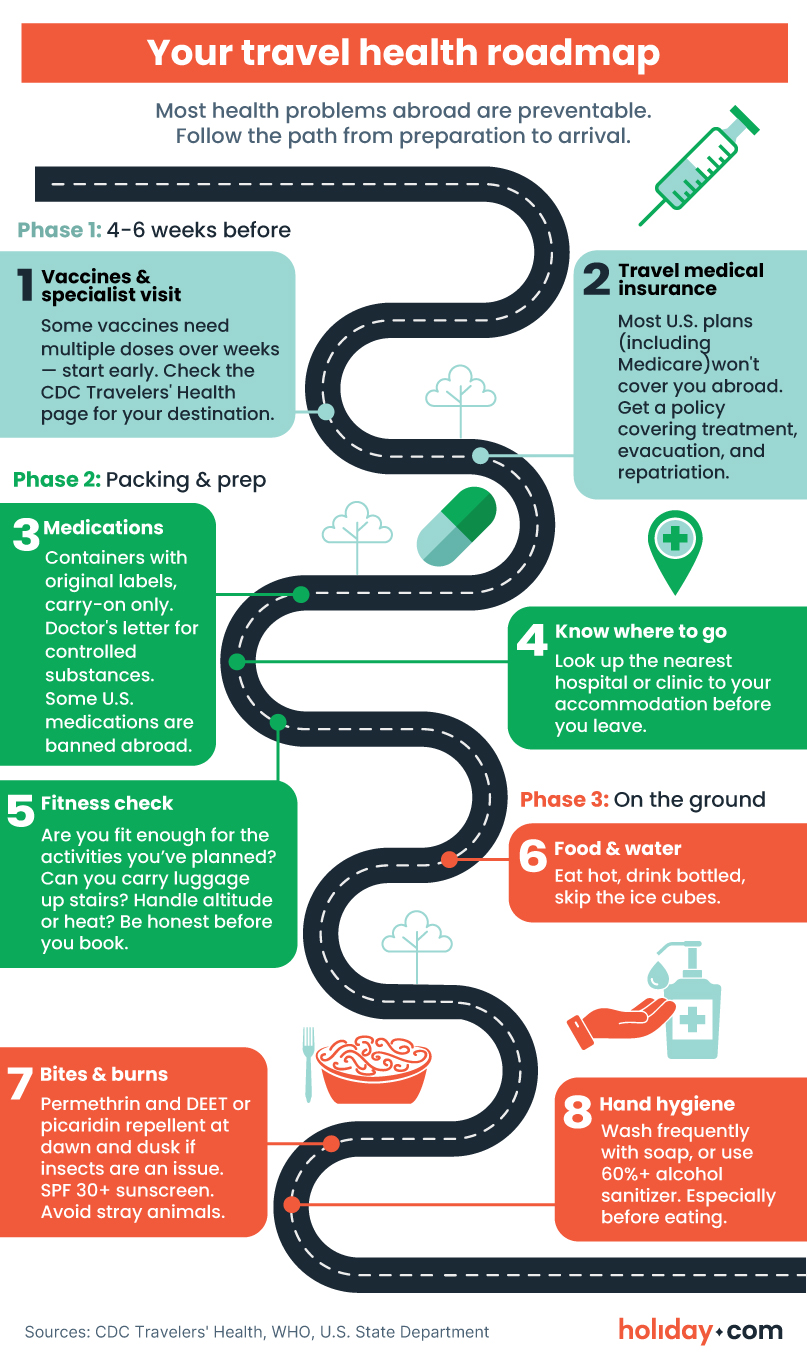
A medical emergency abroad can drain your savings fast, but most health-related travel problems are avoidable with preparation and common sense.
Pre-travel health
See a travel health specialist at least four to six weeks before you leave. A regular doctor can handle routine checkups, but travel medicine clinics know which vaccines and preventive medications you actually need for your destination. Some, like the Japanese encephalitis vaccine, require multiple doses over several weeks, so start the process well in advance.
Check the CDC's Travelers' Health page for destination-specific vaccine recommendations, health alerts, and entry requirements. Some countries require proof of yellow fever vaccination for entry; others may have active outbreaks of diseases uncommon in the U.S.
Pack all medications (prescription and over-the-counter) in their original labeled containers and keep them in your carry-on. Especially for controlled substances or injectable medications like insulin, you should carry a doctor's letter listing your conditions, medications, and dosages. Some medications that are legal and common in the U.S. are banned in other countries. Bring more than enough to last your entire trip — you’ll want some extra should you be delayed.
Health safety practices abroad
Food and waterborne illness is the most common health problem for travelers, and the easiest to prevent. In lower- and middle-income destinations, you should follow some simple rules:
- Eat food that's been cooked and served hot
- Drink only bottled, canned, or boiled beverages
- Skip ice cubes, raw salads washed in local water, and street food that's been sitting out
Insect-borne diseases, such as malaria and dengue, remain major risks in tropical and subtropical regions. Use a quality insect repellent (look for picaridin or DEET as the active ingredient), wear permethrin-treated long sleeves and pants during the worst mosquito hours (dawn and dusk), and sleep under a treated mosquito net if your accommodation doesn’t have screens.
Check the CDC Destinations page to see which diseases are active at your destination. A few other habits that make a big difference:
- Wash your hands frequently with soap and water.
- If you prefer to use hand sanitizer, ensure it has a concentration of at least 60% alcohol.
- Most dermatologists and global health agencies recommend an SPF 30 or higher. Keep in mind that UV exposure increases at high altitudes and near the equator.
- Avoid contact with animals, including stray dogs and cats, as rabies and bacterial infections from bites are still serious risks in many countries.
- Follow water safety rules. Drowning is a leading cause of death among healthy travelers, especially in countries where emergency rescue services are limited.
Medical emergencies and insurance
Most U.S. health insurance plans, including Medicare, don’t cover medical care abroad. If you get sick or injured overseas, you'll likely pay out of pocket first and file for reimbursement later (if your plan covers it at all). A hospital stay in Western Europe, depending on the country, can run $1,000 or more per day, and a medical evacuation flight can cost well upwards of $50,000, reaching $300,000 or more in remote areas and for complex medical needs.
Travel medical insurance fills that gap. When shopping for a policy, look for coverage that includes:
- Emergency medical and dental treatment
- Emergency medical evacuation (transport to the nearest qualified facility, including air ambulance if needed)
- Medical repatriation (getting you home for continued care)
- 24/7 assistance hotline with access to interpreters and care coordination
If you have a preexisting medical condition, confirm that your policy actually covers it. Many exclude conditions treated within the past 60 to 90 days. Carry your insurance card and claim forms while traveling, and save copies of all receipts and medical records.
Before you leave, research where the nearest hospital or urgent care facility is at your destination. In an emergency, find local medical care first, then call your insurer's assistance line — they can coordinate payment, arrange transfers, and connect you with English-speaking providers.
Personal fitness
Running to make connections in airports, hauling luggage through train stations, and walking for hours through museums and foreign cities — a typical vacation day can involve far more exertion than a day at home.
Before you book, honestly assess whether your fitness matches the trip. A few situations that can catch travelers off guard:
- Sightseeing days that involve many miles of walking, often on uneven terrain or stairs
- High-altitude destinations (Mexico City, Cusco, the Swiss Alps) where reduced oxygen makes simple movement more tiring
- Day tours that include climbing in and out of boats, hiking to viewpoints, or scrambling over ruins
- European hotels, especially budget options in older buildings, that lack elevators entirely
- Weather extremes, particularly very hot days
Start building fitness before your trip, focusing on practical things like walking endurance and the ability to carry your luggage up a flight of stairs. If you're thinking about an adventure activity like diving, mountain trekking, or skiing, be honest about your skill level and consider a guided experience.
Transportation and movement safety
How you get around at your destination is one of the biggest safety variables of any trip. See how you can mitigate these risks while on the go.
Air travel
Airports, perhaps surprisingly, can be hot spots for theft, since crowds, distractions, and tired travelers make easy targets. Keep your passport, wallet, and medications in a personal bag on your body (backpack or handbag) rather than in a checked bag you can't see. Pay attention during the security check — it’s the one time at the airport when you have to take valuables (like laptops and cameras) out of your bag and leave them unattended for some time.
Once you're on the plane, pay attention during the safety briefing (most people don't), note where the nearest exits are, and keep your seatbelt fastened whenever you're seated.
If you're flying with an airline you've never heard of, a few tools can help you check its safety credentials:
- The FAA's International Aviation Safety Assessment (IASA) program rates whether a country's aviation authority meets international standards.
- The EU publishes the EU Air Safety List (ASL), a list of banned airlines from countries with weak oversight.
- IATA's Operational Safety Audit (IOSA) registry lets you verify whether a specific airline has been independently audited — IOSA-certified airlines have significantly lower accident rates.
Ground transport
Motor vehicle crashes are the leading cause of death among otherwise healthy U.S. travelers abroad. Driving rules vary enormously around the world, and in many countries traffic laws are loosely enforced or even openly ignored.
If you rent a car, do some homework first. Research which side of the road people drive on, whether your home license is sufficient or if you need an International Driving Permit, and what the local rules are for things like speed limits, right of way, parking, and blood alcohol limits. Many countries enforce zero-tolerance policies for any amount of alcohol behind the wheel, and penalties for violations can be far steeper than what you're used to at home.
For taxis and rideshares, arrange your airport transfer before you land whenever possible. It saves you from negotiating with unlicensed drivers crowding the arrivals hall.
If you use a rideshare app, a quick checklist:
- Book via the app on your own phone. At some airports, people will pretend to be affiliated with rideshare companies and offer to book for you, but instead use a fake version of the app with hugely increased prices.
- Verify the driver is correct. Check the name, photo, vehicle, and license plate before getting in.
- Ask the driver to confirm your name. Don't offer it first.
- Sit in the back seat. And keep your belongings with you.
- Share your trip with a trusted contact. This function is now built into most major rideshare apps.
- Track the route during the ride, and trust your gut. End the ride if something feels wrong.
As a pedestrian, stay alert — especially in countries that drive on the left, where your instinct to look the wrong way when crossing can genuinely get you hurt. Stick to main streets after dark, use pedestrian crossings, and avoid looking at your phone while walking in unfamiliar traffic.
Water travel
Drowning is one of the leading causes of accidental death for Americans abroad, for weak swimmers as well as strong. Rip tides, hidden rocks and dense algae, and minimal rescue services can make foreign waters a lot less forgiving than your local pool or beach.
A few rules that apply everywhere include always wearing a life jacket on boats, swimming in supervised areas when you can, and not mixing alcohol with any water activity.
If you're taking a cruise, a few safety tips worth keeping in mind:
- Pay attention during the muster drill. Remember your station and how to get there.
- Don't lean on or climb over railings. This is one of the main causes of falling overboard.
- Watch your alcohol intake. Balance and judgment suffer more on a moving ship than on solid ground.
- Wear non-slip shoes on deck. Especially near pools and outdoor areas.
For smaller operators like day-trip boats or snorkeling tours, take a look at the safety equipment before you board. Visible life jackets, fire extinguishers, and a crew that seems organized are good signs. If any of those are missing, ask about them (or walk away).
For water sports like diving, jet skiing, or parasailing, be honest about your skill level. If you're trying something for the first time, book with a certified instructor rather than the cheapest operator on the beach. And always check the weather conditions first!
Border and transit safety
Immigration and customs checkpoints are known to spike people’s blood pressure, but as long as you have the following in order you should have no reason to worry:
- Passport
- Visa (if required)
- Any health documentation the destination requires
- Proof of onward travel (if required)
- Proof of funds (if required)
The specifics will come down to the destination — check our guide to official visa sites for your country before you arrive. If purchasing your visa ahead of travel, make sure you're buying from an official government source — search results for visas are rife with agencies, intermediaries, and ads that can charge unnecessary fees or worse.
Something that can particularly trip people up is the proof of onward travel, which is sometimes arbitrarily decided by the airline you’re flying with or the immigration officer. Booking a cheap onward flight to anywhere can be a good safe option, and services exist to cheaply reserve a real onward flight that expires after 24-48 hours.
Keep in mind that some countries require a transit visa even if you're only connecting through their airport. Check the rules for every country in your itinerary, including layovers.
At immigration, answer questions from officers calmly and directly. Getting nervous or evasive can lead to secondary screening and delays. If you're referred for additional inspection, stay cooperative and truthful.
Most countries require you to declare cash above $10,000 (or local equivalent), and many restrict what you can bring in. Certain foods, medications, and animal products are commonly flagged, not to mention obviously illegal cargo like drugs. On the way home, be aware that items like antiques, religious artifacts, and products made from endangered species can be illegal to export, regardless of how openly they're sold in local markets.
Accommodation and personal security
Where you stay sets the tone for how safe you feel on a trip. A well-chosen hotel or rental in the right neighborhood can take a lot of stress off your plate, while a poorly chosen one can do quite the opposite.
Choosing safe lodging
Don't pick accommodations based on price or photos. Researching the neighborhood can pay off for multiple reasons. Safety can vary block by block in many cities, so look at the specific area rather than relying on a city's overall reputation. Google Street View is extremely useful for getting a better look at all angles of the street, and whether it’s well-lit, well-maintained, and the kind of place you'd feel comfortable walking at night.
Read recent guest reviews on multiple platforms (Google, TripAdvisor, Booking.com, Airbnb) and pay attention to mentions of security, noise, or sketchy surroundings. Being close to a hospital, police station, or fire service can also be worth considering, especially if you want some added peace of mind around traveling with children or elderly family members.
For hotels, prioritize properties with staffed reception desks, secure locks, and internet access. If you're arriving late, let them know ahead of time to avoid showing up to a closed front desk or a "no record of your booking" situation.
Protecting yourself and your belongings
When you check in, take a few minutes to get a feel for your room. Check that windows and doors lock properly and whether there’s a room safe, and also locate the nearest fire exit. Safety experts generally recommend rooms on floors three through six, which is high enough to deter break-ins from outside, but low enough for fire ladder access.
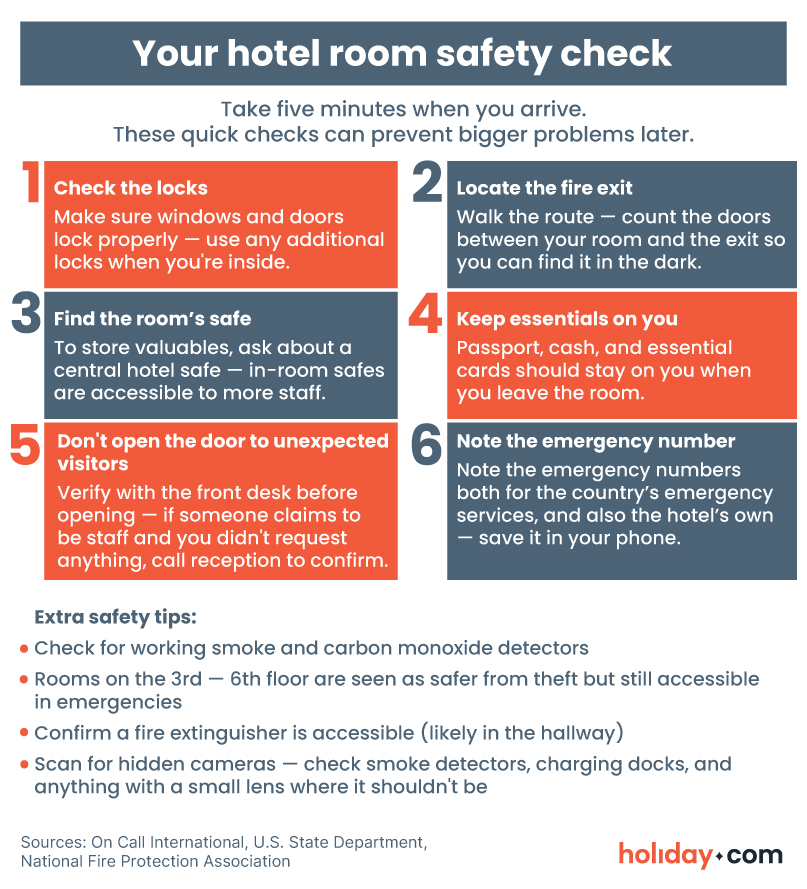
Keep your passport, cash, and essential cards on your person rather than in the room. If you want to store other valuables, you can ask about a central hotel safe rather than the one in-room. In-room safes are accessible to more people, often including housekeeping and maintenance staff. Use the deadbolt and any additional locks provided when you’re in the room, and don’t open the door to unexpected visitors without verifying with the front desk first.
In vacation rentals and Airbnbs, check for working smoke and carbon monoxide detectors when you arrive, and confirm that a fire extinguisher is accessible. Do a quick scan for hidden cameras, too — check smoke detectors, charging docks, and anything that looks like it has a small lens where it shouldn't. You can even buy portable hidden camera detectors if you want to be extra careful.
If your location has gas heating or appliances, check to ensure they are working properly and not leaking. You should also take necessary precautions if your rental has a pool or balcony. Especially if you have children, you’ll want to know that access to these areas is restricted with a gate, and that the guardrails are sturdy.
If you're staying in a hostel or shared room, keep valuables locked in your bag or a locker, and don't leave anything accessible while you're out or asleep.
Alternative and short-term rentals
A major 2018 study by The American Hotel and Lodging Association estimated that around 29 million hotel bookings per year are either fraudulent or misleading, costing consumers over $5.2 billion. By 2024, the FTC recorded $274 million in losses from travel, vacation, and timeshare scams alone. Meanwhile, travel site Booking.com reported a 500%-900% increase in travel scams over an 18-month period. It partly attributed this surge to AI-generated fraud.
Scammers set up convincing fake listings with stolen photos, low prices, and fake urgency to pressure you into paying before you verify details. To protect yourself, book through established platforms like Airbnb, Vrbo, or Booking.com, and never pay outside the platform. If you send a wire transfer, gift card, or cryptocurrency payment, you can’t expect any fraud protection.
If a deal looks suspiciously cheap, it’s very probably a scam. Cross-check the listing photos against the address using Google Street View, and call the property directly if anything feels off. Whichever platform you use, read reviews carefully; generic five-star praise with no specific details is often a red flag.
Documents, money, and digital protection
Losing a passport or having a card skimmed abroad is a quick way to ruin your trip. However, you can ward off a lot of issues if you set things up properly before you leave and stay disciplined about how you handle documents, money, and devices while you're traveling.
Identity and travel documents
Before you leave, strip your wallet down to the essentials. Bring only the cards and ID you'll actually use, and leave your Social Security card, checkbook, and spare credit cards at home. If your wallet is lost or stolen overseas, every item inside it becomes something you need to cancel and replace under pressure.
Make both digital and physical copies of your passport, visa, travel insurance policy, and any important booking confirmations. Store the digital copies in a secure cloud service, and share them (or paper versions) with someone you trust at home. Keep a set of physical copies separate from the originals, such as in your hotel safe or a different bag. Having these backups makes everything faster if the originals go missing.
Be careful when applying for visas and International Driving Permits online. Scam websites designed to look like official government portals are common; they charge inflated fees for services that are free or low-cost through the official channels. In the U.S., only AAA and the American Automobile Touring Alliance (AATA) are authorized to issue IDPs. For visas, always check details on the U.S. Department of State site or the destination country's embassy directly.
If your documents are stolen or you're the victim of a scam abroad, act quickly:
- File a police report at the local station. You'll need this for insurance claims and replacement documents.
- Contact the nearest U.S. Embassy or Consulate. Apply for an emergency passport and get guidance on replacing any visas.
- Cancel lost or stolen cards immediately. Let your bank know via their app or global assistance line. Most banks can ship replacements abroad within a few business days, and some can even arrange emergency cash.
- Call your travel insurance provider to open a claim. They may also have a local partner who can help coordinate next steps.
- Monitor your accounts closely afterward. Look out for unauthorized transactions, and consider enrolling in an identity theft monitoring service.
Financial and cyber safety
Tell your bank and/or credit card companies where you're going before you leave, since a charge from a foreign country could trigger a fraud freeze on your account at an inconvenient time. Carry a mix of payment methods (one credit card, one debit card, and some cash in the local currency) so you're not stranded if one fails.
Use your credit cards before debit wherever you can. Credit cards generally offer stronger fraud protections, and if your number is stolen you generally are not held responsible for unauthorized charges while the dispute is resolved. Digital wallets like Apple Pay and Google Pay insulate you even further by generating a one-time token for each transaction, so your actual card details aren’t shared.
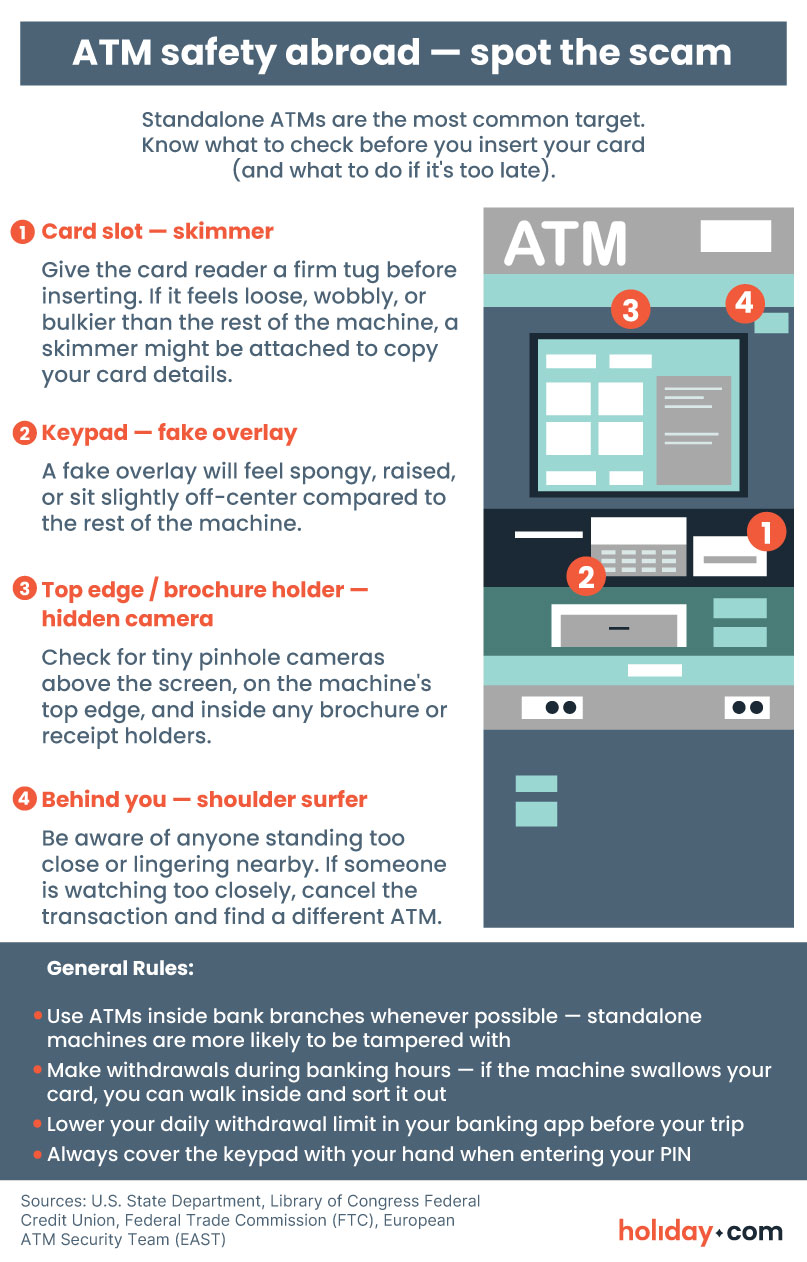
When you do need cash, try to stick to ATMs inside bank branches — standalone machines are much more likely to have been tampered with. A few precautions to keep in mind before withdrawing funds:
- Check for skimmers. Give the card reader a firm tug before inserting your card. If it feels loose or is bulkier than the rest of the machine, a skimmer might be attached to steal your card details. You can also check for false keypads by seeing if the keypad is abnormally thick or hard to press.
- Cover your PIN. Hide the keypad with your hand, even if no one’s nearby. Modern hidden cameras can be tiny and easy to miss.
- Make withdrawals during banking hours. If the machine swallows your card, you can walk inside and sort it out immediately.
- Make fewer, larger withdrawals. This cuts down on per-transaction fees, which can add up fast.
- Lower your daily withdrawal limit. You can change this in your banking app before the trip to reduce your exposure if your card is stolen.
Protecting your devices and data matters just as much as protecting your cash. Some good habits to follow:
- Stay off public Wi-Fi for anything sensitive. Hotel lobbies, airports, and cafes are easy places for someone to intercept login credentials or payment details. If you have no choice, follow the next point below.
- Use a VPN. VPNs encrypt and protect your data on public Wi-Fi and can connect to a server from back home (for instance to help with banking).
- Don't log in to personal accounts on hotel TVs. Your credentials can stay cached after you sign out, leaving them accessible to the next guest or hotel staff. Bring a Fire Stick or Chromecast instead, and connect through your VPN.
- Avoid public USB charging stations. Though rare, these can be used to install malware or steal data. Carry your own wall charger or power bank instead.
- Use strong, unique passwords. Use a password manager for easy credential storing, and enable two-factor authentication on travel-related accounts wherever available.
- Keep travel plans off social media. Don't post live location updates or detailed itineraries, but wait until you're home. This stops strange encounters abroad and prevents people from knowing your home is empty while you’re gone.
- Track your spending. Keep receipts and monitor your account activity during the trip to catch unauthorized charges early.
Social, activity, and lifestyle safety
The activities you choose and the situations you put yourself in abroad carry their own risks. Some are obvious, and some less so, but a little awareness goes a long way toward keeping things fun instead of regrettable.
Activities and excursions
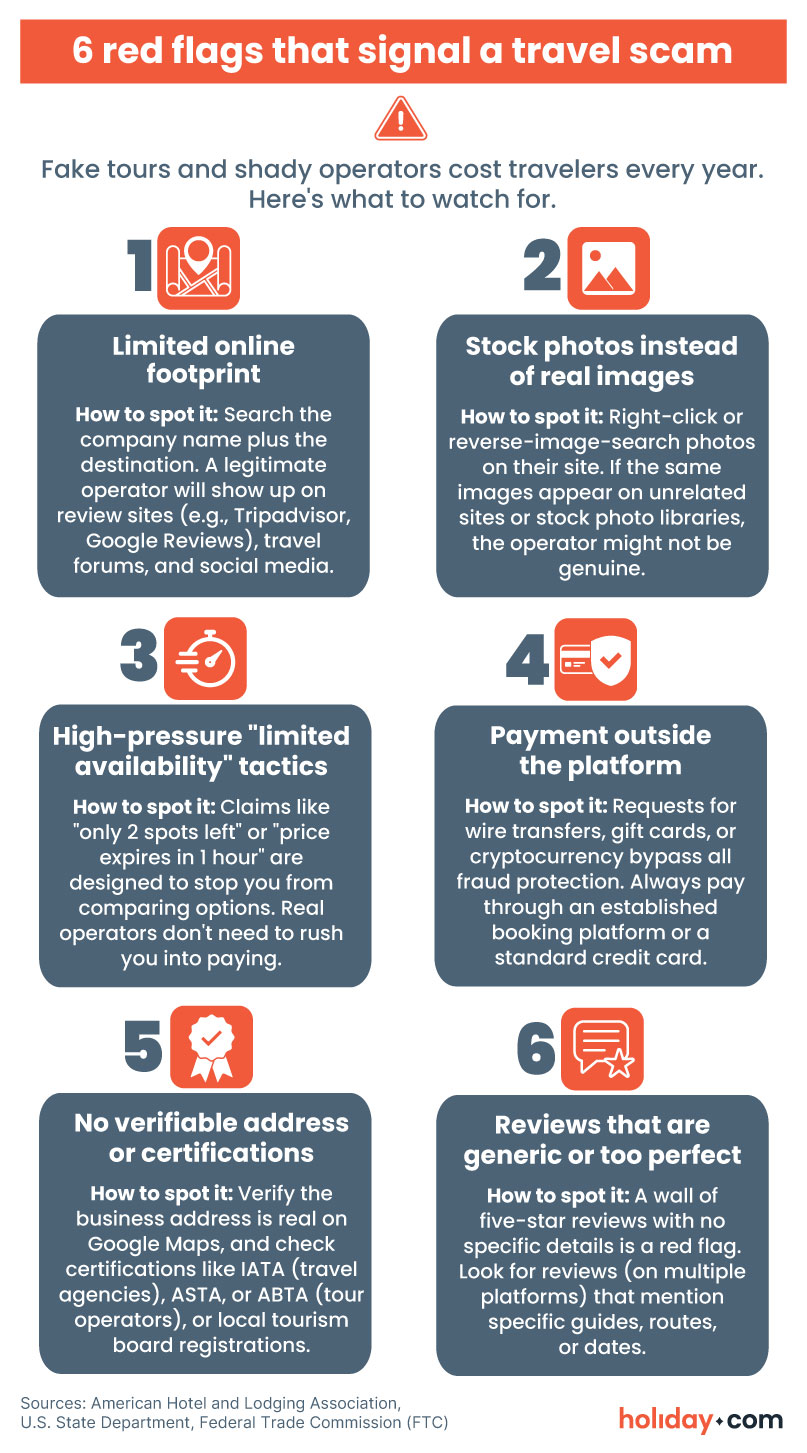
Booking a tour or adventure activity abroad means putting your safety in someone else's hands, so choose carefully. Look for operators who are licensed, have verifiable business addresses, and carry industry certifications (IATA for travel agencies, ASTA or ABTA for tour operators).
If a company has no online footprint beyond its own website, uses stock photos instead of real customer images, or pressures you to pay immediately with limited availability claims, treat those as warning signs.
For outdoor activities like hiking, trekking, diving, skiing, do an honest check of whether the conditions match your preparation:
- Check weather and trail conditions. Don't set off in terrain you haven't researched. Adverse weather like storms, flooding, or extreme heat can turn a manageable hike into a survival situation.
- Tell someone your plans. Leave your route, expected return time, and emergency contact details with someone who is not with you. This could be your hotel, a family member, or even a local authority like a park service.
- Pack for the unexpected. A first-aid kit, headlamp, knife, lighter, whistle, extra water (and better yet, a water filter as well), and a navigation tool (even a paper map) can make a real difference if things go sideways.
- Know when to turn back. Worsening weather, injuries, falling behind schedule, or a route that turns out harder than expected are all good reasons to call it. Coming back another day beats not coming back at all.
- Dress appropriately. Dress for the weather and terrain you’re expecting, but in areas where weather can turn suddenly (such as high altitudes), also carry layers that will fit the possible extremes.
Wildlife encounters are a real consideration in many destinations. Keep your distance. The general rule is at least 100 yards (91 meters) from bears and wolves, and 25 yards (23 meters) from other wildlife. Never feed wild animals, and learn in advance what species you might encounter and how to respond. In bear country, carry bear spray and know how to use it.
At higher altitudes — above roughly 8,000 feet (2,438 meters) — your body has less oxygen to work with, which can cause headache, nausea, fatigue, and worse. Let your body acclimate before ascending beyond 8,000 feet, avoid alcohol and heavy exertion for the first 48 hours, and descend immediately if symptoms get worse rather than better. If you have a heart or lung condition, talk to your doctor before booking anything at elevation.
Nightlife and social situations
Going out at night in a new city can be a highlight of many trips, but it's also when your guard is most likely to drop. A few ground rules help:
- Watch your drink. Never leave drinks unattended or accept one from a stranger. Drink spiking is a real risk in tourist-heavy nightlife areas.
- Know your limits. Alcohol hits harder when you're jet-lagged, dehydrated, or at altitude. Pace yourself and plan how you're getting back to your accommodation.
- Be wary of drugs. Besides the obvious health risks of unknown substances, penalties for drug possession vary wildly by country and can include mandatory prison sentences with no exceptions for tourists.
- Keep details vague with strangers. Enjoy meeting people, but avoid sharing your hotel name, room number, or how long you're in town.
- Stick to reputable venues. Bars and clubs in well-trafficked areas are generally safer. Avoid homemade or unregulated alcohol. Bootleg spirits can cause serious poisoning.
If you're using dating apps while traveling, meet in public during the day for a first encounter; a coffee shop or museum gives you a natural exit if things feel off. Share your plans and the person's profile with a friend and set up a check-in system so someone knows you're safe. Trust your instincts, and if something doesn't feel right, leave.
Emergency and crisis preparedness
Even with solid preparation, things can go wrong in ways you didn't plan for. Knowing how to respond and having the right contacts and tools ready can make the difference between a manageable situation and a full-blown crisis.
Disasters and unrest
Natural disasters and political instability are hard to predict, but you can at least reduce your risk. Check whether your destination is prone to natural disasters during the season you'll visit — the government advisory tools covered earlier will help you track conditions.
If a disaster strikes while you're abroad:
- Follow instructions from local authorities. They know the area and the risks better than you do. Don't wait to see if things "get worse."
- Head to your embassy or consulate if you need evacuation support. They can coordinate with local authorities and help arrange transport out.
- Stay away from protests and civil unrest. Even peaceful demonstrations can turn violent without warning. Don't film, don't participate, and don't linger to watch.
- Keep your travel insurance details accessible. Some policies won't cover you if you've stayed in a region against official "do not travel" directions.
Apps like the American Red Cross Emergency App (similar to the FEMA app in the U.S.) provide real-time alerts for weather events, disease outbreaks, and security threats. Download them before you leave and enable notifications for your destination.
Emergency action planning
Put together a basic emergency plan before you travel and share it with someone you trust at home. It doesn't need to be complex, just enough that you and your emergency contact both know what to do if something goes wrong.
Your plan should cover:
- Emergency contacts:
- Local emergency numbers (not every country uses 911 — 112 works across Europe and many other countries, 999 for the U.K., 000 for Australia)
- Your embassy
- Your travel insurance provider's 24-hour hotline
- At least one person at home
- Nearest medical facilities. Look up the closest hospital or clinic to where you're staying. Apps like SOS Global Emergency Numbers (iOS) provide local emergency numbers for over 200 countries and territories and show your GPS coordinates — useful if you need to tell a dispatcher exactly where you are.
- Communication plan. Decide how you'll stay in touch if your phone or internet goes down. Apps like WhatsApp and Signal work over the internet, so in genuinely remote areas, a satellite messenger (like Garmin inReach) could be the only option.
- Financial backup. Keep a small amount of emergency cash (local currency, sometimes USD depending on the region) in a separate location from your wallet. If your cards are stolen or frozen, you'll have something to get through the next 24 hours.
- Evacuation awareness. Know the location of the nearest airport, train station, or border crossing. In the event of a large-scale emergency, you’ll need to know your exit route.
If you're unsure how to reach emergency services in a foreign country, remember that pharmacies can call services on your behalf and (in some countries) provide basic first aid. Hotels and tourist offices can also help you reach police or medical help, especially if you don't speak the local language.
Considerations for vulnerable and high-risk travelers
Most of this guide applies to everyone, but some travelers face additional risks. Keep the following in mind:
- Solo travelers. Share your live location and plans with a trusted contact at home. If a stranger asks, say you're meeting someone nearby instead of advertising that you're alone. Arrive at new destinations before dark whenever possible.
- Families with children. Pick a meeting point at a crowded location in case you get separated, and ideally pack a child safety ID kit with a recent photo, contact details, and medical information. Car seat laws vary wildly by country — research the rules and ensure you’ll have easy access to one.
- Seniors. Pace yourself, choose accessible accommodations, and look up the nearest hospital before you arrive. Carry at least five extra days of medication, and keep a list of your prescriptions and dosages. Watch for "distraction theft" — someone bumps into you or spills something on your clothes while a partner goes through your things. Unfortunately, seniors are disproportionately targeted.
- LGBTQ+ travelers. More than 60 countries criminalize consensual same-sex relationships. Review the U.S. Department of State's LGBTQ+ Travelers page for your destination before you book. In higher-risk locations, keep a low profile and stay aware of your surroundings.
- Travelers with medical devices or conditions. Notify your airline in advance, and remember that medical supplies and mobility aids don't count toward carry-on limits. Let security officers know about implants or devices before screening. Carry a doctor's letter (especially explaining prescription meds) and keep all supplies in your carry-on.
- Remote or adventure travelers. Cell service and medical access can drop to zero outside major towns. Carry a satellite messenger, pack a well-stocked first-aid kit, and make sure someone knows your route and expected return. Check whether your travel insurance covers rescue from remote areas, since many standard policies don't.
- Language barriers. Download offline translation packs and maps before you leave. Learn a few critical words (like "help," "police," "hospital") and carry your hotel address written in the local script. Know the local emergency number and have it saved in your phone.
HELP GUIDE
Want to track your progress? Download this printable checklist summarizing the safety steps you should take before, during, and after traveling abroad.
Travel smart, travel safe
Traveling abroad doesn't have to be stressful or dangerous, but paying attention before and while you travel goes a long way. The vast majority of trips go smoothly, while the ones that don't often go wrong because of something that could have been prevented with a few hours of preparation.
You don't need to become an expert on every country you visit, but you should understand the basics. This includes what risks exist at your destination, how to protect your health and belongings, what your insurance covers, and who to call if things go sideways. Once you've done it once, it gets easier after every trip.
Finally, stay aware, stay flexible, and trust your instincts. If something feels wrong, there’s a good chance it is — acting on that feeling early is almost always better than waiting to find out.
| Sharing our content: holiday.com is the sole owner of all assets on this site. If you would like to share our content, we ask that you cite holiday.com and provide a link to the page you are citing. This will enable us to maintain the integrity of our intellectual property and continue providing the quality guides and informational content that our readers trust us for. |
About our author

You might also be interested in...
-
 Safety
How to stay safe while traveling: A practical guide for 2026
Traveling puts you in unfamiliar environments where many things can go wrong. A stolen bag or a compromised digital account can quickly derail your trip. Many travelers assume safety means avoiding ri...
 Sarah Kirton
 05.26.2026
 -
 Safety
Is hotel Wi-Fi safe? What you should know and real-world risks
Travelers commonly log into hotel Wi-Fi without giving a second thought to the potential security risks. Public sources of Wi-Fi, including at hotels, can be vulnerable to cyberattacks. This could exp...
Chené Murphy
05.26.2026 -
 Safety
Is airport Wi-Fi safe? Avoid common scams in 2026
When you’re stuck in an unexpected layover or need to book a ride to the hotel, connecting to the free airport Wi-Fi seems like the fastest solution. The truth is that public networks can put your d...
Ivana Shteriova
05.21.2026 -
 Safety
30+ common travel scams to watch out for abroad
Travel scams can be hard to spot. Scammers often operate out of sight, or greet you with a warm smile as they present an offer that sounds too good to miss. They take advantage of the fact that you’...
Aishah Mustapha
05.15.2026 -
 Safety
Hotel safety tips: The ultimate guide in 2026
Staying in a hotel should feel relaxing and serve as a main highlight of your trip. But even the best properties can pose safety risks. It’s not just theft that can turn the perfect getaway into a s...
Sarah Kirton
05.12.2026 -
 Safety
Is public Wi-Fi safe? The risks you need to know
Public Wi-Fi feels convenient, but it’s not always safe to use. The biggest problem with most public networks is that they use weak security or no encryption at all. Encryption protects the data tra...
Sarah Kirton
04.27.2026